







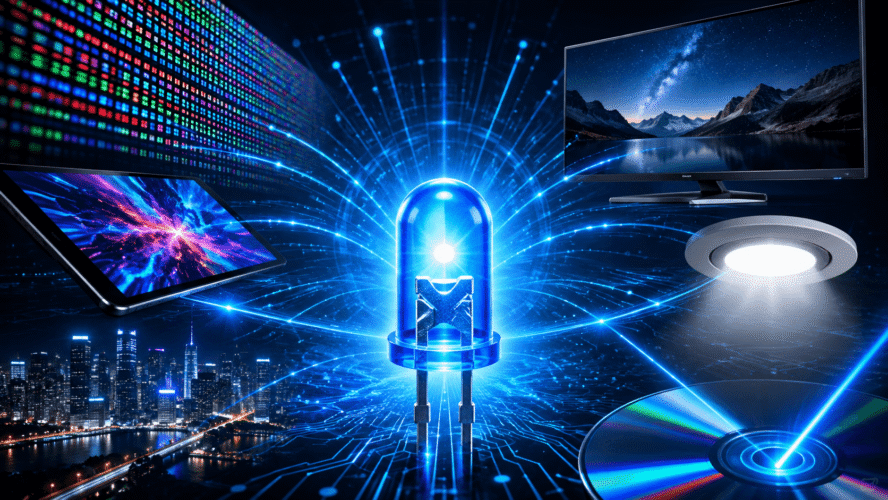
The Blue LED: The Tiny Invention That Lit Up the Digital World
For something so small, the blue LED changed an astonishing amount of modern life.
It sits inside screens, signs, phones, televisions, traffic lights, data centers, car dashboards, optical systems, and countless electronic devices.
But for decades, one simple color was missing.
Red LEDs existed.
Green LEDs existed.
Yellow LEDs existed.
Blue did not.
And without blue, the digital world we know today could not fully happen.
The Problem With Blue
LED stands for:
Light Emitting DiodeAt its simplest, an LED is a semiconductor that emits light when electric current passes through it.
Different semiconductor materials produce different colors.
By the 1960s and 1970s, engineers had already created practical red and green LEDs.
Blue was much harder.
The material needed to produce efficient blue light had to operate at a much higher energy level.
One promising candidate was:
Gallium Nitrideor:
GaNBut GaN was extremely difficult to manufacture well.
The crystals were full of defects.
Electrical control was poor.
And many researchers began to believe that practical blue LEDs might simply be too difficult.
Then Three Researchers Refused to Give Up
The breakthrough came mainly through the work of:
- Isamu Akasaki
- Hiroshi Amano
- Shuji Nakamura
Akasaki and Amano worked for years on gallium nitride.
They eventually developed techniques for growing much higher-quality GaN crystals using carefully designed buffer layers.
That solved one major problem.
But another remained.
To make a useful semiconductor device, engineers needed reliable control over both:
n-type materialand:
p-type materialCreating good p-type gallium nitride was notoriously difficult.
Akasaki and Amano discovered ways to activate magnesium-doped GaN and create usable p-type material.
That was a huge step.
Then Shuji Nakamura pushed the technology even further.
Working at the relatively small Japanese company Nichia, Nakamura developed extremely bright blue LEDs using improved GaN growth techniques and later indium gallium nitride structures.
By the early 1990s, the long-standing blue LED problem had finally been broken.
The work was important enough that Akasaki, Amano, and Nakamura were awarded the 2014 Nobel Prize in Physics for the invention of efficient blue light-emitting diodes.
But the interesting part is what happened next.
Why Was Blue So Important?
You might reasonably ask:
It's just another color. Why does blue matter so much?
Because with:
Red
+
Green
+
Blue
you can create nearly every color visible on a modern display.
This is the RGB color model.
A pixel on a screen can contain three tiny light sources:
Red
Green
Blue
Change their brightness and you can produce:
White
Yellow
Purple
Cyan
Orange
Millions of other colors
Without an efficient blue light source, practical full-color LED displays were extremely difficult.
Blue completed the missing piece.
The World Suddenly Had Full-Color Light
Once efficient blue LEDs existed, engineers could combine:
Red LED
+
Green LED
+
Blue LED
into one pixel.
That enabled much brighter and more efficient:
- Outdoor displays
- Stadium screens
- Electronic billboards
- Traffic signs
- Indicator panels
Think about the giant display in a sports stadium.
From far away, it looks like one enormous image.
Walk close enough and you see thousands or millions of tiny red, green, and blue light sources.
Blue made that possible.
Then Someone Realized You Could Make White Light
This may have had an even bigger impact.
Normally, LEDs emit a narrow range of color.
So how do you make white?
One common solution is surprisingly clever.
Take a:
Blue LEDand coat it with:
PhosphorThe blue LED excites the phosphor.
The phosphor converts part of the blue light into other wavelengths.
The combination appears white to our eyes.
Conceptually:
Blue LED
   ↓
Phosphor coating
   ↓
Blue + converted colors
   ↓
White light
This transformed lighting.
The Light Bulb Changed Again
For more than a century, electric lighting depended heavily on incandescent bulbs.
They work by heating a wire until it glows.
That is beautifully simple.
But also very inefficient.
A large amount of the electricity becomes:
Heatinstead of:
Visible lightFluorescent lighting improved efficiency, but came with its own limitations.
White LEDs changed the equation.
They offered:
- Much lower energy consumption
- Longer lifespan
- Less heat
- Small size
- Better durability
- Instant switching
- Easy electronic control
Suddenly LEDs were not just tiny indicator lights.
They could light:
Homes
Offices
Factories
Roads
Cars
Airports
Cities
A discovery that began as a semiconductor problem became an energy revolution.
Your Phone Depends on This Story
Look at a modern smartphone display.
In many display technologies, the screen depends on carefully controlled red, green, and blue light.
LCD screens, for example, need a backlight.
Modern LED-backlit LCDs rely heavily on blue LED technology combined with phosphors or quantum-dot systems to create the broad white or colored light needed for the display.
Without efficient blue LEDs, modern thin, bright, energy-efficient screens would have been far harder to build.
That affects:
Phones
Laptops
Monitors
Televisions
Tablets
So one semiconductor breakthrough quietly became part of the visual interface to the digital world.
Blu-ray Also Needed Blue
There is another interesting consequence.
CDs used infrared lasers.
DVDs used red lasers.
Then came Blu-ray.
Why blue?
Because shorter-wavelength blue-violet light can be focused into a smaller spot than red light.
Smaller spot:
↓
Smaller data marks
↓
More data on the same disc
That is why Blu-ray discs could store much more information than DVDs.
The same general gallium-nitride family of semiconductor technology that enabled blue LEDs also helped make blue-violet laser diodes practical.
Again, solving one color opened another branch of digital technology.
Blue LEDs Also Changed Communication
LEDs and semiconductor lasers are important in:
- Optical communication
- Sensors
- Industrial equipment
- Medical devices
Blue and ultraviolet semiconductor devices opened new frequency ranges that engineers could use for specialized applications.
GaN technology also eventually became extremely important beyond light itself.
Gallium nitride is now used in high-performance power electronics.
Modern GaN power devices can switch electricity quickly and efficiently, making them useful in:
Fast chargers
Power supplies
Data centers
Electric vehicles
Radio systems
So the material technology developed around blue LEDs helped influence another revolution: efficient power electronics.
The Digital World Became Brighter and More Efficient
The impact of the blue LED is interesting because it appeared everywhere gradually.
There was no single morning when people woke up and said:
The blue LED changed civilization today.
Instead:
Traffic signals changed.Then:
Billboards changed.Then:
TVs got thinner.Then:
Phones got brighter.Then:
Light bulbs became LEDs.Then:
Cars filled with LED lighting.Eventually the technology became so common that we stopped noticing it.
That is often what happens with truly important inventions.
They disappear into everyday life.
There Was Also a Human Story Behind It
Shuji Nakamura's story became particularly famous.
At Nichia, he worked on a technology that many larger companies had struggled with or abandoned.
Gallium nitride was not the fashionable path.
Other researchers were pursuing different materials that seemed more practical.
Nakamura kept pushing GaN.
That decision was risky.
But it eventually produced one of the most commercially important semiconductor breakthroughs of the late twentieth century.
The story is a good reminder that technological progress is not always:
Biggest company
+
Largest research budget
=
Breakthrough
Sometimes it is:
Unpopular idea
+
Years of persistence
+
One stubborn engineer
that changes the industry.
Why the Nobel Prize Called It Revolutionary
When the Nobel committee honored the blue LED researchers in 2014, the importance was not simply that they created blue light.
The breakthrough allowed humanity to create:
Bright
Efficient
Long-lasting
White light
using semiconductor technology.
Lighting consumes a significant amount of global electricity.
So improving lighting efficiency has consequences far beyond electronics.
It affects:
- Energy consumption
- Infrastructure cost
- Carbon emissions
- Remote communities
- Battery-powered devices
An LED lamp powered by a small solar panel can provide lighting in places where maintaining incandescent or fluorescent systems would be far more difficult.
That is an enormous social impact from a tiny semiconductor.
A Small Device With a Huge Legacy
The history can be summarized almost absurdly simply:
Red LED
✓

Green LED
✓

Blue LED
✗
Engineers spend decades trying to solve blue.
Then:
Blue LED
✓
And suddenly:
RGB displays
White LEDs
Efficient lighting
Modern screens
Optical storage
New semiconductor technologies
all accelerate.
Final Thoughts
The blue LED is a perfect example of how technological revolutions often begin with a problem that looks strangely narrow.
Researchers were not trying to invent:
The modern smartphoneor:
The LED-lit cityor:
The flat-screen worldThey were trying to make one semiconductor emit one difficult color efficiently.
But once that color existed, engineers could combine it with everything else.
Red gave us one part of the spectrum.
Green gave us another.
Blue completed the triangle.
And from that tiny blue point of light came:
Millions of colors
White illumination
Brighter displays
Lower energy consumption
Smaller devices
A more efficient digital world
Sometimes a revolution does not begin with a giant machine.
Sometimes it begins with a light small enough to fit on the tip of your finger.