







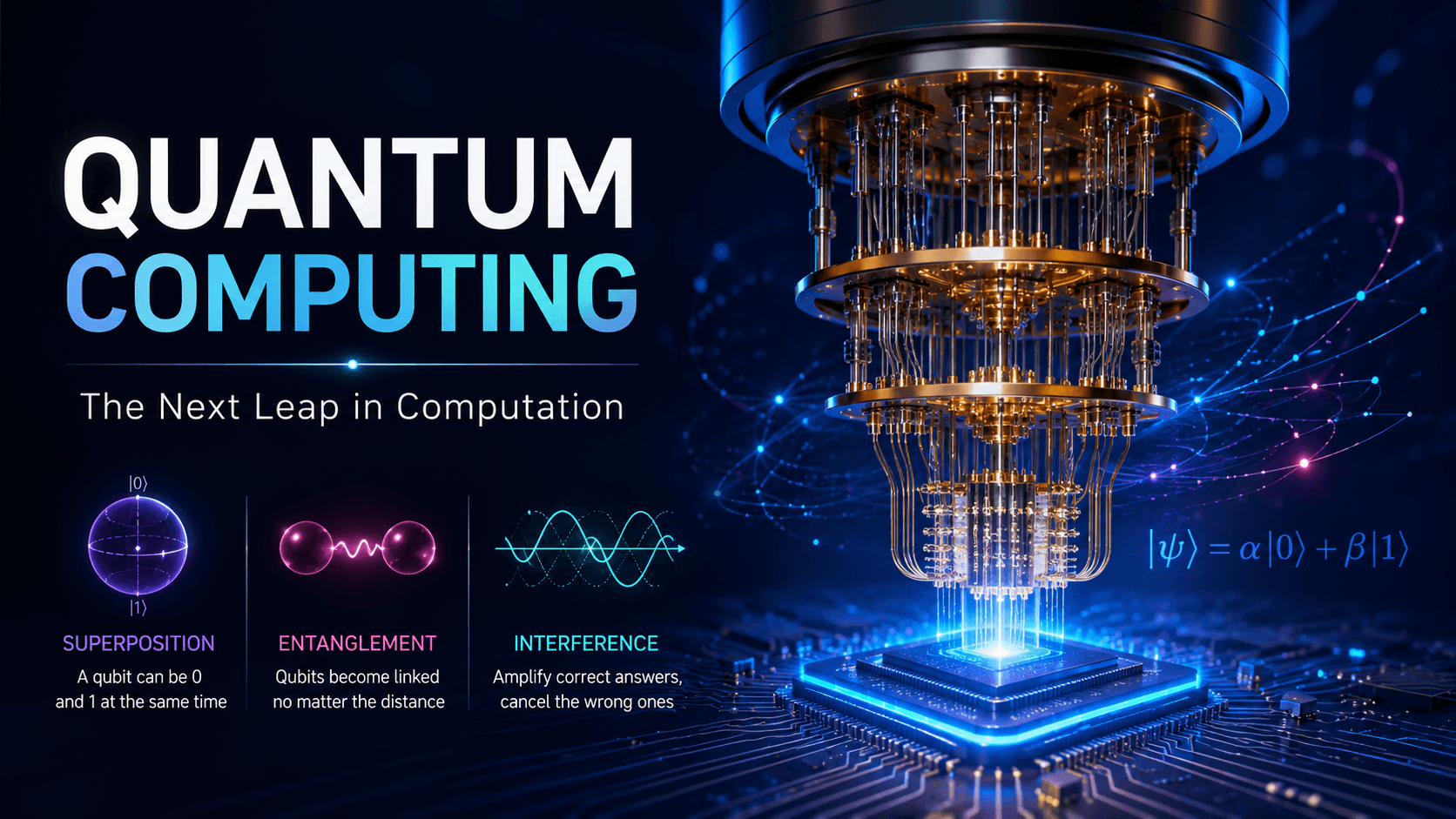
Quantum Computing: The Strange Machine That Promises a New Kind of Power
Imagine you have a maze.
A normal computer tries paths according to a set of rules.
A quantum computer does something stranger.
It uses the rules of quantum physics to represent and manipulate many possibilities in ways that ordinary bits cannot.
That is why quantum computing sounds almost magical.
It is also why it is often misunderstood.
Quantum computers are not simply:
Very fast computersThey are a different kind of computer, useful for certain kinds of problems and surprisingly bad at many ordinary ones.
And despite decades of progress, they still face enormous engineering challenges.
Start With the Ordinary Bit
Every normal computer ultimately works with bits.
A bit is:
0or:
1Eight bits make a byte.
Billions of bits represent:
- photos,
- software,
- databases,
- games,
- documents,
- everything else.
A modern CPU may be incredibly complicated, but underneath it all are enormous numbers of physical states representing zeros and ones.
Quantum Computers Use Qubits
A quantum computer uses a:
qubitInstead of behaving only like:
0
or
1
a qubit can exist in a quantum state involving both possibilities until it is measured.
This is called:
superpositionA useful mental picture is a spinning coin.
A normal bit is like a coin sitting on the table:
Heads = 0
Tails = 1
A qubit is more like the coin while it is spinning.
It is not literally both heads and tails in the everyday sense, but mathematically its state contains amplitudes associated with both possibilities.
When you measure it, you get a definite result.
Then Things Get Stranger: Entanglement
Qubits can also become:
entangledThis means the state of one qubit can become deeply linked to another.
You cannot always describe them independently anymore.
Instead of:
Qubit A
+
Qubit B
you may have to describe:
One combined quantum stateThis allows quantum algorithms to manipulate correlations that ordinary computers do not naturally have.
So Does It Try Every Answer at Once?
This is one of the most common explanations of quantum computing.
It is also misleading.
People often say:
A quantum computer checks every possible answer simultaneously.
If that were literally how it worked, quantum computing would solve almost everything instantly.
It does not.
The real trick is more subtle.
Quantum algorithms manipulate probability amplitudes.
They try to make:
Wrong answers interfere destructivelywhile:
Useful answers interfere constructivelyThen measurement is more likely to produce the answer you want.
Think of waves.
Two waves can reinforce each other:
Wave + Wave
     ↓
Bigger Wave
or cancel:
Wave + Opposite Wave
     ↓
Almost nothing
Quantum algorithms exploit this interference.
That is where much of their power comes from.
Why Would Anyone Need This?
Because some problems become brutally difficult for ordinary computers.
One famous example is factoring large numbers.
Suppose you ask:
Which two prime numbers multiplied together produce this enormous number?
For small numbers, easy.
For sufficiently large numbers, the problem becomes extremely difficult for classical computers.
Modern public-key cryptography relies partly on problems like this being hard.
Then mathematician Peter Shor discovered a quantum algorithm that could factor certain large numbers dramatically more efficiently than known classical approaches.
Suddenly quantum computing was not merely an interesting physics experiment.
It had consequences for cryptography.
That Is Why Quantum Computing Scares Security People
Much of today's internet security relies on public-key algorithms such as RSA and elliptic-curve cryptography.
A sufficiently powerful fault-tolerant quantum computer running algorithms such as Shor's could threaten those systems.
That does not mean someone can currently point a quantum computer at your bank account and instantly decrypt everything.
Today's machines are nowhere near the scale required for breaking modern cryptographic keys in practice.
But governments and technology companies are already preparing.
That is why:
Post-Quantum Cryptographyis becoming important.
These are encryption and signature algorithms designed to remain secure even if large quantum computers eventually exist.
Chemistry May Be an Even Bigger Opportunity
Nature itself is quantum mechanical.
Electrons do not behave like tiny classical balls.
They behave according to quantum rules.
That means simulating molecules precisely can become extraordinarily difficult for normal computers.
The irony is beautiful:
Classical computer
tries to simulate
quantum nature
and struggles.
A quantum computer is itself a quantum system.
So in principle:
Quantum machine
simulates
quantum system
much more naturally.
This could eventually help with:
- drug discovery,
- new materials,
- batteries,
- fertilizers,
- catalysts,
- superconductors.
The word eventually matters.
We are not there yet.
Optimization Is Another Hope
Companies constantly face problems like:
What is the best delivery route?

How should factories schedule production?

How should investment risk be balanced?

How should airline resources be assigned?
These problems can involve enormous numbers of combinations.
Researchers hope certain quantum algorithms may provide useful advantages for some optimization tasks.
But this area is still developing, and claims of practical quantum speedups need careful evaluation.
Not every optimization problem becomes magically easier on a quantum computer.
Quantum Computers Will Not Replace Your Laptop
This is worth saying clearly.
A quantum computer is probably not going to replace:
Your laptop
Your gaming PC
Your phone
Your web server
You do not need quantum mechanics to open Excel.
Or render a webpage.
Or run a database.
Ordinary computers are extraordinarily good at those jobs.
A more realistic future looks like:
Normal Computer
      ↓
Detect special problem
      ↓
Send part to quantum accelerator
      ↓
Receive result
      ↓
Continue normal computation
Much like GPUs today.
Your CPU does not disappear because GPUs exist.
Quantum processors may become another specialized accelerator.
So Why Don't We Already Have Useful Quantum Computers Everywhere?
Because quantum information is unbelievably fragile.
That is the central problem.
A normal transistor can tolerate a reasonable amount of environmental noise.
A qubit may lose its useful quantum state because of tiny interactions with the outside world.
This loss is called:
decoherenceThe enemy of a quantum computer is essentially:
The rest of the universe.Qubits Hate Noise
A qubit may be disturbed by:
- heat,
- electromagnetic radiation,
- vibration,
- manufacturing imperfections,
- nearby particles,
- control electronics,
- interactions with other qubits.
When that happens, errors appear.
And quantum computations may require many operations before producing a useful result.
If errors accumulate too quickly:
Beautiful quantum algorithm
        ↓
Noise
        ↓
Garbage answer
That is why today's quantum systems require extraordinary engineering.
Why Some Quantum Computers Are Extremely Cold
One popular way of building qubits uses superconducting circuits.
These systems often operate at temperatures only a tiny fraction above absolute zero.
The machine may contain a giant refrigeration system resembling a golden chandelier of cables and metal stages.
At the bottom:
Quantum processorAt the top:
Room-temperature electronicsThe refrigerator is often physically much larger than the actual chip.
This surprises people because the famous "quantum computer" photographs mostly show the cooling system.
The quantum processor itself can be comparatively small.
Why Such Extreme Cold?
Heat means motion.
At the quantum scale, uncontrolled thermal activity can destroy delicate states.
Cooling reduces that noise.
So engineers create an environment colder than outer space to keep qubits usable for slightly longer.
That sentence alone tells you something about how difficult the problem is.
And Not Every Quantum Computer Uses the Same Kind of Qubit
Researchers are experimenting with several approaches.
These include:
Superconducting circuits
Trapped ions
Neutral atoms
Photons
Spin qubits
Topological approaches
Each has advantages and disadvantages.
One might offer excellent qubit quality but slow operations.
Another might scale more easily but suffer greater errors.
Nobody has conclusively demonstrated that one architecture will dominate everything.
We are still relatively early in the technology.
The Biggest Problem: Error Correction
Suppose your normal computer has a bit:
1If noise accidentally changes it to:
0classical error correction can often detect and recover from the mistake.
Quantum error correction is much harder.
You cannot simply make copies of an unknown quantum state whenever you want because quantum mechanics forbids arbitrary copying.
So researchers use clever schemes where many physical qubits collectively protect a smaller number of:
logical qubitsConceptually:
Many noisy physical qubits
        ↓
Quantum error correction
        ↓
One reliable logical qubit
This is crucial.
One Useful Qubit May Require Many Physical Qubits
This is one of the biggest obstacles to large-scale quantum computing.
A machine may advertise:
1,000 physical qubitsThat sounds enormous.
But if the error rates are high, the number of reliable logical qubits may be much smaller.
A future fault-tolerant system may require vast numbers of physical qubits to construct enough high-quality logical qubits for serious algorithms.
So qubit count alone does not tell you how powerful a quantum computer is.
Quality matters enormously.
Imagine Building a Computer Where Every Calculation Is Slightly Unreliable
Suppose your CPU made a mistake every few thousand operations.
Your computer would be unusable.
Modern classical processors are extraordinarily reliable.
Quantum systems operate in a much harsher environment.
Researchers therefore need to improve:
Gate fidelity
Coherence time
Readout accuracy
Control systems
Error correction
all at once.
That is a huge engineering challenge.
Scaling Is Another Nightmare
Building:
10 good qubitsis difficult.
Building:
100is harder.
Building:
1,000,000 fault-tolerant qubitsis a completely different engineering problem.
Every qubit may require:
- control signals,
- calibration,
- readout,
- physical isolation,
- connections.
Now imagine scaling that without introducing additional noise.
It is similar to the early history of classical computers—but the components are much more delicate.
Quantum Computers Also Need Classical Computers
The funny part is that a quantum computer cannot really operate alone.
Classical computers are needed to:
- prepare experiments,
- control pulses,
- calibrate qubits,
- decode errors,
- run parts of algorithms,
- process measurements.
So the architecture is more like:
Classical Computer
       ↕
Quantum Controller
       ↕
Quantum Processor
       ↕
Classical Computer
Quantum and classical computing are partners.
The Software Problem Is Hard Too
Even if perfect quantum hardware appeared tomorrow, programmers would face another problem:
What should we run on it?
Quantum algorithms are not simply normal programs rewritten in another language.
Developers need to think in terms of:
- amplitudes,
- quantum gates,
- interference,
- measurement,
- entanglement.
Only certain problems have known algorithms that provide meaningful quantum advantages.
Discovering new useful quantum algorithms is itself a major research field.
There Is Also an Enormous Hype Problem
Quantum computing has all the ingredients for hype.
It is:
Complicated
Futuristic
Hard to verify
Potentially revolutionary
That makes headlines such as:
Quantum computer solves impossible problem!
very tempting.
But there is a huge difference between:
Interesting laboratory demonstrationand:
Practical economic advantageA quantum computer may outperform a classical machine on a carefully selected benchmark that has little practical usefulness.
That does not make the research meaningless.
It simply means "quantum advantage" needs context.
Classical Computers Keep Improving Too
There is another moving target.
Quantum computers are not competing against the computers of 2010.
Classical computing continues to improve through:
- GPUs,
- specialized accelerators,
- better algorithms,
- massive clusters,
- AI-assisted optimization.
Sometimes a quantum experiment looks impressive, and then researchers discover a much better classical algorithm.
Suddenly the claimed advantage shrinks.
The finish line keeps moving.
What Quantum Computers Are Good At Is Narrow
This is perhaps the most important reality check.
Quantum computers may eventually be extraordinary at certain problems.
That does not mean they will be extraordinary at everything.
Think:
Quantum:
Specialized mathematical and physical problems
not:
Quantum:
Everything, but faster
Your gaming PC will not become obsolete because somebody builds a million-qubit machine.
Your web browser will still run perfectly well on classical hardware.
So Where Are We Today?
We are in an awkward but exciting stage.
Quantum computers are real.
Researchers can control qubits.
They can run quantum algorithms.
They can demonstrate increasingly sophisticated experiments.
But large, general-purpose, fault-tolerant quantum computers are still a major engineering goal rather than an everyday reality.
We are somewhere around:
Physics experiment
        ↓
Prototype computer
        ↓
Useful specialized machine
        ↓
Fault-tolerant quantum computing
and the industry is trying to move down that path.
Why Keep Trying?
Because the potential payoff is enormous.
If large fault-tolerant quantum computers become practical, they may change fields such as:
Chemistry
Materials science
Cryptography
Optimization
Physics simulation
Even one breakthrough material could have enormous consequences.
Imagine discovering:
Better battery chemistryor:
More efficient fertilizer catalystor:
New industrial materialbecause quantum simulation allowed researchers to explore molecules more accurately.
That alone could justify decades of research.
Final Thoughts
Quantum computing sounds mysterious because it really is built on strange physics.
At its heart, however, the idea is straightforward:
Normal computers manipulate:
BitsQuantum computers manipulate:
Quantum statesand use phenomena such as:
Superposition
Entanglement
Interference
to perform certain calculations in ways ordinary computers cannot easily reproduce.
The promise is enormous.
The problems are equally enormous.
Quantum states are fragile.
Qubits are noisy.
Error correction is expensive.
Scaling is difficult.
Useful algorithms are limited.
And classical computers remain extremely powerful competitors.
So the story of quantum computing today is not:
The classical computer is about to disappear.
It is:
We may be learning how to build an entirely new kind of computational tool.
The first computers once filled rooms and performed calculations that a pocket calculator can now outperform.
Quantum computers may be at a similarly early stage—or they may ultimately remain specialized machines used only for certain extraordinary problems.
We do not yet know.
And that uncertainty is exactly what makes the field so fascinating.