





From Enigma to HTTPS: How Cryptography Quietly Took Over Everyday Life
Once used to hide military secrets, cryptography now protects your coffee payment, your messages, your passwords, and almost everything you do online.
For most of human history, cryptography was something for kings, generals, spies, and diplomats.
A secret message might decide:
- where an army moved,
- when a fleet attacked,
- whether an agent survived,
- or whether a government learned what its enemy was planning.
Today, cryptography still protects governments and militaries.
But it also protects something far more ordinary:
Your phone
Your bank account
Your Wi-Fi
Your WhatsApp messages
Your browser
Your credit card
Your software updates
The strange thing is that most of us use cryptography hundreds of times a day without ever noticing it.
And the journey from the mechanical cipher machines of World War II to the tiny lock icon in your browser is one of the most fascinating stories in computing.
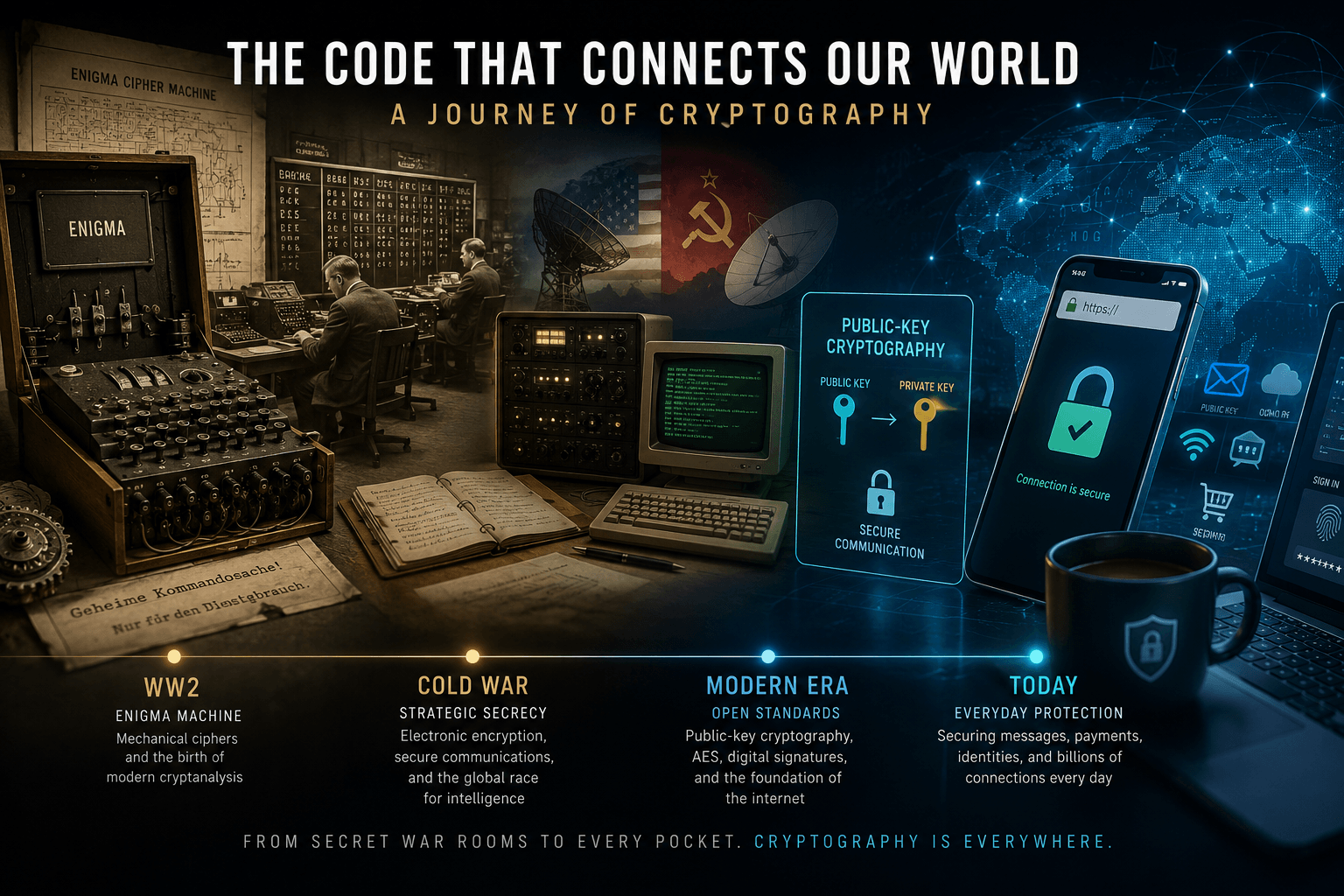
World War II: When Encryption Became a Machine
Before computers, encryption was usually done with codes, substitution tables, books, and mechanical devices.
Then came machines such as:
EnigmaGermany used the Enigma family of cipher machines extensively during World War II to protect military communications. The machine used rotating electrical rotors so that pressing the same letter repeatedly could produce different encrypted letters depending on the machine's changing internal state. (Bletchley Park)
To an enemy intercepting a message, something readable like:
ATTACK AT DAWNmight become something that looked completely meaningless:
XJQLP ZMTKR...But another Enigma machine configured with the correct settings could reverse the transformation.
The technology was impressive enough that German forces trusted it with highly sensitive communications.
The Real Battle Was Over the Key
Encryption algorithms are only half of the story.
The other half is:
The keyYou can think of encryption like a lock.
The cipher is the design of the lock.
The key tells it exactly how to operate.
If both sides know the secret key:
Plaintext
   ↓
Encryption + Key
   ↓
Ciphertext
and:
Ciphertext
   ↓
Decryption + Key
   ↓
Plaintext
The enemy may capture the encrypted message.
But without the key, the message should remain useless.
That was the theory.
Then Bletchley Park Happened
Britain gathered mathematicians, linguists, engineers, chess players, and cryptanalysts at Bletchley Park.
Alan Turing became one of the most famous figures associated with the effort, though the work depended on many people and built heavily on earlier breakthroughs by Polish cryptanalysts.
Bletchley Park achieved its first British wartime break into German Enigma traffic in 1940, aided substantially by intelligence and techniques passed on by the Polish Cipher Bureau. (Bletchley Park)
The Allies built machines to help search enormous numbers of possible settings.
This was not merely puzzle solving.
Cryptanalysis was becoming:
Mathematics
+
Engineering
+
Automation
And that combination would eventually help give birth to modern computing.
One Important Lesson Came Out of Enigma
Enigma itself was sophisticated.
But cryptography does not exist in isolation.
Operators make mistakes.
Procedures become predictable.
Messages contain repeated patterns.
Keys may be reused badly.
So a strong encryption system can still fail because of the way humans use it.
That principle is still true today.
A modern encryption algorithm can be mathematically excellent, while the surrounding system fails because someone uses:
password123as the password.
Cryptography is only as strong as the entire system around it.
After World War II, Cryptography Went Underground
The war ended.
Cryptography did not.
Instead, it became deeply connected to the Cold War.
The United States and Soviet Union were now competing across:
Nuclear weapons
Satellites
Espionage
Submarines
Diplomatic communications
Intelligence networks
Secure communications became more important than ever.
Governments invested heavily in classified cryptographic research.
For much of this era, strong cryptography was viewed less like ordinary software and more like military technology.
That attitude continued surprisingly far into the computer age.
Computers Changed the Game
Mechanical cipher machines were eventually replaced by electronics and software.
Now encryption could process enormous amounts of information automatically.
Banks, governments, and large organizations increasingly needed to protect digital data.
The United States standardized the Data Encryption Standard, or DES, in 1977. DES used a 56-bit key and became an important early public standard for protecting electronic data. (NCCoE)
For the computing power of the time, that seemed strong.
But technology has an annoying habit of getting faster.
What looks impossible today may look trivial decades later.
Eventually, DES became too weak because brute-force searches of its relatively small key space became practical.
This created a pattern we still live with:
Cryptography becomes strong
        ↓
Computers become faster
        ↓
Old cryptography becomes weak
        ↓
New cryptography replaces it
Security is never finished.
Then Came One of the Biggest Ideas in Cryptographic History
Traditional encryption had a serious problem.
Suppose Alice wants to send Bob an encrypted message.
Both need the same secret key.
But how does Alice securely give Bob that key?
If they already have a secure channel for sending the key, why not just send the message through that channel?
For centuries, this was the central headache of cryptography.
Then researchers introduced a revolutionary idea:
Public-Key CryptographyWhitfield Diffie and Martin Hellman's work in the 1970s helped establish the concept publicly, allowing parties to establish secure communications without first sharing a secret through a protected physical channel. NIST describes public-key cryptography as a game-changing breakthrough that enabled both secure key establishment and digital signatures. (NCCoE)
One Key to Lock, Another to Unlock
Imagine Bob has two keys.
Public Key
Private Key
The public key can be given to everyone.
The private key remains secret.
Now Alice can use Bob's public information as part of establishing secure communication without the two having physically exchanged one shared secret beforehand.
This idea sounds almost impossible when you first hear it.
Yet it became one of the foundations of the modern internet.
The Internet Could Not Scale Without This
Imagine online shopping if every website needed to physically send you a secret encryption key before you could connect securely.
Impossible.
Public-key cryptography made large-scale secure communication practical.
The basic relationship eventually became:
Browser
   ↓
Public-key cryptography
   ↓
Secure key agreement / authentication
   ↓
Fast symmetric encryption
   ↓
Secure session
That is roughly the idea behind secure web communication, though modern protocols are much more sophisticated.
Then Cryptography Escaped the Military World
The internet transformed encryption from something governments used into something ordinary people needed.
Suddenly people were sending:
Credit-card numbers
Passwords
Business documents
Personal messages
Bank transactions
across networks anyone might potentially monitor.
Without cryptography, internet commerce would be almost impossible to trust.
The Little Lock in Your Browser
When you visit a modern HTTPS website, cryptography is working behind the scenes.
Your browser needs to determine things such as:
Am I really talking to the correct website?

Can someone read this traffic?

Can someone silently modify it?
Cryptography provides mechanisms for:
Confidentiality
Integrity
Authentication
These are three of its most important jobs.
Confidentiality: "Nobody Else Should Read This"
This is the part most people associate with encryption.
You type:
Credit card numberThe data becomes encrypted before traveling across the network.
Someone intercepting the traffic should see something unusable rather than your actual card information.
Integrity: "Nobody Changed This"
Sometimes secrecy is not even the main requirement.
Suppose you download a software update.
You want to know:
Is this exactly the file the developer published?
Cryptographic hashes and digital signatures can detect changes.
Change even a tiny portion of the input and the cryptographic result can change dramatically.
That lets systems detect tampering.
Authentication: "Are You Really Who You Claim to Be?"
Imagine visiting:
mybank.exampleEncryption is useless if an attacker successfully convinces you that their server is your bank.
Modern cryptography therefore also helps establish identity.
Digital certificates and signatures are part of the systems used to authenticate servers and software.
Digital Signatures Changed the Meaning of "Signature"
Traditional signatures answer:
Did this person approve this document?
Digital signatures try to provide a cryptographic version of that idea.
Conceptually:
Document
   ↓
Private key
   ↓
Digital signature
Others can verify it using corresponding public information.
Digital signatures are now used for things such as:
Software packages
Operating-system updates
Certificates
Secure communications
Official records
Public-key cryptography became an indispensable part of modern IT infrastructure, including financial transactions, software authentication, and internet security. (NIST)
Then AES Became the New Workhorse
As DES aged, the world needed something stronger.
NIST organized an open competition for a new Advanced Encryption Standard.
The winning algorithm was Rijndael, designed by Belgian cryptographers Joan Daemen and Vincent Rijmen.
It became:
AESNIST selected Rijndael in 2000 and standardized AES with 128-, 192-, and 256-bit key sizes. (NIST)
AES went on to become one of the world's most important symmetric encryption algorithms.
Today it appears in an enormous number of systems.
Cryptography Is Probably in Your Pocket Right Now
Take out your phone.
Cryptography may protect:
The lock screen
Stored files
App communication
Banking apps
Messaging
Wi-Fi
Software updates
Cloud backups
It is no longer a special feature.
It is part of the basic plumbing of digital life.
Messaging Is an Especially Interesting Example
Imagine sending someone:
Dinner at 8?
It seems trivial.
But that message might travel through:
Your phone
Mobile network
Internet routers
Data centers
Recipient network
Recipient phone
Without encryption, many points along that path could potentially observe the message.
End-to-end encrypted systems try to change that model.
Conceptually:
Your device
   ↓
Encrypt
   ↓
Network sees ciphertext
   ↓
Recipient device
   ↓
Decrypt
The intention is that the service carrying the message does not need access to the readable contents.
That would have seemed like intelligence-agency technology during the Cold War.
Today people use it to send family photos.
Your Wi-Fi Uses Cryptography
Without Wi-Fi encryption, someone nearby could potentially capture wireless traffic far more easily.
Protocols such as WPA use cryptographic systems to protect wireless communication.
Again, we barely notice.
We type the Wi-Fi password once.
Cryptography does the rest.
Your Bank Depends on It
Modern banking is almost entirely digital.
Money moves as information.
That information must be:
Authenticated
Protected
Verified
Auditable
Without cryptography, online banking, card payments, ATM networks, and electronic financial systems would be dramatically harder to secure.
The money in a modern bank account is deeply dependent on trust in software.
Cryptography helps create that trust.
Software Updates Depend on It Too
Imagine if attackers could replace an operating-system update with malware.
That would be catastrophic.
Modern software distribution therefore uses cryptographic signatures.
Your device can check:
Was this update signed
by someone I trust?

Was the file modified
after it was signed?
Only then should it install it.
This means cryptography protects you even when you are not communicating with another person.
Passwords Also Use Cryptographic Ideas
Good systems do not simply store:
Password123inside a database.
Instead, they normally store a derived representation created using specialized password-hashing techniques.
Then when you log in:
Password entered
      ↓
Password hashing / verification
      ↓
Compare securely
So if the database is stolen, attackers do not automatically receive every password in readable form.
Poor implementations can still fail badly, but the cryptographic principle is fundamental.
Cryptography Even Decides Whether Your Computer Boots
Modern systems may use:
Secure Boot
TPM
Firmware signatures
Disk encryption
to establish a chain of trust.
Conceptually:
Hardware
   ↓
Firmware verified
   ↓
Bootloader verified
   ↓
Operating system verified
The computer is trying to answer:
Can I trust the next thing I am about to execute?
That is a cryptographic question.
And Then Governments Tried to Control It
As strong cryptography spread into civilian computing, governments faced a dilemma.
Encryption protects:
Citizens
Banks
Companies
Governments
but it also makes surveillance and criminal investigations harder.
During the 1990s, encryption technology became the center of major political battles.
The United States placed significant export restrictions on strong cryptographic technology, and NIST's history notes that encryption products were treated under controls associated with munitions; weakened encryption and proposals such as the Clipper Chip became part of the policy debate. (NIST Computer Security Resource Center)
This era became known informally as part of the:
Crypto WarsThe basic disagreement still exists today:
Privacy and security
        VS
Government access
The Backdoor Problem
A tempting idea is:
Let's make encryption strong for everyone, but add a special key for law enforcement.
The technical concern is obvious.
If a special entrance exists:
Good authority
can use it.
But potentially:
Attacker
Foreign intelligence
Insider
Criminal group
may eventually find a way to use it too.
Cryptographers therefore tend to be extremely cautious about deliberately weakening security systems.
A lock cannot easily know whether the person opening the secret back door is a police officer or a thief.
Cryptography Became an Arms Race Again
Today the race is not Enigma versus Bletchley Park.
It is:
Cryptographers
      ↓
Stronger algorithms

Attackers
      ↓
Better attacks

Hardware
      ↓
More computing power

Researchers
      ↓
New mathematical techniques
The battlefield moved from radio messages to global networks.
But the basic struggle remains familiar.
And Now Quantum Computing Is Approaching
Modern public-key systems often rely on mathematical problems believed to be extremely difficult for classical computers.
Large fault-tolerant quantum computers could change that for some important algorithms.
That does not mean current quantum machines can suddenly break internet encryption.
But the threat is serious enough that the transition has already begun.
In August 2024, NIST finalized its first three post-quantum cryptography standards and has encouraged organizations to begin migrating toward quantum-resistant algorithms. (NIST)
So cryptographic history is repeating itself again:
Old protection
      ↓
New technological threat
      ↓
New cryptography
The Incredible Part Is How Invisible It All Became
During World War II, an encrypted communication might involve:
Dedicated cipher machine
Trained operator
Secret key sheets
Military procedure
Today you tap:
Sendand enormously sophisticated cryptography may operate automatically.
The user does nothing.
That is arguably cryptography's greatest success.
It disappeared.
From Enigma to Your Morning Coffee
Imagine someone in 1942 watching an Enigma operator encrypt a military order.
That person sees one of the most advanced secrecy systems of the era.
Now imagine showing them:
A smartphoneYou unlock it with biometric authentication.
Open an encrypted messaging application.
Connect through encrypted Wi-Fi.
Order coffee through HTTPS.
Pay using a cryptographically protected payment system.
Receive a digitally signed software update.
All before breakfast.
What once required military infrastructure became consumer technology.
Final Thoughts
The history of cryptography can almost be summarized as the history of digital trust.
During World War II:
Protect military orders.During the Cold War:
Protect governments and intelligence.During the early computer age:
Protect electronic information.During the internet age:
Protect commerce and communication.Today:
Protect almost everything.Cryptography sits quietly underneath:
Banking
Messaging
Web browsing
Software updates
Passwords
Wi-Fi
Cloud storage
Government systems
Digital identity
We rarely see it.
We mostly notice it only when it fails.
And perhaps that is the strangest part of the story.
A field once associated with secret rooms, wartime codebreakers, spies, and intelligence agencies has become something billions of ordinary people rely on every minute.
The Enigma machine protected messages that could change the course of a war.
Modern cryptography protects a message that says:
"I'm outside. Open the door."
The stakes may be different.
But the underlying human desire is exactly the same:
This message is meant for you—and nobody else.