





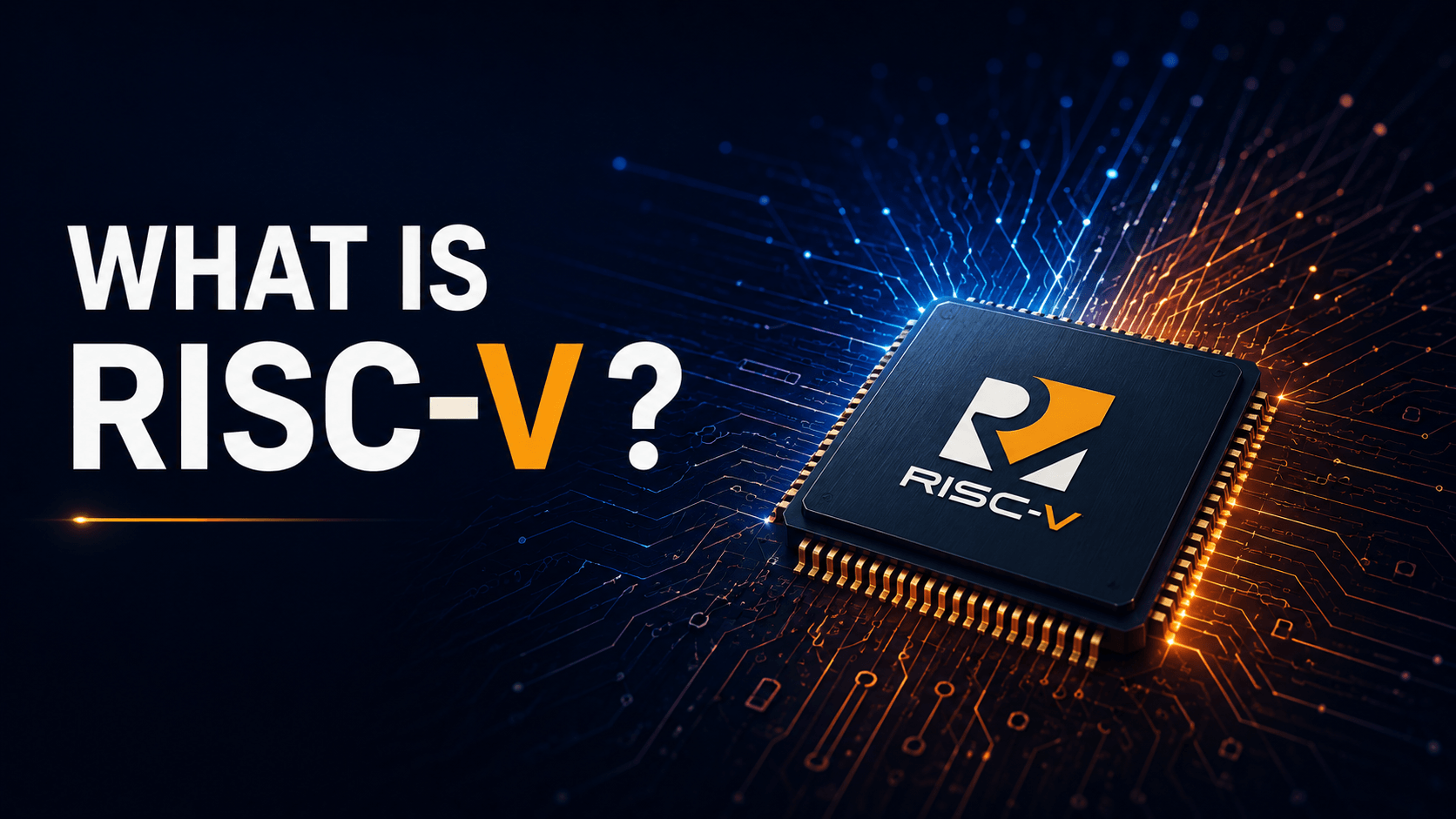
What Is RISC-V?
Most people never think about the instruction set inside their CPU.
They just buy a computer or phone and see names like:
Intel
AMD
Apple M-series
Snapdragon
But underneath those brand names is something more fundamental:
Instruction Set Architectureor:
ISAAn ISA defines the basic language a processor understands.
And one of the most interesting new CPU architectures today is:
RISC-VRISC-V is not a processor brand.
It is not a company making laptops.
It is an open instruction set architecture that anyone can implement.
That is what makes it unusual.
First, What Is an Instruction Set?
Imagine a CPU understands commands such as:
Add these numbers.
Move this value into memory.
Compare two values.
Jump to another instruction.
Those commands are part of the instruction set.
A simplified example might look like:
ADD
SUB
LOAD
STORE
JUMP
The ISA defines things such as:
- available instructions
- registers
- memory operations
- privilege levels
- binary encoding
Software is ultimately translated into this CPU language.
x86 and ARM Are Also ISAs
The two most familiar architectures today are:
x86and:
ARMIntel and AMD primarily build x86 processors.
Apple Silicon, Qualcomm Snapdragon, and many mobile chips are based on ARM.
So you can think of the landscape roughly like:
Intel / AMD
     ↓
    x86

Apple / Qualcomm
     ↓
    ARM

Many companies
     ↓
   RISC-V
The important difference is how access to those architectures works.
RISC-V Is Open
This is the biggest idea.
If a company wants to build an ARM-compatible CPU, it generally needs an agreement and license from Arm.
x86 is even more tightly controlled.
RISC-V takes a different approach.
The instruction set specification is openly available.
A company, university, or individual can design a CPU that implements RISC-V without paying for the right to use the ISA itself.
Conceptually:
RISC-V specification
        ↓
Anyone can design a CPU
        ↓
Chip implementation
That does not mean every RISC-V processor is open-source.
A company can build a proprietary processor around the open ISA.
The ISA is open; the chip design does not have to be.
Why Is It Called RISC-V?
The name comes from:
Reduced Instruction Set Computeror:
RISCThe V means it was the fifth major RISC design developed by the research group at UC Berkeley.
So:
RISC-Vis pronounced roughly:
RISC Fivenot "RISC vee."
Where Did It Come From?
RISC-V began as a research project at the University of California, Berkeley.
The researchers wanted an instruction set that was:
- simple enough to teach
- practical enough for real processors
- extensible
- free from proprietary ISA restrictions
Instead of creating another architecture that belonged to one company, they designed something that could become a shared standard.
That decision turned out to be very important.
Why Do We Need Another CPU Architecture?
You might reasonably ask:
We already have x86 and ARM. Why invent another one?
Because both come with constraints.
x86 has a long history and enormous compatibility, but it is controlled by a very small number of companies.
ARM is extremely successful and flexible, but commercial CPU designers usually operate within Arm's licensing ecosystem.
RISC-V offers another model:
Open standard
+
Custom processor design
+
No ISA licensing fee
That can be very attractive.
Think of It Like USB
Imagine if only one company were allowed to design devices that understood USB.
That would severely limit competition.
Instead, USB is a standard.
Many companies can build:
Keyboards
Storage devices
Cameras
Phones
Controllers
that all speak the same protocol.
RISC-V wants to provide something similar for processors.
The standard says:
Here is the language the CPU should understand.
Different companies decide how to build the CPU itself.
The ISA and the CPU Are Different Things
This distinction is important.
RISC-V does not tell you exactly how powerful a processor will be.
Two RISC-V processors could be completely different.
One might be:
Tiny microcontroller
1 core
Very low power
Another might be:
64-core server processor
Large caches
Advanced out-of-order execution
Both understand the same basic RISC-V architecture.
Similarly, Intel and AMD both implement x86 but build different CPUs.
RISC-V Is Designed to Be Modular
One particularly elegant part of RISC-V is its extension system.
There is a small base architecture.
Then processors can add extensions depending on what they need.
Conceptually:
Base RISC-V
    +
Integer instructions
    +
Multiplication
    +
Floating point
    +
Vector processing
    +
Other extensions
A tiny embedded chip does not need to implement everything a server CPU needs.
That makes the architecture flexible.
A Tiny Device and a Server Can Share the Same Family
Imagine a small sensor.
It might need:
Simple CPU
Small memory
Very low power
A RISC-V implementation can remain minimal.
Now imagine an AI server.
It might need:
Many cores
Vector instructions
Large memory
High performance
That processor can implement a much larger set of extensions.
Both can remain part of the same architecture family.
This Makes RISC-V Interesting for Custom Chips
Suppose you are designing a storage controller.
You do not necessarily need a giant general-purpose CPU.
You may want:
Small RISC-V core
+
Your own storage accelerator
+
Encryption engine
+
Network logic
all on one chip.
RISC-V lets companies build highly customized processors without having to invent an entirely new software-visible CPU architecture.
This Is Similar to What Apple Did, But With a Different ISA Model
Apple's M-series demonstrates the power of custom CPU design.
Apple can build:
CPU
GPU
Neural Engine
Media Engine
Security hardware
into one system-on-chip.
But Apple uses the ARM architecture.
With RISC-V, another company could potentially pursue a similar custom-chip strategy while using an open ISA.
That is one reason RISC-V attracts so much interest.
Where Is RISC-V Used Today?
RISC-V initially became popular in smaller embedded systems.
Examples include:
- Microcontrollers
- Storage controllers
- IoT devices
- Networking chips
- Security processors
- Management controllers
These are areas where companies often need custom processors but do not necessarily need desktop-class performance.
RISC-V Is Moving Upward
The interesting part is that RISC-V is no longer limited to tiny microcontrollers.
More powerful implementations are being developed for:
- Linux computers
- Development boards
- Networking equipment
- AI accelerators
- Servers
- High-performance embedded systems
This progression resembles what happened with ARM.
ARM was once widely associated with small embedded devices and phones.
Then it moved into:
Laptops
Servers
Cloud infrastructure
RISC-V supporters hope for a similar evolution.
Can RISC-V Run Linux?
Yes.
Linux supports RISC-V.
That is very important because a new CPU architecture is not very useful without software.
A capable RISC-V machine can run a Linux stack containing things such as:
Kernel
GNU tools
Python
GCC
Clang
Databases
Web servers
assuming the required packages and hardware support are available.
So RISC-V is already a real general-purpose computing platform, not just a theoretical architecture.
But Software Compatibility Is Still a Challenge
Suppose you have a program compiled for:
x86-64You cannot simply execute that binary directly on a RISC-V processor.
The CPU speaks a different instruction language.
You need either:
Native RISC-V buildor some kind of:
Emulation / translationThis is the same issue Apple faced when moving Macs from Intel x86 to ARM.
Software ecosystems take time to migrate.
Source Code Makes the Transition Easier
For open-source software, this can be relatively straightforward.
If the source code is portable:
Source Code
     ↓
RISC-V Compiler
     ↓
RISC-V Binary
Applications can simply be rebuilt.
That is one reason Linux and open-source software are so important for emerging architectures.
Closed-source applications depend on their vendors choosing to support RISC-V.
RISC-V vs ARM
The comparison people ask most often is:
RISC-V vs ARMBoth are RISC-style architectures.
Both can support low-power processors.
Both can scale into more powerful systems.
But their business models are very different.
A simplified comparison:
| Area | ARM | RISC-V |
|---|---|---|
| ISA ownership | Arm ecosystem | Open standard |
| ISA licensing | Commercial licensing model | No fee to use ISA |
| Custom CPU designs | Yes | Yes |
| Mobile ecosystem | Extremely mature | Early |
| Server ecosystem | Established | Emerging |
| Embedded use | Massive | Growing rapidly |
| Linux support | Excellent | Good and improving |
| Software ecosystem | Huge | Much smaller |
ARM currently has a major ecosystem advantage.
RISC-V has an openness advantage.
RISC-V vs x86
x86 dominates traditional desktop and PC software.
It has decades of compatibility behind it.
RISC-V starts with a cleaner slate.
That means:
x86
=
Huge ecosystem
+
Legacy compatibility
while:
RISC-V
=
Cleaner architecture
+
Open standard
+
More freedom for new designs
For a normal PC user today, x86 remains vastly more mature.
But RISC-V is not trying to replace every x86 machine overnight.
Its growth can begin in places where compatibility matters less.
The Biggest Advantage Is Not Performance
A common misunderstanding is:
RISC-V must be faster because it is RISC.
No.
The ISA does not magically determine performance.
A processor's speed depends on things such as:
- microarchitecture
- cache design
- branch prediction
- clock speed
- manufacturing process
- memory system
- core count
A good x86 CPU can outperform a bad RISC-V CPU.
A good ARM CPU can outperform both.
The major advantage of RISC-V is freedom to design around an open standard.
Why Companies Care About Licensing
Imagine you want to build 100 million chips.
Even relatively small licensing costs or contractual restrictions can become strategically important.
More importantly, dependence on another company's architecture means that company becomes part of your product roadmap.
An open ISA can reduce that dependency.
Conceptually:
Proprietary ISA
      ↓
Architecture owner
      ↓
Your chip
versus:
RISC-V standard
      ↓
Your own implementation
This can be attractive for large technology companies and governments alike.
RISC-V Also Reduces Vendor Lock-In
Suppose several companies design compatible RISC-V CPUs.
Software can target:
RISC-Vrather than one specific vendor.
That creates the possibility of an ecosystem similar to x86, where multiple processor manufacturers compete while supporting the same broad software architecture.
In theory:
Company A CPU
Company B CPU
Company C CPU
      ↓
Same ISA family
      ↓
Same software ecosystem
Competition can be healthy.
It Is Also Attractive for Education
RISC-V began in academia, and its relatively clean architecture makes it useful for teaching.
Students can learn:
CPU instructions
Registers
Assembly
Operating systems
Compilers
Computer architecture
without starting with decades of compatibility baggage.
For computer engineering education, this matters.
RISC-V Is Not the Same as Open-Source Hardware
This deserves repeating.
RISC-V means:
The ISA specification is open.It does not necessarily mean:
The entire CPU design is open.A company can build:
Proprietary high-performance RISC-V CPUand never release its internal design.
Other projects can choose to create open-source RISC-V cores.
Both approaches are allowed.
What Is an Open-Source RISC-V Core?
Some processor designs are released as source code, usually in hardware description languages.
Conceptually:
CPU design source
       ↓
Synthesis
       ↓
FPGA or silicon
This allows universities, companies, and hobbyists to experiment with actual processor implementations.
That makes RISC-V especially interesting to hardware researchers.
RISC-V and AI
AI is another area where RISC-V could become important.
AI chips often contain:
General CPU cores
+
Matrix accelerators
+
Vector engines
+
Custom hardware
The general-purpose CPU does not necessarily need to be the fastest processor in the world.
It may mainly coordinate specialized accelerators.
RISC-V can be an attractive choice for that control processor because it can be customized and integrated without proprietary ISA licensing.
Imagine an AI Accelerator
A chip might look like:
┌─────────────────────────┐
│ RISC-V CPU cores        │
│                         │
│ AI Matrix Accelerator   │
│ Vector Engine           │
│ Memory Controller       │
│ Network Engine          │
└─────────────────────────┘
The RISC-V cores run control software.
The specialized hardware handles the heavy AI calculations.
This kind of architecture is already common in principle across modern accelerator designs.
RISC-V and Embedded Devices
The embedded market may be one of RISC-V's strongest opportunities.
Imagine making:
Smart thermostat
SSD controller
Wi-Fi chip
Automotive controller
Industrial sensor
You may only need a relatively small CPU.
Using RISC-V means manufacturers can integrate processor cores into their products while controlling much more of the design themselves.
Cars Are Full of CPUs
A modern car may contain many processors controlling:
Engine
Brakes
Infotainment
Sensors
Battery
Cameras
Networking
Driver assistance
That makes automotive computing a large potential market for flexible CPU architectures.
RISC-V's openness and ability to support specialized processors make it particularly interesting there.
Security Processors Are Another Good Fit
Modern chips often contain separate processors for:
- secure boot
- cryptography
- firmware management
- device control
These small embedded CPUs may be invisible to the user.
RISC-V is increasingly attractive for exactly these types of internal processors.
So you may eventually own many RISC-V processors without realizing it.
Could RISC-V Replace ARM?
Possibly in some markets.
But not quickly everywhere.
ARM has an enormous advantage in:
Phones
Tablets
Embedded systems
Developer tooling
Operating-system support
Chip-design ecosystem
Replacing such an ecosystem takes years.
A more likely short-term story is:
ARM continues growing
+
RISC-V grows alongside it
with RISC-V capturing areas where openness and customization are especially valuable.
Could It Replace x86 on PCs?
That is an even harder challenge.
PC users expect applications built over decades.
A RISC-V desktop would need excellent support for:
Browsers
Drivers
Games
Office software
Creative software
Development tools
Linux can provide much of the open-source side.
Commercial software would take longer.
So a mainstream RISC-V gaming PC is not the easiest starting point.
Servers Might Be More Interesting
Server software is often:
Linux
Open source
Containerized
Cloud native
That makes architecture migration somewhat easier.
If your application is distributed as source code or container images built for multiple architectures, supporting another CPU family becomes more realistic.
ARM servers already demonstrated this.
RISC-V may attempt to follow the same route.
Containers Help New Architectures
Suppose an application image is available for:
amd64
arm64
riscv64
The user could run the same application across three CPU architectures.
This is where modern build systems and container tooling can help reduce architecture lock-in.
The application becomes less tied to the processor underneath.
Why Governments Are Interested
CPU architectures are strategic technology.
If your country's electronics industry relies entirely on architectures controlled elsewhere, that can create long-term dependency.
Because RISC-V is an open international standard, it attracts interest from countries that want greater semiconductor independence.
The technology is therefore not only about engineering.
It also has economic and geopolitical significance.
But Open Does Not Mean Easy
There is a temptation to think:
Open ISA
=
Anyone can make an Apple M-class CPU.
Not at all.
Designing a high-performance processor is extremely difficult.
You still need expertise in:
- CPU architecture
- verification
- physical design
- cache systems
- memory controllers
- compilers
- fabrication
- packaging
The instruction set is only one part of the problem.
Think of RISC-V Like a Language
Imagine English were free for everyone to use.
That does not mean everyone can automatically write a great novel.
The language provides the rules.
The quality depends on what you build with them.
RISC-V is similar.
It provides the processor language.
The processor designer still has to create a great implementation.
Why RISC-V Matters Even If You Never Buy a RISC-V Laptop
Because it changes the economics of processor design.
Before:
Want a standard CPU architecture?
      ↓
Work within an existing proprietary ecosystem.
Now there is another option:
Want a standard CPU architecture?
      ↓
Use RISC-V.
      ↓
Build your own implementation.
That increases competition and experimentation.
Even if RISC-V never replaces x86 or ARM completely, that alone makes it significant.
A Simple Comparison
| Architecture | Common Today In | Main Strength |
|---|---|---|
| x86 | PCs, servers | Compatibility and performance ecosystem |
| ARM | Phones, laptops, embedded | Efficiency and mature licensing ecosystem |
| RISC-V | Embedded, controllers, emerging computers | Open ISA and customization |
The important thing is that these are not processor brands.
They are instruction-set families that companies build processors around.
The Bigger Story
For decades, the CPU world looked relatively stable:
PC
 ↓
x86

Phone
 ↓
ARM
RISC-V introduces a third major possibility:
Anything
   ↓
Open ISA
   ↓
Custom processor
That could encourage far more specialized chips.
Instead of buying one generic processor for everything, companies may increasingly design silicon specifically around their products.
Final Thoughts
RISC-V is important not because it is automatically faster than Intel, AMD, or Apple Silicon.
It is important because it changes who is allowed to design a compatible CPU.
With RISC-V:
Open instruction set
        ↓
Many CPU designers
        ↓
Many custom implementations
        ↓
Shared software ecosystem
That is a powerful idea.
Today, RISC-V is strongest in embedded systems and specialized processors.
Tomorrow, it may appear increasingly in:
Laptops
Servers
Cars
AI accelerators
Storage devices
IoT hardware
Whether it eventually competes head-to-head with ARM and x86 everywhere remains uncertain.
But the architecture has already changed one important assumption in computing:
A widely used CPU instruction set does not have to belong to one company.
And that may turn out to be RISC-V's biggest contribution.