







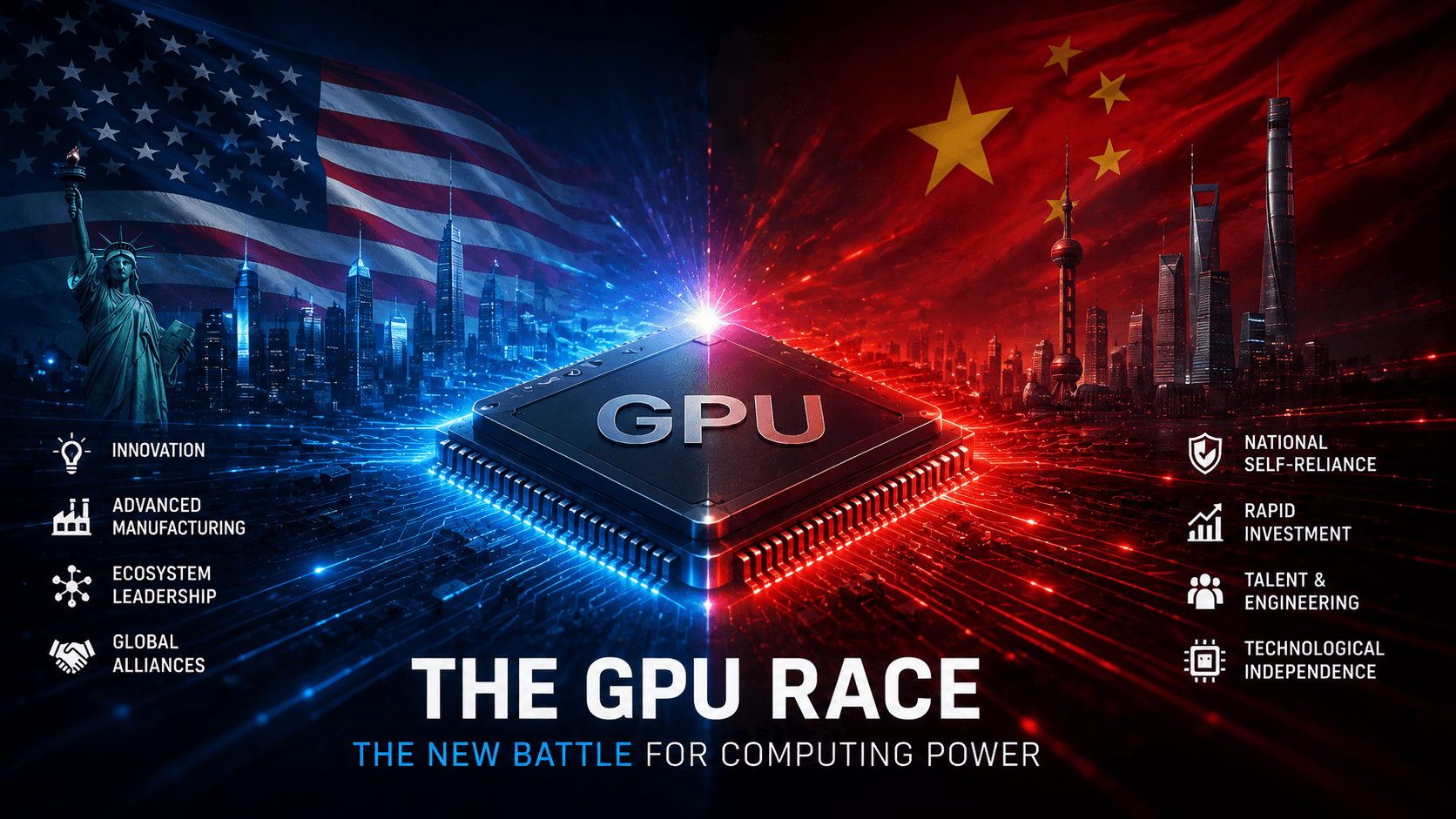
The GPU Race Between the USA and China: The New Battle for Computing Power
For most people, a GPU was once something you bought to play better games.
Gamers argued about frame rates.
PC builders waited for the next NVIDIA or AMD graphics card.
Nobody imagined that these chips would become important enough for governments to restrict their movement across borders.
Then artificial intelligence arrived.
Suddenly, the GPU was no longer just a graphics processor.
It became strategic infrastructure.
And one of the biggest technology competitions of the 21st century began between the United States and China.
The Race Starts With AI
Modern AI models require enormous amounts of computation.
Training a large neural network means performing billions upon billions of matrix calculations.
GPUs are extremely good at exactly this kind of parallel work.
The equation was becoming simple:
More advanced GPUs → more AI computing power.
And more AI computing power could mean better:
- language models
- robotics
- autonomous systems
- scientific research
- cybersecurity
- military technology
- industrial automation
Governments began looking at GPUs differently.
They weren't just computer components anymore.
They were becoming something closer to oil in the industrial age—a resource capable of powering an entire technological revolution.
America Had a Powerful Advantage
The United States entered this new era with an extraordinary position.
NVIDIA had built the dominant platform for high-performance AI computing.
AMD was another major American GPU and accelerator designer.
But NVIDIA's advantage wasn't only hardware.
Over many years, it had built CUDA, a software platform that allowed developers to program NVIDIA GPUs for general-purpose parallel computing.
Researchers learned CUDA.
Universities taught it.
AI frameworks supported it.
Cloud providers deployed enormous numbers of NVIDIA accelerators.
Eventually, NVIDIA wasn't simply selling GPUs.
It had created an ecosystem.
That ecosystem became one of America's biggest advantages in the AI race.
There was one complication.
The semiconductor supply chain was international.
Many advanced American-designed chips depended on manufacturing and packaging capabilities outside the United States, particularly companies such as Taiwan's TSMC.
The GPU race was therefore never purely America versus China.
It was a contest involving an entire global semiconductor supply chain.
Washington Changes the Rules
American policymakers became increasingly concerned that advanced AI accelerators could strengthen China's military and intelligence capabilities.
So Washington began restricting China's access to some advanced computing chips and semiconductor technology.
The restrictions evolved over several years.
By 2026, U.S. export controls and licensing requirements continued to shape which advanced AI processors Chinese organizations could obtain, including restrictions intended to prevent controlled chips from reaching Chinese companies indirectly through overseas subsidiaries.
For NVIDIA, this created an unusual challenge.
China was an enormous technology market.
But some of NVIDIA's most capable processors could not simply be sold there like normal products.
Different generations of China-compatible accelerators appeared as the regulatory environment changed.
By July 2026, limited shipments of NVIDIA's H200 processors to China had begun under U.S. approvals, showing just how fluid the policy had become.
The GPU had effectively become part of foreign policy.
China's Response: Build Our Own
If China couldn't depend permanently on American processors, there was an obvious response:
Build alternatives.
Huawei emerged as one of the most important players.
Its Ascend family of AI processors was designed to compete in workloads that would otherwise run on NVIDIA hardware.
And Huawei wasn't alone.
Alibaba, Biren, MetaX, Moore Threads and other Chinese companies began developing accelerators and GPU-like computing platforms.
In 2026, Reuters reported that Huawei remained the leading domestic alternative to NVIDIA while companies including Alibaba were expanding their own AI-chip efforts.
This wasn't simply about building a faster chip.
China increasingly wanted an entire domestic stack:
AI Models
    ↓
AI Frameworks
    ↓
Software / Compilers
    ↓
GPU / AI Accelerators
    ↓
Memory
    ↓
Chip Manufacturing
    ↓
Semiconductor Equipment
Every layer mattered.
The Hardest Problem Isn't Just the GPU
Designing a powerful processor is difficult.
Manufacturing one is another problem entirely.
Modern chips contain billions of microscopic transistors.
Producing them requires some of the most sophisticated factories ever created.
The global supply chain includes specialized companies from many countries:
- chip designers
- foundries
- lithography manufacturers
- memory producers
- packaging companies
- semiconductor equipment suppliers
China's biggest challenge has therefore been bigger than simply producing an NVIDIA competitor.
It has been building more of the semiconductor ecosystem domestically.
China's largest foundry, SMIC, has been expanding as domestic demand rises. In the second quarter of 2026, SMIC's revenue exceeded $3 billion and its profit more than tripled year over year, with AI-related semiconductor demand contributing to strong utilization and expansion.
Restrictions may slow China's progress.
But they also create an enormous incentive to become independent.
Huawei Enters the Arena
Consider what happened with Huawei.
American sanctions severely restricted parts of its semiconductor supply chain.
For a while, many observers wondered whether this would cripple Huawei's ability to compete at the high end.
Instead, Huawei doubled down.
Its Ascend processors became increasingly important inside China.
In 2026, demand for Huawei's newest AI accelerators rose sharply among major Chinese technology companies.
Huawei also began emphasizing another strategy.
If producing the world's best individual chip is difficult, perhaps performance can be increased by connecting large numbers of processors together.
This is critical because AI supercomputers are not really about one GPU.
They are about thousands of accelerators working as one enormous machine.
The battle therefore moves from:
"Who has the fastest chip?"
to:
"Who can build the most powerful computing system?"
But NVIDIA Has a Secret Weapon
Imagine China produces a GPU with excellent hardware performance tomorrow.
There is still another problem.
Software.
Millions of developers already understand NVIDIA's ecosystem.
AI frameworks are heavily optimized around it.
Libraries, debugging tools, training systems and years of documentation already exist.
This creates something extremely powerful:
developer lock-in.
Replacing NVIDIA therefore isn't like replacing one brand of memory with another.
Companies may need to rewrite software, optimize models, change infrastructure and retrain engineers.
This is why CUDA may ultimately be as important to NVIDIA as its transistor designs.
China doesn't only need an alternative to NVIDIA hardware.
It needs alternatives to the ecosystem surrounding NVIDIA.
And that battle could take much longer.
The Race Creates Two Ecosystems
Something interesting is now happening.
The restrictions intended to limit China's access to advanced American technology are also encouraging China to invest more aggressively in domestic alternatives.
China's latest five-year policy blueprint emphasizes technological self-reliance and breakthroughs in core technologies, while AI is being pushed deeper into the country's economy.
At the same time, the United States is increasingly organizing international technology partnerships around semiconductors, AI infrastructure and critical supply chains.
The world could gradually move toward two partially separate computing ecosystems.
One centered around technologies such as:
NVIDIA + AMD + CUDA + Western and allied semiconductor supply chains
and another increasingly built around:
Huawei + Chinese accelerators + domestic software + Chinese semiconductor manufacturing
They won't be completely separated.
Global technology supply chains are too interconnected for that.
But the direction is becoming visible.
This Isn't a Normal Technology Race
Intel versus AMD was mostly a business competition.
PlayStation versus Xbox was a platform competition.
The American-Chinese GPU race is different.
It involves:
Companies.
Governments.
National security.
Trade policy.
Manufacturing.
Energy.
Artificial intelligence.
And ultimately, geopolitical power.
That makes the outcome difficult to predict.
The United States currently holds major advantages in advanced AI processors and the surrounding software ecosystem.
China has something equally important:
an enormous domestic market, large engineering resources and a strong strategic incentive to reduce dependence on foreign technology.
Restrictions can slow a competitor.
But restrictions can also tell that competitor exactly what it needs to build.
The New Space Race
During the Cold War, technological power was demonstrated with rockets.
The United States and Soviet Union competed to put satellites, humans and eventually footprints into space.
Today's competition looks quieter.
There may be no rocket launch on television.
Instead, engineers stand inside semiconductor fabs.
Researchers train enormous neural networks.
Thousands of GPUs fill data centers.
Governments debate nanometers, memory bandwidth and export licenses.
Yet the underlying question is remarkably similar:
Who will control the technology that defines the next era?
The GPU race is therefore about much more than GPUs.
It is about who builds the machines that build the intelligence.
And in the age of AI, computing power itself has become geopolitical power.