







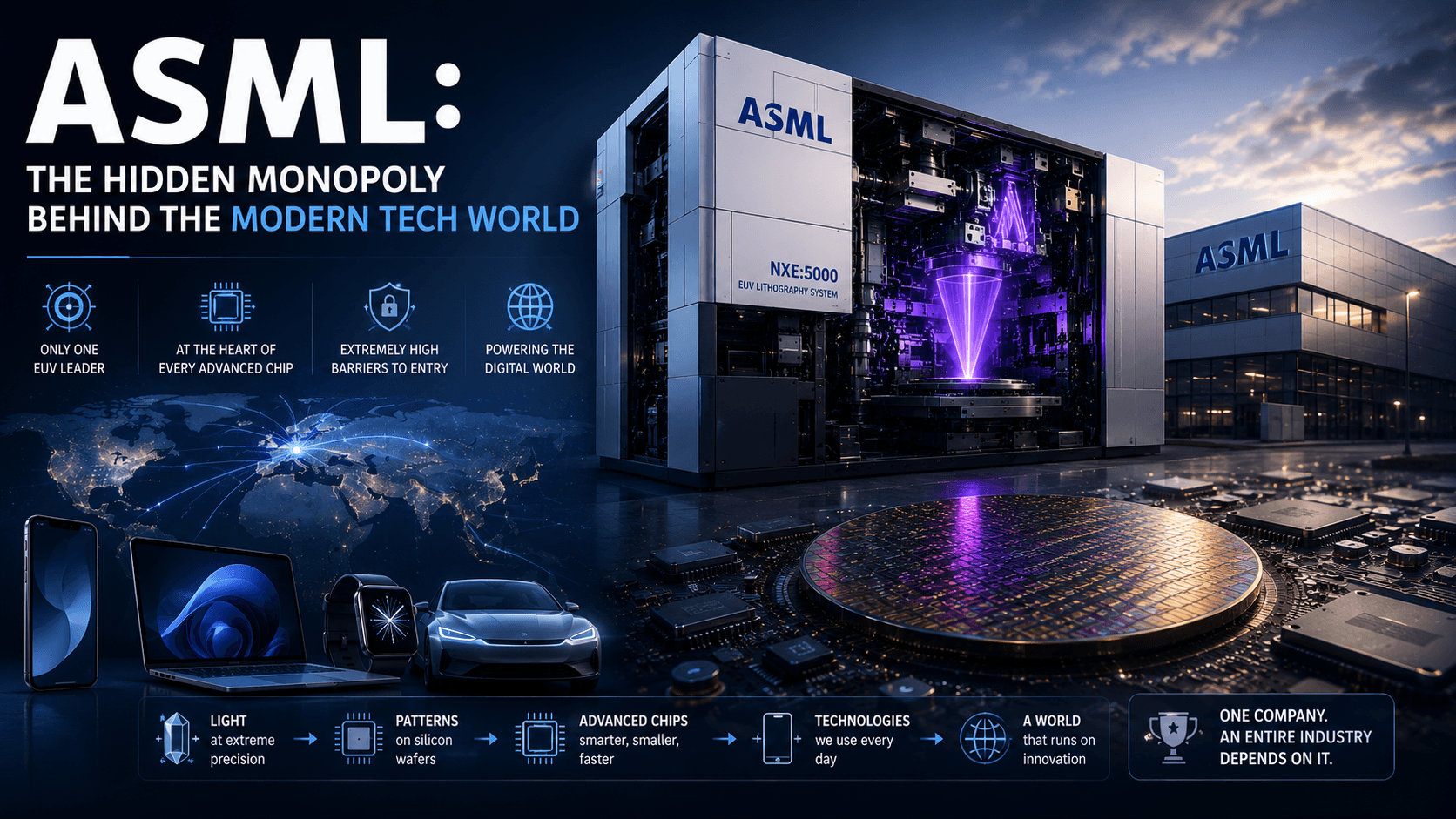
ASML: The Hidden Monopoly Behind the Modern Tech World
Imagine waking up tomorrow and discovering that the world's most advanced computer chips can no longer be manufactured.
No new flagship processors.
No cutting-edge AI accelerators.
No next-generation smartphone chips.
Companies like NVIDIA, AMD, Apple, Intel, Samsung, and TSMC would still have brilliant engineers capable of designing processors.
But designing a chip is only half the story.
Someone has to build it.
And hidden deep inside that manufacturing process is a Dutch company most consumers have never heard of:
ASML.
Today, ASML is the world's only manufacturer of the extreme ultraviolet, or EUV, lithography systems needed for mass-producing many of the most advanced chips.
That makes ASML one of the strangest monopolies in modern technology.
It Started in a Shed
ASML didn't begin as a technology giant.
It was founded in the Netherlands in 1984 as a joint venture between electronics giant Philips and semiconductor-equipment company ASM International.
The new company was called ASM Lithography.
Its mission was to build machines called wafer steppers.
The beginning was far from glamorous.
ASML's early team worked from temporary facilities near Philips in Eindhoven, and the company struggled to establish itself against much larger competitors.
At the time, companies such as Nikon and Canon were already major names in semiconductor lithography.
ASML looked like the outsider.
Few could have predicted that decades later the semiconductor industry would depend on it.
Printing a Chip With Light
To understand ASML, imagine making a processor like printing an incredibly complicated city onto a piece of silicon.
A modern chip contains billions of transistors.
These components must be arranged in microscopic patterns.
Chipmakers begin with a silicon wafer, coat it with light-sensitive material, and then use a process called photolithography to project patterns onto its surface.
Conceptually:
Chip design
     ↓
Mask
     ↓
Light
     ↓
Optical system
     ↓
Silicon wafer
     ↓
Tiny circuit pattern
Repeat this process layer after layer and eventually an incredibly complex processor emerges.
There's just one problem.
As transistors become smaller, the patterns become harder to print.
Eventually ordinary light becomes too large for the job.
The industry needed light with a dramatically shorter wavelength.
That led to EUV.
The Impossible Machine
Extreme ultraviolet lithography uses light with a wavelength of about 13.5 nanometers.
Producing that light is extraordinarily difficult.
Inside an ASML EUV system, microscopic droplets of molten tin are fired through a chamber.
Powerful laser pulses strike those droplets.
The tin becomes plasma.
That plasma produces EUV light.
Then another problem appears.
EUV light is absorbed by almost everything.
Normal lenses can't be used.
Even air absorbs it.
So the machine must operate largely inside a vacuum and guide the light using extraordinarily precise mirrors.
Those mirrors are supplied through ASML's long-running partnership with German optics specialist ZEISS.
Eventually the light reaches the wafer and helps print microscopic structures onto it.
Described simply, it sounds almost reasonable.
In engineering terms, it is absurdly difficult.
A modern EUV machine contains huge numbers of precision components and is one of the most complicated pieces of manufacturing equipment humanity has ever built.
Why Doesn't Someone Just Copy It?
This is where ASML becomes fascinating.
Normally, when one company develops a profitable technology, competitors eventually appear.
Smartphones have dozens of manufacturers.
Cars have hundreds.
Processors have multiple competing architectures and vendors.
Why not EUV lithography?
Because ASML didn't simply invent a machine.
It spent decades assembling an ecosystem of technologies that are individually difficult to reproduce.
The system depends on:
- precision optics
- powerful lasers
- vacuum technology
- robotics
- plasma physics
- advanced materials
- nanometer-scale positioning
- computational lithography
- extremely sophisticated software
Some pieces come from ASML.
Others come from specialized suppliers around the world.
Even ASML itself depends heavily on companies such as ZEISS for critical optical systems.
Reproducing the machine therefore isn't like reverse-engineering a laptop.
You have to reproduce an entire industrial ecosystem.
The Bet That Took Decades
EUV wasn't an overnight success.
For years, the technology looked almost impossible to commercialize.
ASML and its partners poured enormous amounts of money and engineering effort into solving problem after problem.
There wasn't enough light.
Then the light source improved.
Mirrors weren't efficient enough.
They improved.
Machines weren't reliable enough for factories.
Reliability improved.
Eventually even ASML's future customers became financially involved.
Intel, TSMC, and Samsung participated in a co-investment program supporting ASML's next-generation lithography development.
They weren't simply buying equipment.
They were helping ensure that the equipment they would need in the future actually existed.
Eventually, EUV moved from laboratory experiment to semiconductor production.
And by then, the competitors were far behind.
TSMC May Make the Chip, but ASML Enables It
Consider an advanced AI processor.
NVIDIA might design the architecture.
EDA software companies help engineers design its billions of transistors.
TSMC may manufacture it.
Companies such as SK Hynix or Samsung may supply advanced memory.
But somewhere inside the fabrication process, ASML lithography systems help print critical layers onto the silicon.
That makes ASML unusual.
It doesn't necessarily design the world's fastest processors.
It doesn't manufacture the processors.
It doesn't sell smartphones or cloud services.
Instead, it sells the machines that allow other companies to manufacture advanced technology.
ASML is essentially:
the company behind the companies behind the chips.
Then AI Arrived
The artificial-intelligence boom made ASML's position even more important.
Training and running modern AI systems requires enormous amounts of computing infrastructure.
That means more GPUs.
More GPUs require advanced semiconductor manufacturing.
Advanced semiconductor manufacturing requires more lithography capacity.
In July 2026, ASML raised its expected full-year revenue to roughly €43–45 billion as customers accelerated capacity plans amid strong AI-related semiconductor demand.
Its EUV production capacity was effectively being booked years ahead.
A company once struggling to sell wafer steppers had become one of the bottlenecks of the AI revolution.
One Machine Becomes Geopolitical
Once governments understood how important advanced chips were, ASML stopped being merely a technology story.
It became a geopolitical story.
The United States has restricted China's access to advanced semiconductor technology.
But ASML isn't American.
It is Dutch.
That means the Netherlands suddenly occupies an unusually important position in the global technology competition.
ASML's most advanced EUV systems cannot currently be exported to China, and licensing controls also cover certain advanced DUV lithography systems.
Think about how strange this is.
Diplomats are now discussing machines that fire lasers at droplets of molten tin because those machines influence which countries can manufacture the world's most sophisticated processors.
Semiconductor equipment has become foreign policy.
Why China Wants an Alternative
China understands this dependency extremely well.
It has invested heavily in building domestic semiconductor manufacturing capability.
But replacing ASML is exceptionally difficult.
China doesn't simply need to build a lithography machine.
It needs advanced optics.
Light sources.
Precision motion systems.
Materials.
Software.
Metrology.
Suppliers.
And decades of accumulated manufacturing knowledge.
Chinese companies are making progress in parts of the lithography ecosystem, including DUV equipment, but matching ASML's leading EUV capability remains a much larger challenge. Recent reports in 2026 still described ASML as the exclusive global supplier of production EUV systems.
This is why lithography has become one of the most important technological bottlenecks in the U.S.–China semiconductor competition.
Beyond EUV
ASML isn't standing still.
The next generation is called High-NA EUV.
NA means numerical aperture.
Without diving too deeply into optics, increasing it allows lithography systems to print even smaller features more precisely.
ASML shipped modules for its first High-NA EUV system to Intel in late 2023, beginning another transition in semiconductor manufacturing technology.
These machines push complexity even further.
The goal remains the same as it was decades ago:
Keep shrinking the patterns.
Keep increasing transistor density.
Keep computing moving forward.
The Hidden Monopoly
When we talk about technological power, we usually talk about famous companies.
NVIDIA.
Apple.
Microsoft.
Google.
TSMC.
Samsung.
But beneath many of them sits an obscure layer of companies manufacturing the tools required to build technology itself.
ASML may be the most important example.
Its power doesn't come from owning every semiconductor factory.
It comes from controlling a technology those factories cannot easily replace.
And that reveals something important about modern civilization.
The world's most important companies aren't always the ones whose logos appear on our devices.
Sometimes the most powerful company is several layers deeper in the supply chain.
A company that most people never interact with.
A company in the Netherlands.
Building machines the size of buses.
Firing lasers at microscopic drops of molten metal.
So that somewhere else in the world, billions of transistors can be printed onto a piece of silicon.
ASML doesn't build the digital world.
It builds the machines that make building the digital world possible.