







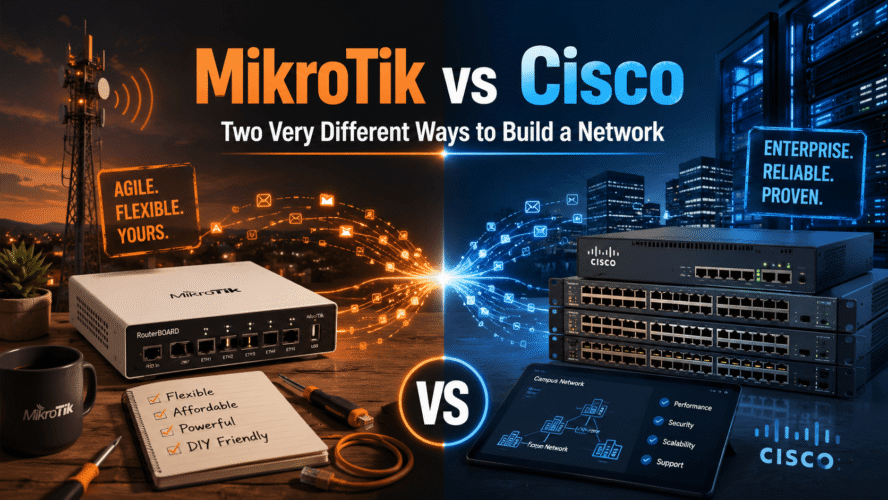
MikroTik vs Cisco
Imagine you are building a network for a growing company.
You need:
- internet routing,
- VLANs,
- VPNs,
- firewall rules,
- switches,
- maybe BGP,
- maybe multiple branches.
Then two names appear almost immediately:
MikroTikand:
CiscoBoth can route packets.
Both can build serious networks.
Both can be found in businesses, ISPs, campuses, and data centers.
But they come from very different worlds.
The easiest way to describe them is:
MikroTik gives you a lot of networking power for relatively little money. Cisco gives you a much larger enterprise ecosystem around the network itself.
MikroTik currently sells routers, switches, wireless systems, and carrier-oriented gear around RouterOS, while Cisco's portfolio spans enterprise switching, branch and edge routing, industrial networking, data-center platforms, SD-WAN, and service-provider routing. (MikroTik)
Imagine Two Network Engineers
One engineer walks into a small ISP.
The budget is tight.
They need:
BGP
OSPF
VLANs
VPN
Firewall
QoS
Multiple WAN links
and they need it all from one affordable router.
They may reach for MikroTik.
Another engineer walks into a large bank.
The network spans:
Head office
100 branches
Data centers
Factories
Cloud
Thousands of users
They need not only routers and switches, but also:
- formal vendor support,
- standardized designs,
- certifications,
- enterprise management,
- long product lifecycles,
- large deployment teams.
They may reach for Cisco.
Neither decision is strange.
The environments are different.
MikroTik's Big Idea: Give You Everything
MikroTik's RouterOS is one of the reasons the brand became so popular.
A relatively small MikroTik device may expose features such as:
Routing
Firewall
NAT
VPN
VLAN
BGP
OSPF
QoS
DHCP
DNS
Traffic shaping
Wireless
through one operating system.
RouterOS is the operating system used on MikroTik devices, and MikroTik maintains a single documentation set for its current stable RouterOS release. (MikroTik Help)
For someone learning networking, that can feel like receiving an enormous toolbox.
You buy one router and suddenly have access to concepts normally associated with much more expensive enterprise gear.
This Is Why MikroTik Became Popular With ISPs
Suppose a small ISP needs to connect:
500 customersIt may need:
PPPoE
Bandwidth limits
Routing
Firewalling
BGP
VLANs
Multiple uplinks
Budget matters enormously.
Buying expensive enterprise hardware at every point in the network may simply not be realistic.
MikroTik made advanced routing features accessible at much lower price points.
That helped it become common among:
- local ISPs,
- WISPs,
- small businesses,
- home labs,
- regional networks.
MikroTik itself positions its portfolio from small-office use through carrier-grade ISP infrastructure. (MikroTik)
Cisco's Big Idea Is Different
Cisco is not simply selling:
A routerIt is often selling an entire networking architecture.
Cisco's current portfolio covers areas such as:
Campus
Branch
Data center
Cloud edge
Industrial networking
SD-WAN
Service-provider core
with large families of routers and switches designed for different layers of the network. (Cisco)
That matters once networks become very large.
The Small Network Question
Imagine a company with:
50 employees
2 internet connections
3 VLANs
VPN for remote staff
10 access points
A MikroTik router may handle the routing, firewall, VPN, DHCP, and failover comfortably depending on the required throughput.
For this organization, buying a much larger Cisco solution may not automatically produce a better business result.
You may simply spend more money solving the same problem.
Now Make the Company 100 Times Bigger
Suppose instead you have:
5,000 employees
50 branches
Multiple data centers
24/7 operations
Dedicated network team
Compliance requirements
Now the decision changes.
The organization may care deeply about:
Vendor support
Hardware replacement contracts
Lifecycle documentation
Centralized management
Standard design patterns
Certified engineers
Integration with enterprise systems
Cisco's scale becomes a major advantage.
Cisco provides a broad support ecosystem, product-specific documentation and downloads, as well as extensive training and certification paths. (Cisco)
Price Is the Most Obvious Difference
This is where MikroTik often gets attention.
MikroTik hardware can provide an impressive feature set for the money.
That makes it attractive when:
Budget is limitedbut:
Networking requirements are not simple.Cisco enterprise equipment can be much more expensive.
But comparing only purchase price is misleading.
In a large company, the cost of the router may be tiny compared with:
Downtime
Engineer salaries
Support contracts
Compliance
Troubleshooting time
A network outage that stops a factory for an hour can cost far more than the networking equipment itself.
MikroTik Rewards Engineers Who Like Control
RouterOS exposes a huge amount of configuration.
That is powerful.
It also means you can build something extremely clever.
Or extremely confusing.
For example:
Routing
+
mangle rules
+
queues
+
policy routing
+
NAT
+
scripts
can solve difficult networking problems.
But six months later another engineer may look at the configuration and ask:
Why does this packet go through three routing tables and two mangle rules?
MikroTik gives you freedom.
Freedom increases the importance of good design.
Cisco Often Pushes You Toward Standard Architecture
Enterprise networking frequently values boring designs.
That sounds like an insult.
It is actually a compliment.
A large organization wants someone to look at a branch and immediately recognize:
Access
Distribution
Core
WAN
Routing policy
Security boundary
Standardization makes:
Troubleshooting
Training
Expansion
Replacement
Auditing
easier.
Cisco has spent decades building products, documentation, training, and design practices around that environment.
The CLI Experience Is Different
A Cisco-trained engineer may be familiar with commands that look like:
configure terminal
interface GigabitEthernet1/0/1
switchport mode access
switchport access vlan 20
MikroTik has its own RouterOS CLI, along with tools such as WinBox and its web interface.
The RouterOS philosophy feels different.
You are usually configuring objects such as:
/ip address
/ip route
/ip firewall
/interface vlan
/routing
Neither is inherently better.
But switching between them requires changing how you think about the configuration.
WinBox Is One of MikroTik's Secret Weapons
Many network engineers first meet MikroTik through:
WinBoxIt provides graphical access to a large portion of RouterOS configuration.
For someone who is still learning networking, this can be extremely useful.
You can visually inspect:
Interfaces
Routes
Firewall rules
Queues
DHCP leases
Connections
without memorizing every CLI command.
That makes MikroTik approachable even though RouterOS itself can become very advanced.
Cisco Has a Much Bigger Training Ecosystem
Cisco did something extremely important for the networking industry.
It did not only sell routers.
It helped create a common language for learning networking.
Certifications such as the Cisco networking tracks became major career paths for network engineers.
Cisco continues to provide training ranging from beginner networking material to associate and expert-level certification programs. (Cisco)
As a result, when a company says:
We need a Cisco engineer.there is a large global talent pool that roughly understands what that means.
That human ecosystem is enormously valuable.
MikroTik Has Certifications Too
MikroTik also has training and certification programs and a strong community.
But its ecosystem is smaller.
In many markets, especially among ISPs and regional network operators, MikroTik knowledge can be extremely valuable.
Still, at global enterprise scale, Cisco's training ecosystem is much larger.
Switching Is Another Important Difference
MikroTik sells switches as well as routers.
Some devices run:
RouterOSwhile some switching products can use:
SwOSMikroTik documents both platforms. (MikroTik Help)
For smaller networks, this can provide excellent value.
Cisco, however, has an enormous switching portfolio covering:
Small business
Campus access
Distribution
Core
Data center
and other specialized environments. (Cisco)
At large campus scale, that breadth matters.
Cisco Is Much More Than IOS
People often simplify Cisco to:
Cisco = IOSModern Cisco networking is much broader.
Depending on the product line, you may encounter different operating systems, cloud-managed platforms, automation tools, SD-WAN systems, and specialized networking architectures.
Cisco's current router lineup alone spans branch, cloud edge, industrial, secure routing, virtualized routing, and service-provider systems. (Cisco)
So comparing:
RouterOS vs Cisco IOSdoes not fully describe the modern Cisco ecosystem.
Performance Depends on the Device, Not Just the Logo
It is tempting to say:
Cisco is faster.
or:
MikroTik gives the same performance for less money.
Neither statement works universally.
Both companies make many different products.
A small MikroTik router and a carrier-grade Cisco router are not meaningful competitors.
You need to compare:
Actual throughput
Packet size
Firewall performance
VPN performance
Port speed
Routing-table size
Hardware offloading
Redundancy requirements
for the specific devices.
Brand comparisons should come after workload requirements.
Support May Be More Important Than Features
Imagine your main router fails at 2:00 AM.
If this is your home lab:
You troubleshoot it.If this router connects a bank:
You want escalation procedures.Enterprise organizations often pay heavily for:
Support
Replacement hardware
Known lifecycle
Vendor accountability
Cisco's support infrastructure is one of the reasons organizations accept its higher total cost. Cisco maintains dedicated product support, downloads, security notices, and technical resources across its supported networking portfolio. (Cisco)
MikroTik Can Be Extremely Reliable
Low cost does not automatically mean unreliable.
Properly designed MikroTik networks can run for years.
The important phrase is:
properly designedThe same is true for Cisco.
A badly configured $50,000 router can still create a terrible network.
Hardware does not replace engineering.
Security Is Not a Brand Checkbox
No router is secure because of the logo on the front.
Security still requires:
Updates
Restricted management access
Strong authentication
Firewall design
Configuration review
Monitoring
MikroTik has continued adding platform security controls to RouterOS, including device-mode restrictions intended to limit potentially risky functionality and reduce abuse if unauthorized access occurs. (MikroTik Help)
Cisco likewise emphasizes security across current enterprise routing and switching platforms. (Cisco)
Whichever platform you choose, configuration quality matters enormously.
Where MikroTik Often Makes Sense
MikroTik is especially attractive for:
Small and medium businesses
ISPs and WISPs
Home labs
Branch networks
Advanced routing on limited budgets
Network-learning labs
Custom networking projects
It often gives you enough flexibility to solve surprisingly complicated problems without buying extremely expensive hardware.
Where Cisco Often Makes Sense
Cisco becomes especially attractive for:
Large enterprises
Banks
Governments
Universities
Large campus networks
Industrial environments
Data centers
Large branch deployments
Service providers
particularly when the organization values:
Standardization
Vendor support
Central management
Certification
Long-term lifecycle
Cisco explicitly targets enterprise, data-center, industrial, cloud-edge and service-provider use cases across its current networking portfolio. (Cisco)
The Most Common Mistake Is Buying by Brand
Suppose someone says:
Cisco is enterprise, so we need Cisco.
Maybe.
Or:
MikroTik is cheaper, so Cisco is a waste of money.
Maybe not.
Start instead with:
How much traffic?

How many routes?

How many users?

How many sites?

What uptime is required?

Who will manage it?

How quickly must failed hardware be replaced?

What is the budget?
Then choose the platform.
A 30-Person Office
Suppose you have:
30 users
2 ISPs
A few VLANs
Site-to-site VPN
Guest Wi-Fi
A MikroTik solution may be completely appropriate.
You may get excellent functionality without spending enterprise-level money.
A 30,000-Person Organization
Now imagine:
30,000 users
100 locations
Multiple data centers
Regulatory audits
Dedicated NOC
24/7 vendor escalation
Suddenly Cisco's ecosystem may justify the additional cost.
The hardware itself is only one part of the decision.
The Better Analogy
MikroTik is a bit like buying a very capable workshop.
You receive:
Lots of tools
Lots of flexibility
Very good value
but the quality of the final result depends heavily on the person using them.
Cisco is more like buying into a large industrial system.
You get:
Tools
Standards
Support
Training
Documentation
Ecosystem
but you pay significantly more for that environment.
Quick Comparison
| Area | MikroTik | Cisco |
|---|---|---|
| Cost | Usually lower | Usually higher |
| Feature/value | Excellent | Excellent, enterprise-focused |
| Small ISP use | Very strong | Strong |
| Small business | Very strong | Strong |
| Large enterprise | Possible, but less common | Major strength |
| Data center portfolio | Smaller | Extensive |
| Router OS | RouterOS | Multiple Cisco platforms |
| GUI tools | Strong with WinBox | Depends on platform |
| CLI | Powerful | Industry-standard familiarity |
| Training ecosystem | Good | Extremely large |
| Vendor support | More limited | Major strength |
| Product portfolio | Broad | Extremely broad |
| Custom configuration | Very flexible | Very capable, often more standardized |
| Best advantage | Capability per dollar | Enterprise ecosystem |
So Which One Would I Choose?
For a lab:
MikroTikis fantastic.
You can learn real networking concepts without spending huge amounts of money.
For a small office:
MikroTikmay be all you need.
For a regional ISP:
MikroTikcan be extremely attractive depending on scale and design.
For a large enterprise where downtime, vendor contracts, standardized operations, and staff availability matter more than hardware price:
Ciscobecomes much easier to justify.
Final Thoughts
MikroTik and Cisco are not really trying to win exactly the same game.
MikroTik's appeal is:
Give engineers serious networking capability at a price that makes advanced networking accessible.
Cisco's appeal is closer to:
Give organizations a complete networking ecosystem that can scale across very large environments.
MikroTik asks:
How much networking can we put into this box?Cisco increasingly asks:
How do we operate the entire network as one system?That is why comparing only specifications or price misses the point.
For a 50-person company, a MikroTik router may be the smarter engineering decision.
For a multinational bank, paying far more for Cisco may also be the smarter engineering decision.
The best router is not the one with the most famous logo.
It is the one that fits the network, the budget, and—most importantly—the people who have to keep that network alive.