







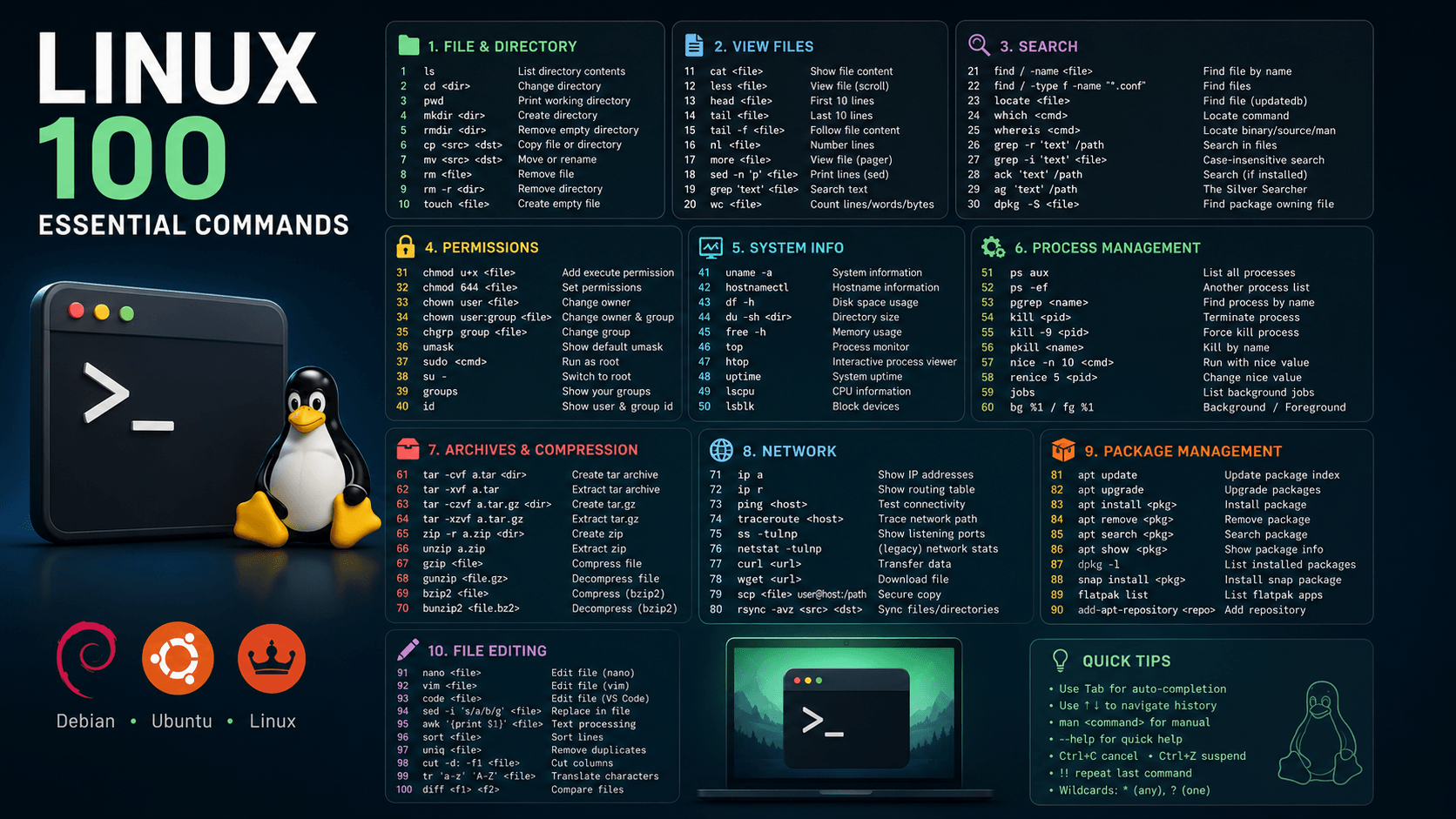
Linux/Debian/Ubuntu 100 Essential Commands
A practical reference of 100 essential Linux commands commonly used by Linux administrators, developers, DevOps engineers, and server operators.
The commands cover:
- File and directory management
- Text processing
- Archives and compression
- Networking
- Process management
- Services and logs
- System information
- Storage and filesystems
- Scheduling and automation
Commands marked with
*may require installing an additional package depending on your Linux distribution.
1. File and Directory Commands
ls
List files and directories.
lsUseful options:
ls -l
ls -a
ls -lh
ls -lah-l— detailed listing-a— include hidden files-h— human-readable file sizes
pwd
Display the current working directory.
pwdExample output:
/home/user/projectscd
Change the current directory.
cd /var/logGo to the home directory:
cd ~Go up one directory:
cd ..Return to the previous directory:
cd -mkdir
Create directories.
mkdir myfolderCreate nested directories:
mkdir -p /opt/apps/myapp/datarmdir
Remove an empty directory.
rmdir oldfolderIt only works when the directory is empty.
touch
Create an empty file or update a file's timestamp.
touch file.txtCreate several files:
touch file1.txt file2.txt file3.txtcp
Copy files or directories.
cp source.txt destination.txtCopy a directory recursively:
cp -r source-directory destination-directoryPreserve file attributes:
cp -a source destinationmv
Move or rename files and directories.
Rename a file:
mv old.txt new.txtMove a file:
mv file.txt /tmp/rm
Remove files or directories.
rm file.txtRemove a directory recursively:
rm -r directoryForce removal:
rm -rf directoryBe extremely careful with
rm -rf, especially when running commands asroot.
cat
Display file contents.
cat file.txtCombine files:
cat file1.txt file2.txtRedirect into another file:
cat file1.txt file2.txt > combined.txtless
View a file interactively.
less /var/log/syslogUseful keys:
Space       Next page
b           Previous page
/word       Search
n           Next match
q           Quit
head
Show the beginning of a file.
head file.txtShow the first 20 lines:
head -n 20 file.txttail
Show the end of a file.
tail file.txtFollow a log file continuously:
tail -f /var/log/syslogShow the last 100 lines:
tail -n 100 file.txt2. Text Editors
nano
Simple terminal text editor.
nano file.txtCommon shortcuts:
Ctrl + O    Save
Ctrl + X    Exit
Ctrl + W    Search
Ctrl + K    Cut line
Ctrl + U    Paste
vim
Powerful modal text editor.
vim file.txtBasic commands:
i           Insert mode
Esc         Command mode
:w          Save
:q          Quit
:wq         Save and quit
:q!         Quit without saving
3. Shell Output and Redirection
echo
Print text or variables.
echo "Hello Linux"Print a variable:
echo "$HOME"Write into a file:
echo "Hello" > file.txtAppend instead:
echo "Another line" >> file.txttee
Write output to both the terminal and a file.
echo "Hello" | tee file.txtAppend:
echo "Another line" | tee -a file.txtUseful when working with sudo:
echo "example" | sudo tee /etc/example.conf4. Finding Files
find
Search files and directories.
Find by name:
find /var -name "*.log"Case-insensitive:
find /var -iname "*.LOG"Find directories:
find / -type d -name "docker"Find files larger than 1 GB:
find / -type f -size +1Glocate *
Search for files using an indexed database.
locate nginx.confOn Debian/Ubuntu, plocate is commonly used:
sudo apt install plocateupdatedb *
Refresh the database used by locate.
sudo updatedbstat
Display detailed file metadata.
stat file.txtShows information such as:
- File size
- Permissions
- Owner
- Group
- Access time
- Modification time
- Inode
file
Determine a file's type.
file archive.tar.gzExample:
archive.tar.gz: gzip compressed data5. Disk Usage and Links
du
Show disk usage.
du -sh /var/logShow sizes of directories:
du -h --max-depth=1 /vardf
Show filesystem usage.
dfHuman-readable:
df -hShow filesystem types:
df -hTln
Create hard or symbolic links.
Hard link:
ln source.txt link.txtSymbolic link:
ln -s /opt/app/app.conf /etc/app.conf6. Permissions and Ownership
chmod
Change permissions.
chmod 644 file.txtMake a script executable:
chmod +x script.shCommon permissions:
755    rwxr-xr-x
644    rw-r--r--
700    rwx------
600    rw-------
chown
Change ownership.
sudo chown user file.txtChange owner and group:
sudo chown user:group file.txtRecursive:
sudo chown -R user:group /opt/myappchgrp
Change group ownership.
sudo chgrp developers file.txt7. Command Discovery and Documentation
which
Show the executable found in PATH.
which nginxExample:
/usr/sbin/nginxman
Read command manual pages.
man lsSearch manuals:
man -k networkQuit with:
q8. Text Processing
grep
Search text.
grep "error" app.logCase-insensitive:
grep -i "error" app.logRecursive:
grep -r "database" /etc/Show line numbers:
grep -n "error" app.logawk
Process structured text.
awk '{print $1}' file.txtExample with /etc/passwd:
awk -F: '{print $1}' /etc/passwdsed
Stream editor used for text transformations.
Replace text:
sed 's/old/new/' file.txtReplace all occurrences:
sed 's/old/new/g' file.txtEdit a file in place:
sed -i 's/old/new/g' file.txtcut
Extract fields or columns.
cut -d: -f1 /etc/passwdExtract characters:
cut -c1-10 file.txtsort
Sort text.
sort file.txtNumeric:
sort -n numbers.txtReverse:
sort -r file.txtuniq
Remove adjacent duplicate lines.
sort file.txt | uniqCount duplicates:
sort file.txt | uniq -ctr
Translate or remove characters.
Convert lowercase to uppercase:
echo "linux" | tr 'a-z' 'A-Z'Remove characters:
echo "a-b-c" | tr -d '-'wc
Count lines, words, and bytes.
wc file.txtLines only:
wc -l file.txtWords:
wc -w file.txtxargs
Convert input into command arguments.
find . -name "*.tmp" -print0 | xargs -0 rmAnother example:
echo "file1 file2 file3" | xargs touchsplit
Split large files.
Split into 100 MB pieces:
split -b 100M large-file.bin part-Split by line count:
split -l 1000 file.txt part-paste
Merge files line by line.
paste file1.txt file2.txtSpecify a delimiter:
paste -d, file1.txt file2.txtdiff
Compare files.
diff file1.txt file2.txtUnified format:
diff -u file1.txt file2.txtCompare directories:
diff -r directory1 directory2patch
Apply changes from a patch file.
patch < changes.patchA patch is commonly generated using:
diff -u old.txt new.txt > changes.patch9. Archives and Compression
tar
Create and extract archives.
Create:
tar -cvf backup.tar directory/Extract:
tar -xvf backup.tarCreate gzip-compressed archive:
tar -czvf backup.tar.gz directory/Extract gzip archive:
tar -xzvf backup.tar.gzgzip
Compress files.
gzip file.txtProduces:
file.txt.gzgunzip
Decompress gzip files.
gunzip file.txt.gzzip *
Create ZIP archives.
zip archive.zip file.txtRecursive:
zip -r archive.zip directory/unzip *
Extract ZIP archives.
unzip archive.zipExtract to a specific directory:
unzip archive.zip -d /tmp/archive10. File Synchronization and Remote Copy
rsync *
Synchronize files efficiently.
rsync -av source/ destination/Remote synchronization:
rsync -av /data/ user@server:/backup/Commonly used form:
rsync -avh --progress source/ destination/scp
Copy files over SSH.
Upload:
scp file.txt user@server:/tmp/Download:
scp user@server:/tmp/file.txt .Copy directories:
scp -r directory user@server:/tmp/ssh
Connect to a remote server.
ssh [email protected]Specify a port:
ssh -p 2222 [email protected]Run a remote command:
ssh user@server "uptime"11. Network Commands
curl
Transfer data using HTTP, HTTPS, and other protocols.
curl https://pocketx.appFollow redirects:
curl -L https://pocketx.appShow response headers:
curl -I https://pocketx.appDownload a file:
curl -O https://example.org/file.tar.gzwget
Download files.
wget https://example.org/file.isoResume an interrupted download:
wget -c https://example.org/file.isoping
Test host connectivity.
ping 8.8.8.8Send four packets:
ping -c 4 8.8.8.8traceroute *
Display network hops to a destination.
traceroute 8.8.8.8mtr *
Combine ping and traceroute.
mtr 8.8.8.8Generate a report:
mtr -rw 8.8.8.8ip
Manage network interfaces, addresses, and routes.
Show addresses:
ip addrShort form:
ip aShow routes:
ip routeShow interfaces:
ip linkss
Inspect sockets.
Show listening sockets:
ss -tulnShow associated processes:
sudo ss -tulpnShow established TCP connections:
ss -tn state establishedethtool *
Inspect network interfaces.
sudo ethtool eth0Can show:
- Link speed
- Duplex mode
- Link status
- Driver capabilities
dig *
Perform DNS queries.
dig pocketx.appQuery an A record:
dig pocketx.app AQuery MX records:
dig pocketx.app MXUse a specific DNS server:
dig @1.1.1.1 pocketx.appnmap *
Scan hosts and ports.
nmap 192.168.1.10Scan specified ports:
nmap -p 22,80,443 192.168.1.10Service detection:
nmap -sV 192.168.1.10Only scan systems and networks you are authorized to test.
tcpdump *
Capture network traffic.
sudo tcpdumpSpecific interface:
sudo tcpdump -i eth0Specific port:
sudo tcpdump -i eth0 port 443Write packets to a file:
sudo tcpdump -i eth0 -w capture.pcap12. Process Management
ps
Display processes.
psCommon administrator usage:
ps auxSearch using grep:
ps aux | grep nginxtop
Interactive process monitor.
topShows:
- CPU usage
- RAM usage
- Load
- Processes
- Uptime
htop *
Enhanced interactive process monitor.
htopOften installed with:
sudo apt install htoppgrep
Find process IDs.
pgrep nginxInclude command names:
pgrep -a nginxpkill
Send a signal to processes matching a name.
pkill nginxForce kill:
pkill -9 nginxUse SIGKILL only when normal termination does not work.
kill
Send signals by PID.
kill 1234Default:
SIGTERMForce kill:
kill -9 1234killall
Send signals to all matching processes.
killall nginxnice
Start a process with adjusted scheduling priority.
nice -n 10 commandNice values normally range from:
-20    Highest priority
19     Lowest priority
Increasing priority with negative values generally requires elevated privileges.
renice
Change the priority of an existing process.
renice 10 -p 1234strace
Trace system calls made by a process.
Run a program:
strace ./applicationAttach to an existing process:
sudo strace -p 1234Useful for diagnosing:
- File access problems
- Permission errors
- Network calls
- Missing files
- Unexpected system calls
jobs
Display shell jobs.
jobsStart something in the background:
sleep 300 &Then:
jobs13. Scheduling Commands
crontab
Manage scheduled cron jobs.
Edit:
crontab -eList:
crontab -lExample:
0 2 * * * /usr/local/bin/backup.shThis runs every day at 02:00.
Cron format:
Minute Hour Day Month Weekday Commandat
Schedule a one-time command.
at 23:00Then enter:
/usr/local/bin/backup.shPress:
Ctrl+Dto finish.
The at package/service may need to be installed first.
14. Services and Logs
systemctl
Manage systemd units and services.
Check status:
systemctl status nginxStart:
sudo systemctl start nginxStop:
sudo systemctl stop nginxRestart:
sudo systemctl restart nginxEnable at boot:
sudo systemctl enable nginxEnable and immediately start:
sudo systemctl enable --now nginxservice
Traditional compatibility command for managing services.
sudo service nginx statusRestart:
sudo service nginx restartOn modern systemd-based distributions, systemctl is generally preferred.
journalctl
Read systemd logs.
journalctlLogs for a service:
journalctl -u nginxFollow logs:
journalctl -u nginx -fLogs from current boot:
journalctl -bRecent errors:
journalctl -p err15. System Information
uname
Display kernel and system information.
unameShow everything:
uname -aKernel version:
uname -rArchitecture:
uname -mhostnamectl
Display hostname information.
hostnamectlSet hostname:
sudo hostnamectl set-hostname server01date
Display current date and time.
dateCustom format:
date "+%Y-%m-%d %H:%M:%S"UTC:
date -uuptime
Show uptime and system load.
uptimeExample:
16:45:01 up 12 days, 3:21, 2 users, load average: 0.15, 0.20, 0.18who
Show logged-in users.
whow
Show logged-in users and their activity.
wIt also displays system load information.
last
Display login history.
lastShow reboot history:
last reboot16. Memory, CPU, and Performance
free
Show memory usage.
freeHuman-readable:
free -hvmstat
Display system performance statistics.
vmstatRefresh every second:
vmstat 1Shows information about:
- Processes
- RAM
- Swap
- I/O
- CPU
iostat *
Display CPU and disk I/O statistics.
iostatExtended disk statistics:
iostat -xz 1On Debian/Ubuntu, it is provided by sysstat:
sudo apt install sysstatdmesg
Read kernel messages.
dmesgHuman-readable timestamps:
dmesg -TSearch for errors:
dmesg -T | grep -i errorKernel restrictions may require:
sudo dmesgwatch
Run a command repeatedly.
watch df -hRun every second:
watch -n 1 free -hHighlight changes:
watch -d ip addrlsof
List open files and the processes using them.
lsofFind what is using port 8080:
sudo lsof -i :8080Find processes using a file:
sudo lsof /var/log/app.log17. Storage and Filesystems
lsblk
List block devices.
lsblkShow filesystem information:
lsblk -fExample:
NAME   FSTYPE MOUNTPOINT
sda
├─sda1 ext4   /
└─sda2 swap   [SWAP]
blkid
Display block device UUIDs and filesystem types.
sudo blkidUseful when configuring:
/etc/fstabfdisk
Manage partition tables.
List disks:
sudo fdisk -lOpen a disk:
sudo fdisk /dev/sdbIncorrect partitioning commands can permanently destroy data.
Although historically associated mainly with MBR partitioning, modern fdisk versions can also work with GPT partition tables.
parted
Partition management utility with GPT support.
sudo parted /dev/sdbDisplay disks:
sudo parted -lmkfs
Create a filesystem.
Create ext4:
sudo mkfs.ext4 /dev/sdb1Create XFS:
sudo mkfs.xfs /dev/sdb1Formatting a partition destroys its existing filesystem and data.
mount
Mount a filesystem.
sudo mount /dev/sdb1 /mnt/dataShow current mounts:
mountFor persistent mounts, configure:
/etc/fstabumount
Unmount a filesystem.
sudo umount /mnt/dataOr:
sudo umount /dev/sdb1Check processes preventing unmount:
sudo lsof /mnt/dataswapon
Enable swap.
Show configured swap:
swapon --showEnable a swap partition:
sudo swapon /dev/sdb2Enable a swap file:
sudo swapon /swapfilelscpu
Display CPU information.
lscpuShows information such as:
- CPU architecture
- Logical CPUs
- Cores
- Threads
- Sockets
- Virtualization support
- CPU model
- Cache information
18. Quick Reference Table
| # | Command | Purpose |
|---|---|---|
| 1 | ls |
List files and directories |
| 2 | pwd |
Show current directory |
| 3 | cd |
Change directory |
| 4 | mkdir |
Create directories |
| 5 | rmdir |
Remove empty directories |
| 6 | touch |
Create files/update timestamps |
| 7 | cp |
Copy files/directories |
| 8 | mv |
Move or rename files |
| 9 | rm |
Remove files/directories |
| 10 | cat |
Display file contents |
| 11 | less |
Page through files |
| 12 | head |
Show beginning of file |
| 13 | tail |
Show end of file |
| 14 | nano |
Simple text editor |
| 15 | vim |
Advanced text editor |
| 16 | echo |
Print text/variables |
| 17 | tee |
Duplicate command output |
| 18 | find |
Search filesystem |
| 19 | locate* |
Indexed file search |
| 20 | updatedb* |
Update locate database |
| 21 | stat |
File metadata |
| 22 | file |
Identify file type |
| 23 | du |
Directory/file disk usage |
| 24 | df |
Filesystem usage |
| 25 | ln |
Create links |
| 26 | chmod |
Change permissions |
| 27 | chown |
Change owner |
| 28 | chgrp |
Change group |
| 29 | which |
Locate executable |
| 30 | man |
Command documentation |
| 31 | grep |
Search text |
| 32 | awk |
Process structured text |
| 33 | sed |
Transform text |
| 34 | cut |
Extract columns |
| 35 | sort |
Sort lines |
| 36 | uniq |
Remove/count duplicates |
| 37 | tr |
Translate characters |
| 38 | wc |
Count lines/words/bytes |
| 39 | xargs |
Build command arguments |
| 40 | split |
Split files |
| 41 | paste |
Merge lines |
| 42 | diff |
Compare files |
| 43 | patch |
Apply patches |
| 44 | tar |
Archive files |
| 45 | gzip |
Compress files |
| 46 | gunzip |
Decompress gzip |
| 47 | zip* |
Create ZIP files |
| 48 | unzip* |
Extract ZIP files |
| 49 | rsync* |
Synchronize files |
| 50 | scp |
Secure remote copy |
| 51 | ssh |
Remote shell |
| 52 | curl |
Transfer data |
| 53 | wget |
Download files |
| 54 | ping |
Test connectivity |
| 55 | traceroute* |
Trace network path |
| 56 | mtr* |
Live route diagnostics |
| 57 | ip |
Network configuration |
| 58 | ss |
Socket information |
| 59 | ethtool* |
NIC configuration |
| 60 | dig* |
DNS queries |
| 61 | nmap* |
Network scanner |
| 62 | tcpdump* |
Packet capture |
| 63 | ps |
List processes |
| 64 | top |
Process monitor |
| 65 | htop* |
Enhanced process monitor |
| 66 | pgrep |
Find process IDs |
| 67 | pkill |
Signal processes by name |
| 68 | kill |
Signal process by PID |
| 69 | killall |
Signal named processes |
| 70 | nice |
Start with priority |
| 71 | renice |
Change process priority |
| 72 | strace |
Trace system calls |
| 73 | jobs |
Show shell jobs |
| 74 | crontab |
Recurring schedules |
| 75 | at |
One-time schedules |
| 76 | systemctl |
Manage systemd |
| 77 | service |
Service compatibility command |
| 78 | journalctl |
Systemd logs |
| 79 | uname |
Kernel/system information |
| 80 | hostnamectl |
Hostname management |
| 81 | date |
Date/time |
| 82 | uptime |
Uptime/load |
| 83 | who |
Logged-in users |
| 84 | w |
Logged-in user activity |
| 85 | last |
Login history |
| 86 | free |
Memory usage |
| 87 | vmstat |
System performance |
| 88 | iostat* |
Disk I/O statistics |
| 89 | dmesg |
Kernel messages |
| 90 | watch |
Repeat commands |
| 91 | lsof |
Open files/processes |
| 92 | lsblk |
Block devices |
| 93 | blkid |
Filesystem UUID/type |
| 94 | fdisk |
Partition editor |
| 95 | parted |
GPT/partition editor |
| 96 | mkfs |
Create filesystem |
| 97 | mount |
Mount filesystem |
| 98 | umount |
Unmount filesystem |
| 99 | swapon |
Enable swap |
| 100 | lscpu |
CPU information |
19. Optional Packages
Some commands may not be installed by default.
For Debian/Ubuntu systems:
sudo apt update
sudo apt install -y \
    plocate \
    zip \
    unzip \
    rsync \
    traceroute \
    mtr-tiny \
    ethtool \
    dnsutils \
    nmap \
    tcpdump \
    htop \
    sysstat \
    lsof \
    parted \
    at \
    strace
Package names differ between Linux distributions.
20. Useful Administrator Command Combinations
Check storage:
df -h
lsblk -f
du -sh /var/*
Check memory:
free -hCheck CPU:
lscpu
top
Check listening ports:
sudo ss -tulpnCheck what is using a port:
sudo lsof -i :8080Check a service:
systemctl status nginxFollow its logs:
journalctl -u nginx -fCheck network configuration:
ip addr
ip route
Test DNS:
dig pocketx.appTest connectivity:
ping -c 4 pocketx.appTrace network problems:
mtr -rw pocketx.appFind large files:
find / -type f -size +1G 2>/dev/nullFind a process:
pgrep -a nginxMonitor a command continuously:
watch -n 2 'df -h'21. Safety Notes
Several Linux commands can modify or permanently destroy system data. Pay particular attention to:
rm -rf
mkfs
fdisk
parted
chmod -R
chown -R
kill -9
Before running destructive storage commands, verify the target device:
lsblkBefore deleting a directory, inspect it:
ls -lah /path/to/directoryWhenever possible, allow a process to terminate normally:
kill PIDbefore resorting to:
kill -9 PIDSummary
These 100 commands provide a strong foundation for everyday Linux administration.
The commands you will likely use most frequently are:
ls        cd        pwd       cp
mv        rm        cat       less
grep      find      tail      chmod
chown     df        du        free
ps        top       ssh       scp
curl      ip        ss        systemctl
journalctl          lsblk     mount
Learning these commands together with Linux permissions, pipes, redirection, systemd, networking, and filesystem concepts covers a large portion of routine Linux server administration.