





The Chokepoint of Modern Technology: ASML and Why China Still Struggles to Make the Most Advanced Chips
Imagine China designs an incredible new processor.
The architecture is ready.
The engineers are ready.
The factories are waiting.
There is only one problem.
One of the machines needed to manufacture the most advanced version of that chip cannot simply be bought.
That machine comes from a Dutch company called ASML.
And that is where the story of modern semiconductor power becomes much more interesting.
Designing a Chip Is Not the Same as Making One
When people hear that China is developing its own processors, a natural question appears:
"If China can design chips, why can't it just manufacture them?"
Because semiconductor manufacturing is a completely different problem.
A processor may contain billions of transistors packed into an area smaller than your hand.
Those structures have to be printed onto silicon with extraordinary precision.
One of the most important tools used to do that is a lithography machine.
Think of it as an unbelievably advanced projector.
Instead of projecting a movie onto a wall, it projects microscopic circuit patterns onto silicon wafers.
And when those circuits become extremely small, ordinary lithography becomes increasingly difficult.
That is where EUV lithography enters the story.
The Machine Nobody Else Can Sell
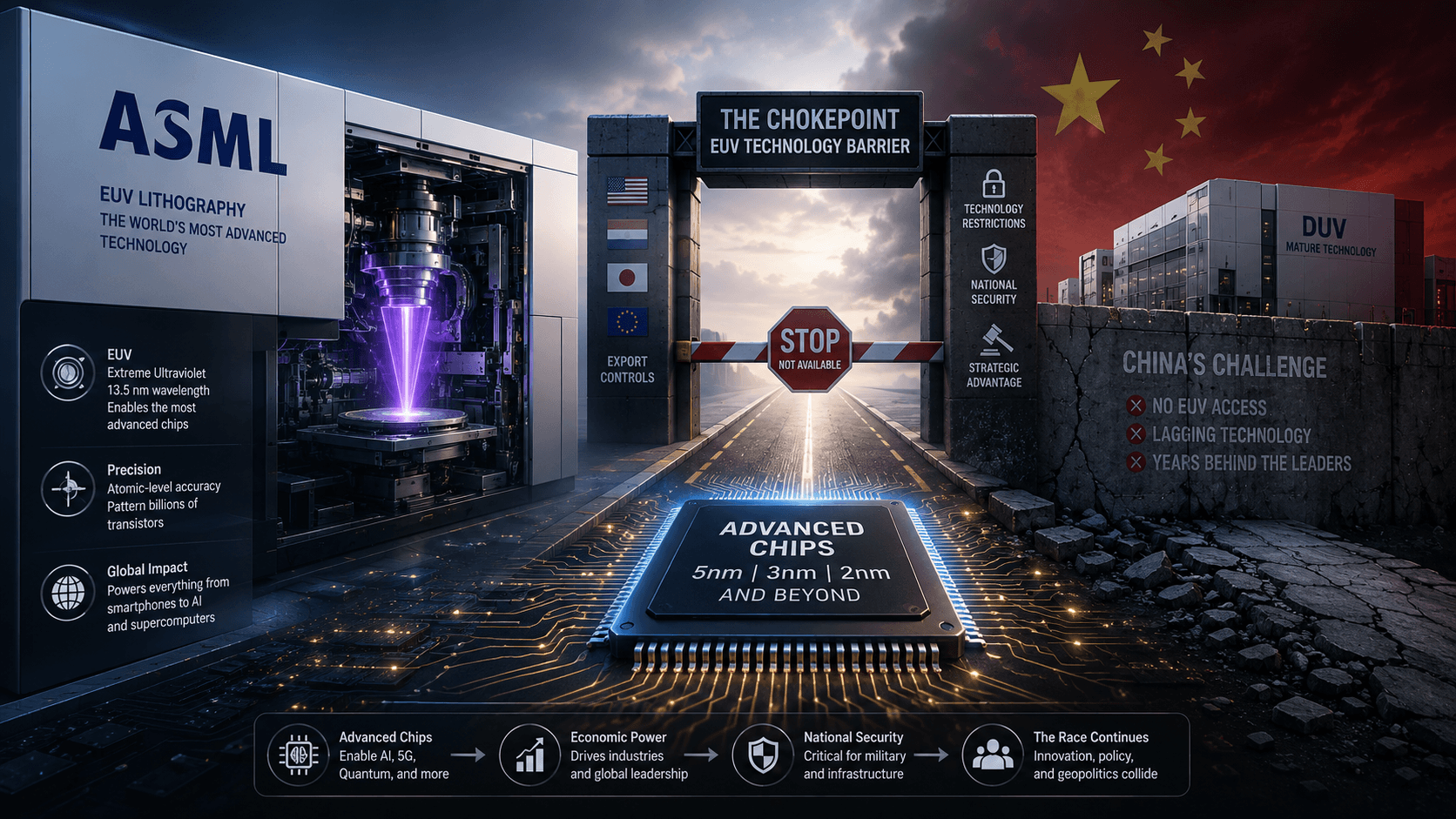
EUV means Extreme Ultraviolet.
It uses light with a wavelength of about 13.5 nanometers.
Producing and controlling that light requires one of the most complicated industrial machines ever created.
ASML remains the only commercial supplier of EUV lithography systems used for advanced semiconductor production. (Reuters)
Inside such a machine, lasers strike microscopic droplets of molten tin.
The resulting plasma produces EUV light.
That light cannot travel through ordinary lenses.
It cannot even travel effectively through normal air.
So the system uses vacuum chambers and extraordinarily precise reflective optics.
Then the wafer itself must be moved with extreme accuracy while this process repeats thousands of times.
It sounds less like a printer and more like science fiction.
Yet this is how some of the world's most advanced processors are manufactured.
Why China Cannot Simply Buy One
For years, China bought huge amounts of semiconductor-manufacturing equipment from foreign companies.
But advanced chipmaking became a national-security issue.
The United States, Netherlands and other countries introduced export controls covering increasingly sophisticated semiconductor technologies.
ASML says it has never shipped an EUV machine to China. ([Reuters][2])
Chinese companies can still obtain some older lithography equipment, but access to the most advanced systems is restricted. Current controls also cover categories of advanced DUV equipment and other semiconductor-manufacturing tools. (ASML)
This creates an extraordinary situation.
China can have:
engineers,
chip designs,
fabs,
billions of dollars,
and enormous demand.
But one missing class of manufacturing equipment can limit how efficiently it produces the most advanced chips.
That is a technological chokepoint.
But China Does Make Advanced Chips
This is where the story needs an important correction.
It would be wrong to say:
"China cannot make chips."
China manufactures enormous quantities of semiconductors.
Its leading foundry, SMIC, can even manufacture 7-nanometer-class logic chips used for CPUs and GPUs. (Reuters)
The real problem is something different.
Without EUV, making very advanced chips becomes considerably harder.
Instead, manufacturers can use older DUV — Deep Ultraviolet — lithography and expose the wafer multiple times.
Imagine you need to draw an extremely fine pattern, but your pen is too thick.
You could carefully draw the pattern in multiple passes.
It can work.
But now you need more steps.
More alignment.
More time.
And every additional step creates another opportunity for something to go wrong.
This technique is known broadly as multi-patterning.
It allows older equipment to reach surprisingly advanced nodes.
But the process becomes more complex and potentially more expensive than using EUV for appropriate layers.
The Problem Is Yield
Suppose you manufacture 100 advanced processors.
If 90 work correctly, your yield is excellent.
If only 40 work, manufacturing becomes enormously expensive.
The challenge is therefore not merely:
"Can we produce this chip?"
The better question is:
"Can we produce millions of them reliably, quickly and economically?"
That is where semiconductor manufacturing becomes brutal.
A prototype proves that something is possible.
High-volume manufacturing proves that it is commercially useful.
ASML's advantage is therefore not simply that its machines can print tiny patterns.
Its equipment has been refined through decades of production experience alongside companies such as TSMC, Samsung and Intel.
Why Doesn't China Just Build Its Own ASML?
It is trying.
And this is perhaps the most important part of the story.
Chinese semiconductor executives have openly called for a national effort to create advanced domestic lithography equipment during the country's 2026–2030 development period. (Reuters)
China has also recently started producing domestically developed immersion DUV lithography machines.
In July 2026, reports said Shanghai Aishengna Electronic Technology Group had begun production of Chinese immersion DUV tools expected to be supplied to manufacturers including SMIC, Hua Hong and CXMT. (Reuters)
That is an important milestone.
But DUV is not EUV.
And building an EUV system requires far more than copying a single machine.
ASML Is Really an Ecosystem
An ASML machine is assembled from technologies developed across an enormous international supply chain.
There are precision optics.
High-power lasers.
Vacuum systems.
Motion-control systems.
Materials.
Sensors.
Software.
Metrology.
Advanced light sources.
ASML depends on companies such as Germany's ZEISS for some of the world's most sophisticated optical systems.
So replacing ASML means reproducing not merely one Dutch company's knowledge.
China would need domestic alternatives across a large portion of the semiconductor-equipment ecosystem.
That is why technological independence can take decades.
The Chokepoint Goes Deeper
Lithography isn't China's only semiconductor challenge.
Making leading-edge processors also depends on:
- electronic design automation software
- deposition equipment
- etching systems
- inspection and metrology
- advanced packaging
- high-bandwidth memory
- specialty chemicals and materials
- manufacturing knowledge
Some of the strongest suppliers of these technologies are located in the United States, Netherlands, Japan, South Korea, Taiwan and Europe.
So there is no single magical machine that determines the entire industry.
But lithography is arguably the most visible chokepoint because EUV currently has essentially one commercial supplier.
And that supplier is ASML.
The Irony of Export Controls
There is an interesting paradox here.
Export controls make it harder for Chinese companies to access advanced foreign technology.
That slows development in the short term.
But it also gives China one of the strongest possible incentives to replace that technology.
For years, buying an ASML machine was easier than spending billions developing a domestic competitor.
Now that access is restricted, the calculation changes.
Domestic lithography becomes a strategic priority.
And progress is already visible in DUV.
China's new domestic tools are not expected to immediately match ASML's performance or production reliability, but their existence shows that the gap is being attacked directly. (Reuters)
The Race Is About Time
So can China eventually build its own EUV machine?
There is no fundamental law of physics saying it cannot.
China has enormous engineering resources, a massive semiconductor market and strong government incentives.
The challenge is time.
ASML has spent decades solving problems that initially appeared nearly impossible.
And while competitors try to reproduce today's technology, ASML continues improving tomorrow's.
Its newer High-NA EUV systems are designed to push semiconductor manufacturing even further.
So the race looks something like this:
ASML today
       ↓
EUV
       ↓
High-NA EUV
       ↓
Future generations

China
       ↓
Domestic DUV
       ↓
Improve reliability
       ↓
Advanced lithography
       ↓
Eventually challenge EUV
China is moving forward.
But the target is also moving.
The Machine Behind Geopolitical Power
During the industrial revolution, strategic power depended on things such as steel, coal, ships and oil.
In the digital age, something much smaller has joined that list:
the transistor.
But transistors cannot simply be ordered into existence.
They require factories.
Those factories require machines.
And some of those machines are incredibly difficult to replace.
That is why a Dutch company most consumers had never heard of became part of the strategic competition between the world's two largest economies.
China's semiconductor problem is not that its engineers don't know how computers work.
It is that modern technology has become so specialized that no major country truly builds everything alone.
One company designs the processor.
Another manufactures it.
Another produces the memory.
Another builds the software.
And somewhere in the Netherlands, ASML builds a machine that can determine whether the next generation of chips can be manufactured efficiently at all.
That is the hidden weakness of the modern technological world.
The semiconductor industry looks enormous.
But at its narrowest points, the entire system can depend on only a handful of companies.
And at perhaps the narrowest point of all sits ASML.
[2]: https://www.reuters.com/world/china/us-tells-asml-it-is-concerned-china-may-have-top-chip-tool-bloomberg-news-2026-06-19/?utm_source=pocketx.app"ASML denies selling EUV chipmaking tool to China after ..."