







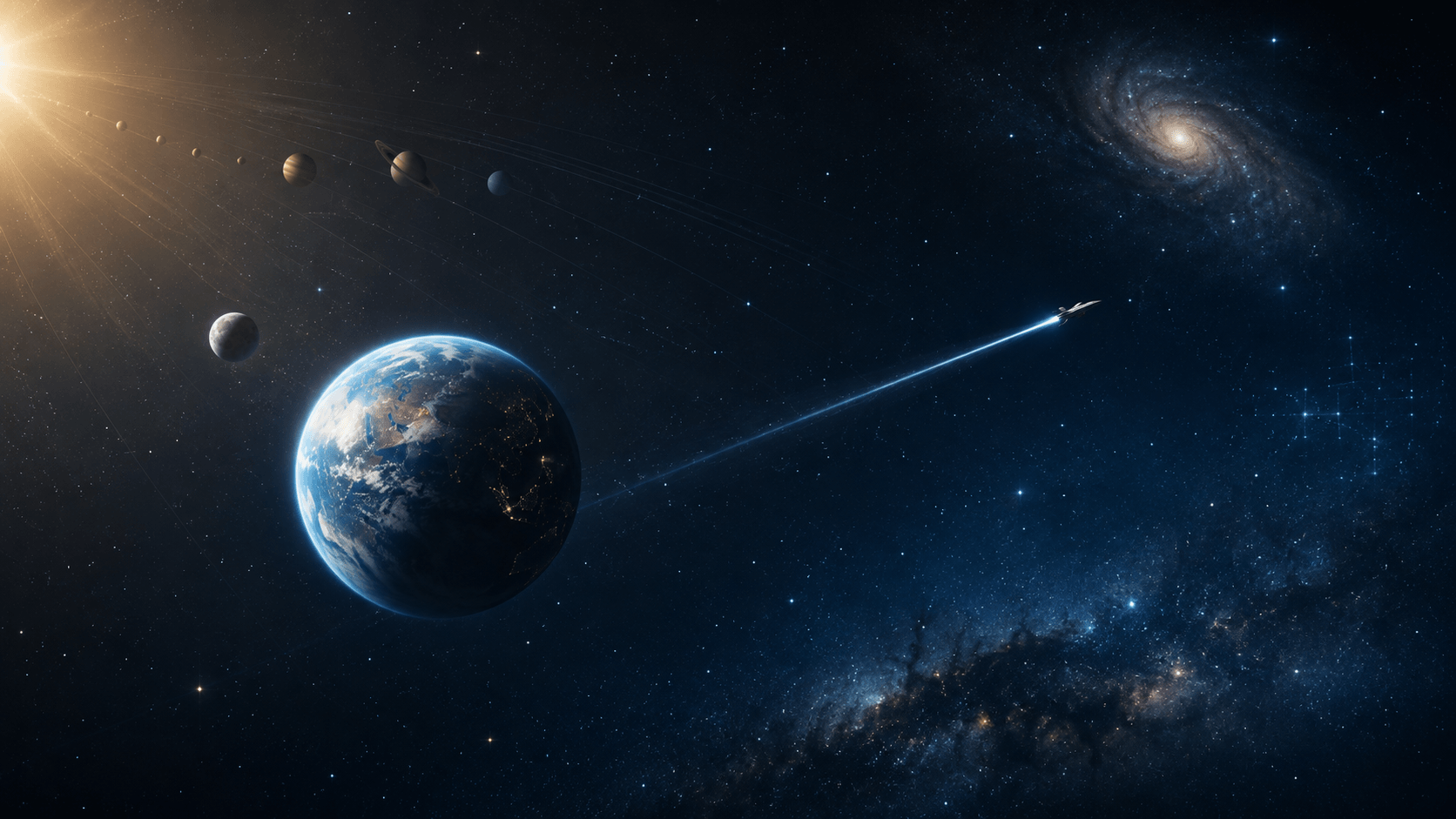
A Pale Blue Miracle: Why Earth Exists, Whether We Are Alone, and If Humanity Can Ever Escape the Solar System
Imagine standing outside on a clear night.
No city lights. No traffic. No glowing screens.
Just darkness.
Above you, thousands of stars appear scattered across the sky. They look peaceful from here—tiny points of white light suspended in silence.
But that peaceful sky is an illusion.
Space is violent.
Stars explode. Galaxies collide. Radiation travels across billions of kilometers. Planets freeze in permanent darkness or burn beneath unbearable heat. Asteroids wander between worlds. Black holes tear matter apart. Entire solar systems can be sterilized by events happening thousands of light-years away.
There is almost no air.
Almost no warmth.
Almost nowhere to stand.
And yet, somewhere inside all of this chaos, there is Earth.
A small rocky world with oceans, forests, rain, oxygen, thunderstorms, bacteria, whales, cities, music, computers—and creatures capable of looking back into the universe and asking:
Why are we here?
Even more unsettling:
Are we the only ones asking?
And if Earth is only a temporary shelter, could humanity someday leave not just our planet, but our solar system—and perhaps even the Milky Way itself?
To understand those questions, we have to travel backward.
Long before Earth existed.
Before There Was Earth
About 13.8 billion years ago, the universe was extraordinarily hot and dense.
As it expanded and cooled, matter began forming.
At first, the universe was chemically simple.
Mostly hydrogen.
Some helium.
Almost nothing else.
There was no oxygen to breathe, no carbon for life, no iron for machines, no silicon for computers.
Those elements had not been made yet.
Then gravity began pulling enormous clouds of hydrogen together.
The first stars were born.
Inside stars, something remarkable happens.
Gravity compresses matter so strongly that atomic nuclei fuse together. Hydrogen becomes helium. Larger stars eventually manufacture heavier elements.
Carbon.
Oxygen.
Silicon.
Sulfur.
Iron.
But many elements cannot easily be produced during the ordinary life of a star.
They require something more violent.
A star must die.
Massive stars eventually collapse and explode as supernovae, throwing newly created elements across space.
The calcium inside your bones, the oxygen in your lungs, the iron carrying oxygen through your blood—all were forged through cosmic processes that occurred long before the Sun existed.
In a very literal sense, the universe had to build the ingredients for humans before humans could appear.
Generation after generation of stars lived and died.
Their remains mixed into enormous interstellar clouds.
And roughly 4.6 billion years ago, one particular cloud of gas and dust began collapsing.
At its center, pressure increased.
Temperature rose.
Nuclear fusion began.
The Sun ignited.
Around it spun a disk of leftover material.
Dust collided with dust.
Rocks collided with rocks.
Small objects became larger objects.
Eventually, planets emerged.
One of them formed approximately 150 million kilometers from the Sun.
Earth.
Why Earth?
At first, Earth was nothing like home.
It was violent, molten and constantly bombarded by debris left over from the formation of the solar system.
Then something extraordinary happened.
Earth stabilized.
It cooled.
A solid crust formed.
Water accumulated.
An atmosphere developed.
Eventually, chemistry became biology.
Exactly how the first life appeared remains one of science's great unanswered questions.
Perhaps organic molecules formed around hydrothermal vents deep beneath ancient oceans.
Perhaps lightning helped create increasingly complicated chemistry in shallow waters.
Perhaps important molecules arrived aboard meteorites and comets.
Whatever the path was, somewhere on early Earth, chemistry crossed a remarkable boundary.
Earth happened to possess an extraordinary combination of conditions.
We orbit at a distance where liquid water can exist.
We have enough gravity to hold an atmosphere.
Our magnetic field helps shield the surface from charged particles from the Sun.
Plate tectonics continuously reshapes the planet and participates in long-term carbon regulation.
Jupiter may influence the trajectories of some comets and asteroids.
Our large Moon stabilizes Earth's rotation to some degree and drives powerful tides.
None of these things alone guarantees life.
But together they created an environment where life survived for billions of years.
That raises an uncomfortable possibility.
Maybe Earth is extraordinarily rare.
Or maybe planets like Earth are everywhere.
We simply do not know yet.
The Universe Doesn't Look Empty
For most of human history, we knew about only a handful of planets.
Mercury.
Venus.
Earth.
Mars.
Jupiter.
Saturn.
Eventually Uranus and Neptune joined the list.
For centuries, asking whether planets existed around other stars was largely philosophical.
Then astronomers started finding them.
Today we know that planets are common.
Stars across the Milky Way host enormous varieties of worlds.
There are planets larger than Jupiter orbiting extremely close to their stars.
Rocky planets.
Frozen planets.
Ocean-world candidates.
Planets orbiting two stars.
Systems containing several planets packed into surprisingly small regions.
If planets are common, Earth may not be astronomically unique.
Consider the numbers.
The Milky Way contains hundreds of billions of stars.
The observable universe contains hundreds of billions, perhaps trillions, of galaxies depending on how galaxies are counted and defined.
Even if intelligent life appeared around only a tiny fraction of suitable stars, there could still be civilizations scattered throughout the cosmos.
Mathematically, loneliness feels almost impossible.
And yet...
The sky remains silent.
Where Is Everybody?
This is the heart of what is known as the Fermi paradox.
The argument is simple.
The galaxy is ancient.
The Milky Way existed billions of years before humans appeared.
If technologically advanced civilizations are common, some of them should have developed millions—or even billions—of years before us.
A civilization capable of traveling between stars would not necessarily need faster-than-light technology.
Imagine robotic probes traveling at only a small fraction of the speed of light.
They arrive at another star.
Build copies of themselves.
Those copies continue toward additional stars.
Given enough time, even relatively slow expansion could spread across huge portions of the galaxy.
Compared with the age of the Milky Way, millions of years is not particularly long.
So if advanced civilizations commonly expand...
Where are they?
No unmistakable spacecraft.
No confirmed alien transmissions.
No visible galaxy-spanning civilization.
Nothing.
At least, nothing we have confidently detected.
Perhaps intelligent life is incredibly rare.
Maybe simple microorganisms are common, but the journey from bacteria to technological civilization almost never happens.
Earth itself gives us an interesting clue.
Life appeared relatively early in our planet's history.
But technological intelligence took billions of years.
For most of Earth's existence, there were no humans.
There weren't even animals.
For billions of years, Earth belonged almost entirely to microorganisms.
Maybe bacteria are common throughout the universe.
Maybe civilizations are not.
Or Perhaps Civilizations Don't Last
There is another darker possibility.
Perhaps many civilizations reach roughly our level of development.
Then something happens.
Nuclear war.
Engineered pandemics.
Ecological collapse.
Uncontrolled technology.
Artificial intelligence.
Asteroid impacts.
Nearby supernovae.
Or dangers we haven't imagined.
This idea is sometimes called the Great Filter.
Somewhere between lifeless chemistry and a civilization capable of colonizing the galaxy, there may be an extremely difficult step.
The frightening question is:
Is that step behind us... or ahead of us?
If the difficult step was the creation of life itself, humanity may have already passed the greatest barrier.
If the difficult step comes after technological civilization emerges, the silence of the universe becomes much more disturbing.
Perhaps the stars are quiet because civilizations tend to destroy themselves before escaping their home worlds.
We cannot know yet.
But there is another explanation.
Maybe civilizations are out there and space is simply much bigger than our intuition can understand.
The Prison Called Distance
Light is extraordinarily fast.
Approximately 300,000 kilometers every second.
At that speed, light could circle Earth more than seven times in one second.
The Moon?
About 1.3 light-seconds away.
The Sun?
Around eight light-minutes away.
Then things become uncomfortable.
The nearest star system, Alpha Centauri, is about 4.37 light-years away.
That means its light requires more than four years to reach us.
Our fastest spacecraft are nowhere close to light speed.
Voyager 1, launched in 1977, is one of humanity's most distant objects.
It has traveled beyond the heliopause into interstellar space.
But at anything like Voyager's speed, reaching another star would take tens of thousands of years.
And Alpha Centauri is practically our next-door neighbor.
The Milky Way is roughly 100,000 light-years across.
Even traveling at the speed of light—something objects with mass cannot do according to our current understanding of physics—crossing the galaxy would take around 100,000 years from Earth's reference frame.
Our galaxy is not a destination.
It is an ocean.
The solar system is one tiny island inside it.
Can Humans Escape the Solar System?
Technically, we already know how to send objects into interstellar space.
Voyager 1 and Voyager 2 are leaving the solar neighborhood.
But sending a human is radically harder.
A spacecraft must provide everything Earth currently gives us for free.
Air.
Water.
Food.
Pressure.
Radiation protection.
Temperature control.
Gravity—or some substitute for its physiological effects.
Medical care.
Energy.
Waste recycling.
And it must provide those things not for months, but potentially for decades or centuries.
Suppose we built a spacecraft traveling at 10% of the speed of light.
That would be astonishingly fast by today's standards.
Alpha Centauri would still require roughly 44 years of travel, ignoring acceleration and deceleration.
A crew leaving Earth might spend most of their lives aboard the ship.
If the spacecraft traveled slower, we might need something even more ambitious.
A generation ship.
Instead of the people who leave Earth reaching another star, their children—or grandchildren—would arrive.
The spacecraft would become a moving civilization.
People would be born aboard it.
Grow up aboard it.
Have families aboard it.
And die aboard it.
For them, Earth would become a place in history books.
The Energy Problem
Speed is expensive.
Not financially.
Physically.
Accelerating even a relatively small spacecraft to a significant fraction of light speed requires enormous amounts of energy.
Then, once the spacecraft reaches its destination, it needs energy to slow down.
Interstellar dust becomes dangerous at high velocity.
A grain of material hitting a spacecraft traveling at a substantial percentage of light speed could release tremendous energy.
Radiation becomes another problem.
So does reliability.
A ship traveling for fifty or one hundred years cannot simply return to Earth when something breaks.
Every critical system would need backups.
The backups would need backups.
The spacecraft would need machine shops, manufacturing facilities, medical systems and perhaps the ability to produce replacement electronics.
An interstellar spacecraft would not merely be a vehicle.
It would be a miniature world.
Could New Technology Change Everything?
Possibly.
Several concepts might someday make interstellar travel more practical.
Nuclear propulsion could outperform conventional chemical rockets enormously.
Fusion propulsion could potentially provide even greater capabilities if controlled fusion becomes practical for spacecraft.
Laser-driven light sails offer another fascinating possibility.
Instead of carrying enormous amounts of fuel, an extremely lightweight spacecraft could be accelerated by powerful lasers fired from the solar system.
Small robotic probes might potentially reach nearby stars much faster than conventional spacecraft.
There are also more exotic ideas.
Antimatter engines.
Interstellar ramjets.
Warp drives.
Wormholes.
The last two appear regularly in science fiction, but currently exist mainly as theoretical ideas derived from unusual solutions to physics equations.
A warp-drive-like system would require extraordinary forms of energy or matter whose practical existence remains uncertain.
Wormholes face similar problems.
Physics has not clearly told us that interstellar civilization is impossible.
But it has certainly not made it easy.
Leaving the Galaxy Is Another Story
Escaping the solar system is difficult.
Escaping the Milky Way is almost absurdly more difficult.
The nearest major galaxy, Andromeda, is about 2.5 million light-years away.
Imagine humanity somehow builds a spacecraft capable of traveling at 10% of light speed.
Ignoring acceleration and other complications, the journey would take roughly:
25 million years.
Homo sapiens has existed for only a few hundred thousand years.
Recorded civilization is only several thousand years old.
Twenty-five million years ago, there were no humans.
Our ancestors looked radically different.
At those timescales, the travelers leaving the Milky Way might not simply become another human civilization.
Evolution itself could transform them into something new.
Of course, relativity changes the experience for travelers approaching the speed of light. Time aboard the spacecraft can pass more slowly relative to observers on Earth.
In principle, passengers traveling extremely close to light speed could experience journeys much shorter than millions of years.
But achieving such speeds for something as massive and complicated as a human spacecraft would require extraordinary amounts of energy.
So perhaps humanity will someday cross the galaxy.
Perhaps even travel between galaxies.
But unless our understanding of physics changes dramatically, those achievements belong to a civilization vastly more technologically capable than ours.
Perhaps Humans Won't Be the Ones Who Leave
There is another possibility.
Humanity may expand into the stars without biological humans doing most of the traveling.
Machines tolerate space far better than we do.
They don't need oxygen.
They don't need food.
They aren't concerned about gravity.
They can potentially survive long periods of inactivity.
An intelligent robotic probe could travel for hundreds or thousands of years.
Arrive at another solar system.
Use local materials.
Build factories.
Create additional probes.
Continue onward.
Our first true interstellar explorers may therefore not have beating hearts.
They may carry computers.
Perhaps artificial intelligence.
Perhaps stored human embryos.
Perhaps digital representations of human minds, assuming such technology ever becomes possible.
Civilization might eventually spread across the galaxy in forms that would seem strange to us today.
Which creates an interesting twist in the search for extraterrestrial life.
We often imagine aliens as biological creatures.
But perhaps the oldest civilizations stopped being biological millions of years ago.
Maybe the things traveling between stars are machines built by species that no longer exist.
So Are We Alone?
We don't know.
And perhaps that is what makes the question so powerful.
There are several possibilities.
Maybe Earth is almost impossibly rare.
Maybe microbial life fills the galaxy, while intelligent life rarely appears.
Maybe civilizations exist, but they are too distant.
Maybe they communicate using technologies we haven't discovered.
Maybe they deliberately remain quiet.
Maybe civilizations tend to disappear.
Or perhaps humanity simply appeared early.
The universe will continue producing stars for unimaginably long periods.
It is possible that most technological civilizations have not appeared yet.
In that case, when humanity looks into the darkness and hears silence, we may not be arriving late to a crowded universe.
We may be among the first guests to enter the room.
The Most Important Planet in the Universe
People sometimes speak about colonizing Mars or finding another Earth as though humanity has backup planets waiting nearby.
We don't.
Mars is extraordinary.
But compared with Earth, it is brutally hostile.
It has a thin atmosphere, intense radiation exposure, freezing temperatures and no breathable air.
Even if humanity eventually builds cities there, those cities will depend on machines simply to keep their inhabitants alive.
Earth, by contrast, does something astonishing every second.
Trees manufacture oxygen.
Oceans regulate climate.
Rain moves freshwater.
Microorganisms recycle nutrients.
Magnetic fields protect the atmosphere.
Countless biological systems maintain the conditions that allow us to exist.
We are surrounded by one of the most complicated life-support systems imaginable.
We call it nature.
Perhaps someday humanity will become an interstellar species.
Perhaps our descendants will watch alien sunsets beneath different stars.
Perhaps cities will exist beneath the skies of worlds whose names haven't been invented yet.
Perhaps human civilization—or whatever evolves from it—will spread throughout the Milky Way.
But for now, every human who has ever lived shares one small spacecraft.
Earth.
It has no engines.
No emergency exit.
And as far as we currently know, no replacement.
One Final Look at the Sky
Go back to that dark field.
Look upward again.
Every star is another sun.
Around many of them are planets.
Some may have oceans.
Some may have atmospheres.
Some may contain chemistry slowly becoming biology.
Some may contain forests beneath unfamiliar constellations.
And perhaps somewhere, at this exact moment, another intelligent creature is standing beneath another sky.
Looking toward our region of the Milky Way.
Wondering exactly what we are wondering.
Is anyone else out there?
Maybe one day, one of us will answer.
Until then, humanity exists on a tiny blue world surrounded by an almost incomprehensibly large darkness.
That may make us insignificant.
Or it may make Earth extraordinarily precious.
Because in all the violent emptiness we have explored so far, there is one place where we know the universe opened its eyes...
and began asking questions about itself.
That place is here.