







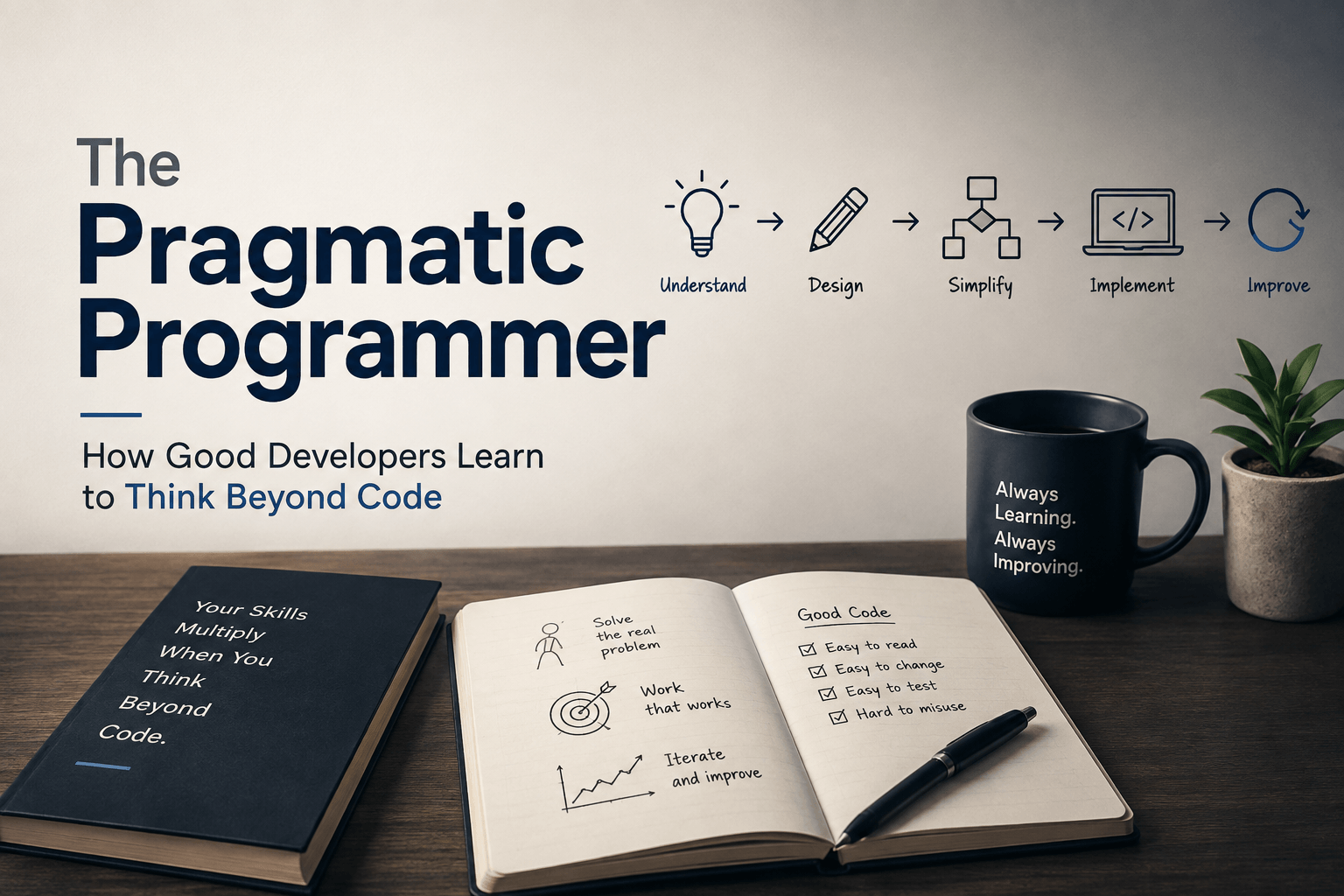
The Pragmatic Programmer: How Good Developers Learn to Think Beyond Code
Imagine two developers joining the same software company on the same Monday morning.
Both are talented.
Both know the programming language.
Both understand databases, APIs, Git, testing, and cloud deployment.
Six months later, something strange has happened.
The first developer has written far more code.
Thousands of lines.
New abstractions.
New services.
New helper classes.
New frameworks.
Yet every change seems dangerous.
Fixing one bug creates another.
Nobody knows which configuration is correct.
Important knowledge exists only inside someone's head.
Deployments are stressful.
The second developer has written less code.
But their systems are easier to understand.
Changes are smaller.
Errors are caught earlier.
Automation handles repetitive work.
Knowledge is documented.
Components have clear responsibilities.
When something breaks, the team usually knows where to look.
Both developers can program.
But only one has learned something deeper:
how to practice programming as a craft.
That is the central idea behind Andrew Hunt and David Thomas's legendary book The Pragmatic Programmer.
It is not really a book about a programming language.
It is not about Java, C++, Python, C#, or JavaScript.
It is about how programmers make decisions.
How they learn.
How they communicate.
How they design systems that can survive change.
And perhaps most importantly:
How they take responsibility for the software they create.
The Programmer as a Craftsperson
Imagine a carpenter.
A good carpenter does not simply know how to operate a saw.
They understand wood.
They maintain their tools.
They measure carefully.
They recognize when a shortcut will create problems later.
They know that the quality of the finished work depends on hundreds of small decisions invisible to the customer.
Programming is similar.
Knowing syntax is only the beginning.
A programmer may know:
classes
loops
interfaces
databases
HTTP
containers
threads
But professional software development requires another layer of knowledge.
When should something become a separate component?
When should duplication be removed?
When should an abstraction be introduced?
When should one be deleted?
When should you automate?
When should you stop designing and start testing?
When should you admit that an approach is failing?
The pragmatic programmer is constantly making these judgments.
The goal is not perfection.
The goal is to make effective decisions under real-world constraints.
Take Responsibility
One of the strongest ideas in the book appears before architecture, algorithms, or design patterns.
Take responsibility for your work.
Imagine production goes down.
A developer says:
"The API failed because the database team changed something."
The database engineer says:
"The deployment team used the wrong configuration."
The deployment team says:
"The developer didn't document the required environment variable."
Everyone may technically be correct.
Yet the customer still cannot use the system.
Pragmatic thinking asks a different question:
What could I have done to reduce the chance of this happening?
Maybe the application could validate its configuration during startup.
Maybe integration tests could detect the database change.
Maybe deployment could be automated.
Maybe monitoring could have alerted the team earlier.
Responsibility does not mean accepting blame for everything.
It means refusing to make excuses your primary engineering strategy.
A professional says:
"This happened. Here is why. Here is what we can change."
That mindset alone can transform a team.
Software Entropy
Leave a building unattended long enough and it deteriorates.
Paint fades.
Metal rusts.
Water enters cracks.
Windows break.
Software behaves strangely similarly.
One temporary workaround appears.
Then another.
Someone copies a function because refactoring feels risky.
A debugging flag remains enabled.
A dependency becomes obsolete.
Nobody removes an unused table.
Tests begin failing occasionally, so the team ignores them.
Eventually the system becomes what developers politely call:
legacy code.
Not because it is old.
Because nobody trusts it.
The Pragmatic Programmer warns against allowing small signs of neglect to become normal.
If a bad piece of code must remain temporarily, clearly mark it.
Create the issue.
Schedule the repair.
Do not let the team psychologically accept decay.
Because once developers believe:
"This codebase is already a mess,"
the next mess becomes easier to justify.
Quality is contagious.
Unfortunately, so is disorder.
Don't Repeat Yourself
One of the most famous principles associated with the book is DRY:
Don't Repeat Yourself.
It is often misunderstood as:
"Never write the same code twice."
The deeper idea is about knowledge duplication.
Imagine an employee's overtime calculation exists in three places:
Payroll service
Attendance service
HR report
All three contain:
Overtime = Hours × Rate × 1.5Then company policy changes.
Overtime becomes:
Hours × Rate × 2Someone updates payroll.
Someone forgets the HR report.
Now the company has two definitions of the same business truth.
That is the real danger.
The same knowledge is represented in multiple places.
A pragmatic system tries to maintain a single authoritative representation.
Perhaps:
OvertimePolicy.Calculate(...)Now when the rule changes, there is one place to change it.
DRY is not primarily about saving typing.
It is about preventing reality from having multiple conflicting definitions inside your software.
But Don't Worship DRY
There is another trap.
Developers discover DRY and begin eliminating every similarity.
Two functions look vaguely alike?
Create a generic abstraction.
Three classes share four lines?
Build an inheritance hierarchy.
Soon the codebase contains something like:
AbstractGenericEntityOperationProcessorFactoryBaseNobody knows what it does.
Sometimes two pieces of code merely look similar today.
They may evolve differently tomorrow.
Good programmers remove duplication of knowledge, not blindly every duplicated character.
Pragmatism means principles serve the software.
The software does not exist to demonstrate how many principles you know.
Orthogonality: Make Things Independent
Imagine a car where adjusting the radio changes the tire pressure.
Nobody would accept that design.
Yet software often behaves exactly like this.
You change invoice formatting...
and authentication stops working.
You modify logging...
and database migrations fail.
You update customer validation...
and inventory calculations change.
The book uses the concept of orthogonality to describe components that are relatively independent.
Ideally:
Change Ashould affect:
Arather than:
A + B + C + D + unknown surprisesConsider an application:
API
 │
 ├── Authentication
 ├── Orders
 ├── Payments
 ├── Notifications
 └── Reporting
If changing the notification provider requires modifying payment calculations, the boundaries are probably wrong.
Good architecture reduces the number of unrelated things that move together.
This is not only cleaner.
It makes systems safer to change.
And enterprise software spends most of its life being changed.
Your Knowledge Portfolio
A programmer's most important technology eventually becomes obsolete.
Maybe you were an expert in:
Visual Basic.
Silverlight.
Web Forms.
Flash.
Objective-C.
AngularJS.
Some technology that once seemed permanent.
Then the industry moved.
The Pragmatic Programmer compares professional knowledge to an investment portfolio.
You cannot invest once and expect it to provide value forever.
You must keep adding.
Learning.
Experimenting.
Diversifying.
A programmer might spend most of the day working in C#.
But perhaps they periodically learn:
A little Rust.
A new database model.
Distributed systems.
Networking.
Security.
Machine learning.
A functional programming language.
Not because every technology will enter production.
Because different technologies teach different ways of thinking.
Learning PostgreSQL may change how you think about data.
Learning Rust may change how you think about ownership.
Learning functional programming may change how you think about state.
Learning distributed systems may teach you to distrust networks.
The value is not merely another line on a résumé.
It expands the number of ways your brain can attack a problem.
Tools Matter
A craftsperson cares about tools.
Programmers should too.
Your editor.
Terminal.
Debugger.
Git.
Shell.
Profiler.
Database tools.
Search utilities.
Automation scripts.
A programmer who understands their tools can move dramatically faster than someone who performs everything manually.
Suppose you repeat the same deployment process every week:
Build

Copy files

Change configuration

Restart service

Check logs

Run health check
Every manual step is an opportunity for error.
A pragmatic programmer eventually asks:
Why am I still doing this myself?
Turn it into:
deployThe exact tooling changes over time.
The principle does not.
If a computer can reliably perform repetitive work, let the computer do it.
Humans are better used making decisions.
Write Code That Can Change
One of the hardest lessons in software engineering is this:
Your requirements are going to change.
Maybe not today.
But they will.
A customer requests another workflow.
A government changes a tax rule.
A payment provider changes its API.
The business expands into another country.
The database grows from one million records to one billion.
A programmer could respond:
"But that wasn't in the original specification."
The universe does not care.
Software exists inside changing organizations.
Therefore, good software should not assume the current world will remain frozen forever.
This does not mean predicting every possible future requirement.
That would create enormous overengineering.
Instead, design so important decisions are reasonably replaceable.
For example:
OrderService
      │
      ▼
PaymentProcessor
rather than:
OrderService
      │
      ▼
500 lines of Stripe-specific logic
The first design acknowledges:
Today we use this payment provider.
Tomorrow we might not.
Reversibility
Some engineering decisions are cheap to reverse.
Others are extremely expensive.
Choosing a variable name?
Cheap.
Changing your entire database architecture after five years?
Expensive.
A pragmatic programmer learns to identify the difference.
When uncertainty is high, avoid unnecessarily locking the system into irreversible choices.
Perhaps wrap an external provider behind an interface.
Perhaps avoid exposing database implementation details everywhere.
Perhaps keep configuration outside compiled code.
You are effectively buying future options.
It is similar to architecture.
Moving a chair later is easy.
Moving a supporting concrete wall is not.
Therefore, think harder before pouring concrete.
Prototypes Are Not Production Systems
Suppose management asks:
"Can this idea work?"
A programmer disappears for three months.
They build authentication.
Logging.
Database migrations.
Monitoring.
Beautiful architecture.
Eventually they return.
"No."
The core idea was impossible.
A prototype could have answered the question in three days.
Prototyping is about learning.
Perhaps you need to discover:
Can this API handle our workload?
Can WebRTC connect through this network?
Can this machine-learning model classify our data?
Can this database perform the required query fast enough?
Build the smallest experiment capable of answering the uncertainty.
Throw away unnecessary details.
But there is a danger.
Someone sees the prototype and says:
"Great! Ship it."
Now your experiment becomes production software.
A prototype and production code have different goals.
The pragmatic programmer knows which one they are building.
And communicates that clearly.
Tracer Bullets
Sometimes you do not know whether the architecture will work.
Instead of building every layer completely, build one thin path through the entire system.
Imagine creating an ERP module.
Instead of finishing the entire database layer first, then all business logic, then the entire API, then the entire UI, create one tiny working feature:
UI
 ↓
API
 ↓
Business Logic
 ↓
Database
Perhaps:
Create CustomerNothing fancy.
But now you know the pieces connect.
Authentication works.
Serialization works.
Database access works.
Deployment works.
Frontend communication works.
You have fired a metaphorical tracer bullet through the architecture.
Then you expand around that working path.
This often reveals architectural problems much earlier than building large isolated layers.
Estimate Without Pretending You Know the Future
A manager asks:
"How long will this take?"
The developer says:
"Three days."
Why three?
No particular reason.
It simply sounds professional.
Then the feature takes three weeks.
Software estimation is difficult because software development often involves discovering unknowns.
Pragmatic developers try to understand what kind of estimate is being requested.
Are we talking:
Hours?
Days?
Weeks?
Months?
What assumptions are involved?
What uncertainties?
A better answer may be:
"If the external API behaves as documented, approximately three to five days. We should know much more after implementing the integration prototype."
That is not weakness.
That is useful information.
An estimate should communicate uncertainty rather than hide it.
Debugging Without Panic
At 2:13 AM production crashes.
Logs are filling with errors.
Users are complaining.
Someone says:
"It has to be the database."
Someone else starts restarting servers.
Another developer changes random configuration values.
This is how outages become disasters.
Debugging should be systematic.
First:
Reproduce the problem if possible.
Then:
Gather evidence.
Logs.
Inputs.
Stack traces.
Metrics.
Recent changes.
Then ask:
What do we know?
What do we merely suspect?
The book repeatedly encourages programmers to avoid assumptions.
If something "cannot possibly happen," prove it.
Because computers have an unfortunate habit of demonstrating that your impossible assumptions are entirely possible.
Fix the cause.
Not merely the symptom.
Test Early
Imagine building a bridge.
You finish the entire structure.
Cars begin crossing.
Only then do you test whether the foundation is strong enough.
Software teams sometimes work like this.
Months of development.
Then:
"Now QA can test it."
Testing should instead be part of development.
When code is easy to test, that often tells us something positive about the design.
Dependencies are clearer.
Responsibilities are smaller.
Inputs and outputs are understandable.
Testing is not merely about catching bugs.
It provides feedback about architecture.
If testing a tiny business rule requires:
database
Redis
message broker
HTTP server
cloud storage
perhaps the rule is too tightly coupled to infrastructure.
Testability frequently reveals design quality.
Automation Is Memory
Humans forget.
Computers repeat.
Imagine a deployment requires fifteen steps.
A senior engineer knows all fifteen.
Then that engineer takes leave.
Nobody can deploy.
You don't have a deployment process.
You have tribal knowledge.
Automation turns memory into executable documentation.
Instead of:
"Remember to run migration before restarting service B, except in staging where you first update configuration C..."
you create a process the machine executes consistently.
Build
Test
Migrate
Deploy
Health check
Rollback if necessary
The computer does not get tired.
It does not skip step seven because it is Friday evening.
Automation is not just convenience.
It is reliability.
Requirements Are Not Found; They Are Discovered
A customer says:
"We need an attendance report."
A programmer might hear:
SELECT ...
FROM Attendance
But what does "attendance" mean?
Late arrivals?
Overtime?
Night shifts?
Missing checkout?
Approved leave?
Employees crossing midnight?
Different weekends?
Different time zones?
A specification rarely contains the entire truth.
Often the truth emerges through conversation.
Show something early.
Ask questions.
Create examples.
Let users react.
Software development is often less like constructing something from a perfect blueprint and more like exploring territory while drawing the map.
Pragmatic programmers expect this.
They build feedback into the process.
Good Names Matter
There is a reason naming feels difficult.
A name reveals how well you understand something.
Suppose you create:
ProcessData()What data?
What process?
Now compare:
CalculateInvoiceTax()Much clearer.
Names are part of design.
They create the vocabulary developers use to think about the system.
If your domain contains:
SalesOrder
PurchaseInvoice
ProductionOrder
StockMovement
those concepts become part of the language shared between developers and business experts.
Good names reduce explanation.
Bad names create permanent confusion.
Code is read far more often than it is written.
Therefore, readability is not cosmetic.
It is productivity.
Comments Cannot Save Bad Code
Developers sometimes create confusing logic and then write a paragraph explaining it.
// This code checks X because Y except when Z...Sometimes comments are necessary.
But often a better question is:
Could the code explain itself?
Instead of:
if (x > 0 && y == 2 && !z)perhaps:
if (customerCanPlaceOrder)Comments should explain things such as:
Why a strange workaround exists.
Why an apparently simpler solution is unsafe.
Why a particular algorithm was chosen.
The code can usually explain what.
Comments are most valuable when they explain why.
Don't Program by Coincidence
This is one of the book's most memorable ideas.
Imagine changing a line of code.
You don't fully understand why.
The bug disappears.
Great.
You commit it.
Three months later, the bug returns in another form.
Why?
Because you never understood why the original fix worked.
Programming by coincidence means software works because several accidental conditions happen to align.
Maybe execution order happens to be correct.
Maybe a hidden default happens to match.
Maybe an object happens to remain alive long enough.
Maybe a network request usually finishes before another.
Pragmatic programming demands understanding.
Do not settle for:
"It works."
Ask:
Why does it work?
Only then can you know under which conditions it might stop working.
The Power of Small Pieces
Large functions are difficult to reason about.
Large classes.
Large services.
Large teams.
Large deployments.
Large changes.
All increase cognitive load.
Pragmatic software tends to favor smaller, understandable units.
Not because small is automatically beautiful.
But because small things are easier to test.
Replace.
Understand.
Combine.
Debug.
A thousand-line function forces you to understand a thousand lines simultaneously.
Ten well-designed functions allow you to reason about one idea at a time.
This principle scales surprisingly far.
Functions.
Classes.
Modules.
Services.
Teams.
Even entire systems.
Complexity rarely disappears.
Good design puts boundaries around it.
Then AI Started Writing Code
The Pragmatic Programmer was conceived long before today's generative AI tools.
Yet its lessons may be becoming more important, not less.
Today, an AI system can generate:
Controllers.
SQL.
Tests.
Docker files.
React components.
Algorithms.
Entire services.
Code production is becoming cheaper.
But software engineering was never primarily limited by typing speed.
The difficult questions remain:
What should we build?
Where should this responsibility live?
Which requirement is actually important?
Does this generated code understand our business rule?
What security assumptions does it make?
Can we maintain it?
How do we test it?
Should we depend on this library?
What happens when requirements change?
AI may write twenty functions in seconds.
A pragmatic programmer still decides whether those twenty functions should exist.
As code becomes easier to generate, judgment becomes more valuable.
The Pragmatic Programmer Is Never Finished
Imagine our two developers again.
Years pass.
Technology changes.
One memorizes whatever framework is currently fashionable.
The other keeps learning how systems behave.
They learn new languages.
New tools.
New architectures.
They question assumptions.
They automate repetitive work.
They experiment.
They read.
They teach.
They occasionally discover that something they believed five years ago was wrong.
And they change their mind.
This is perhaps the most important lesson in the entire philosophy.
Being pragmatic does not mean finding the perfect set of rules.
It means refusing to become intellectually frozen.
There is no final architecture.
No final programming language.
No final framework.
No final best practice.
Software changes because the world around it changes.
The programmer must change too.
More Than Writing Code
At first, programming feels like learning commands.
if
for
while
class
return
Then it becomes learning frameworks.
Then architecture.
Databases.
Distributed systems.
Infrastructure.
Eventually something changes.
You realize the hardest problems are rarely syntax problems.
They are problems of:
Communication.
Uncertainty.
Complexity.
Tradeoffs.
Responsibility.
Change.
The best programmer on a team is not necessarily the person who produces the most code.
Sometimes it is the person who removes unnecessary code.
Who notices duplication before it spreads.
Who writes the automation that prevents twenty future mistakes.
Who asks the uncomfortable question before six months of development begins.
Who turns an undocumented process into something repeatable.
Who leaves the system easier to understand than they found it.
That is what The Pragmatic Programmer is ultimately trying to teach.
Not how to become someone who can make computers obey.
But how to become a professional who can repeatedly turn messy, changing, uncertain human problems into software that survives the real world.
Frameworks will change.
Languages will change.
Databases will change.
AI will change how code is produced.
But the programmer who learns to think pragmatically will continue adapting.
Because their greatest tool was never the IDE.
It was never the programming language.
It was never the framework.
It was judgment.