






From True and False to the Modern Computer: The Tale of Boolean Algebra
Modern computers can render entire virtual worlds, simulate galaxies, generate music, recognize faces, and connect billions of people across the planet.
Yet beneath all of that complexity lies an almost absurdly simple idea:
True or false.
1 or 0.
That idea began long before computers existed.
And it began with a mathematician named George Boole.
A Strange Kind of Mathematics
In the middle of the 19th century, mathematics was mostly about numbers.
Addition.
Multiplication.
Geometry.
Calculus.
But George Boole was interested in something different.
He wanted to describe logic itself using mathematics.
Instead of asking:
2 + 3 = ?
Boole wanted mathematics to answer questions like:
Is this statement true?
Are both conditions true?
Is at least one of them true?
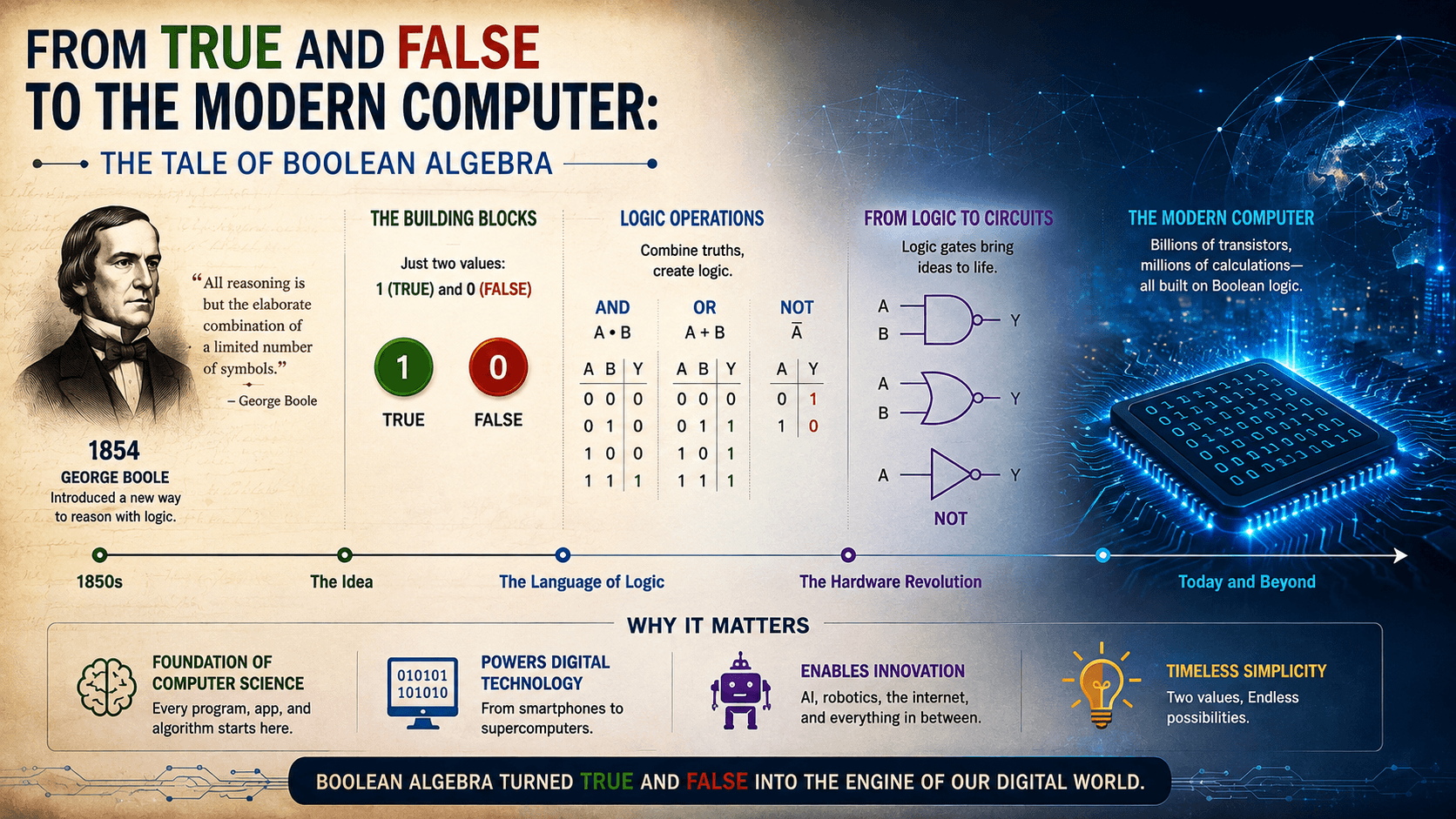
In 1854, he published The Laws of Thought, introducing a mathematical system built around logical values.
Today we call it Boolean algebra.
Its world was surprisingly small.
There were essentially two states:
TRUE
FALSE
Or mathematically:
1
0
And Boole introduced operations that could combine them.
The most famous became:
AND
OR
NOT
For example:
TRUE AND TRUE = TRUE
TRUE AND FALSE = FALSE
Or:
1 AND 1 = 1
1 AND 0 = 0
At the time, this was abstract mathematics.
Boole had no laptop.
No transistor.
No microprocessor.
He died in 1864, almost a century before modern digital computers appeared.
He could hardly have imagined what his algebra would become.
Electricity Meets Logic
Jump forward several decades.
Electrical engineers were building telephone networks.
Inside switching stations were enormous collections of electromechanical relays.
A relay was basically an electrically controlled switch.
It could be:
ONor
OFFTwo states.
That should sound familiar.
In the 1930s, a young MIT student named Claude Shannon noticed something remarkable.
Electrical switches behaved almost exactly like Boolean algebra.
Consider two switches connected in series:
Switch A ---- Switch B ---- LampThe lamp turns on only when both switches are closed.
That is:
A AND BNow connect them in parallel:
       -- Switch A --
Power                 Lamp
       -- Switch B --
The lamp turns on if either switch is closed.
That is:
A OR BA switch that reverses a condition behaves like:
NOTSuddenly, Boole's abstract mathematics had become something physical.
Logic could be built from electricity.
The Birth of Logic Gates
Engineers began designing circuits specifically to perform Boolean operations.
These became known as logic gates.
An AND gate answers:
Are both inputs 1?An OR gate asks:
Is at least one input 1?A NOT gate simply flips the answer:
1 → 0
0 → 1
With combinations of these simple gates, engineers discovered they could perform much more complicated operations.
They could compare numbers.
Store information.
Make decisions.
And even perform arithmetic.
For example, circuits made from logic gates can add two binary digits.
Combine enough of those circuits and you can add large numbers.
Build more logic around them and you get something resembling a calculator.
Add memory and control circuitry...
and something much more powerful begins to appear.
A computer.
From Relays to Vacuum Tubes
The earliest computers used technologies far larger than modern electronics.
Some machines used mechanical switches.
Others used relays.
Then came vacuum tubes.
Vacuum tubes could act as electronic switches.
Unlike mechanical relays, they had no moving parts and could switch much faster.
Machines such as ENIAC contained thousands of them.
But vacuum tubes had serious problems.
They were huge.
They consumed enormous amounts of electricity.
They produced tremendous heat.
And they failed frequently.
Computers filled entire rooms.
Yet internally, their world was still mostly the same.
ON
OFF
1
0Boolean logic was quietly controlling everything.
Then Came the Transistor
In 1947, researchers at Bell Labs demonstrated the transistor.
It changed computing forever.
A transistor could act like an extremely small electronic switch.
Compared with vacuum tubes, transistors were smaller, faster, more reliable, and more energy-efficient.
Engineers began replacing vacuum tubes with transistors.
Computers became smaller.
Then smaller again.
Soon, engineers discovered how to manufacture many transistors together on a single piece of semiconductor material.
The integrated circuit was born.
Instead of wiring individual transistors manually, thousands could now exist on one chip.
Then millions.
Then billions.
Today, a modern processor can contain tens of billions of transistors.
But each transistor still participates in the same ancient game.
On.
Off.
True.
False.
How 1 and 0 Become Everything
This is where computers begin to feel almost magical.
How do billions of switches become photographs, videos, games, websites, and artificial intelligence?
Through layers of abstraction.
Start with transistors.
Transistors form logic gates.
Transistors
↓
Logic gatesLogic gates form circuits.
AND
OR
NOT
XOR
↓
Adders
Comparators
RegistersThose circuits form processor components.
Arithmetic Logic Unit
Registers
Control Unit
CacheThose components form a CPU.
And the CPU executes instructions.
An instruction might effectively say:
ADD these numbers
MOVE this data
COMPARE these values
JUMP somewhere elseThousands or millions of such instructions become programs.
Those programs become:
Operating systems
Browsers
Databases
Games
Apps
AI systemsWhat looks like enormous complexity at the top is built from extremely simple decisions at the bottom.
Even Your Photos Are Boolean
Open a photograph on your computer.
To you, it contains colors, shadows, faces, and memories.
To the computer, it is ultimately numbers.
Those numbers are stored in binary.
For example:
01010110
11001001
00110101Music works the same way.
A microphone converts sound waves into numerical samples.
Those numbers become binary.
Text also becomes numbers.
The letter:
Acan be represented numerically and eventually stored as bits.
Video?
Millions of pixels and audio samples represented using binary data.
Every document.
Every website.
Every database record.
Every video game world.
Eventually it all descends into:
1
0And those bits are manipulated using Boolean logic.
An if Statement Is Boole's Descendant
Consider one of the most common ideas in programming:
if (user.IsLoggedIn && user.IsAdmin)
{
ShowAdminPanel();
}The computer must answer:
IsLoggedIn?
AND
IsAdmin?The exact same logical idea George Boole described more than 170 years ago is being used inside modern software.
Developers write:
&&
||
!Hardware engineers build:
AND
OR
NOTDifferent layers.
Same logic.
From Boole to Billions of Transistors
George Boole probably never imagined smartphones.
Claude Shannon could see that logic and electrical circuits were connected, but even he lived before today's semiconductor world reached its extraordinary scale.
Now consider what happens when you tap an icon on your phone.
Millions of instructions execute.
Processors move data through billions of transistors.
Memory cells change state.
Network packets travel across the internet.
Servers respond.
Graphics processors calculate millions of pixels.
And somewhere beneath every layer...
Boolean logic is still working.
TRUE
FALSE
YES
NO
1
0Human civilization built one of the most complicated machines ever created by repeatedly combining one of the simplest possible questions:
Is it true, or is it false?
That is the strange beauty of computing.
The modern digital world did not begin with the microchip.
It began with an attempt to turn human reasoning into mathematics.
George Boole gave us the algebra.
Claude Shannon connected it to switches.
Engineers turned those switches into transistors.
Transistors became chips.
Chips became computers.
And computers became the foundation of modern civilization.
All from two tiny symbols:
0
1