






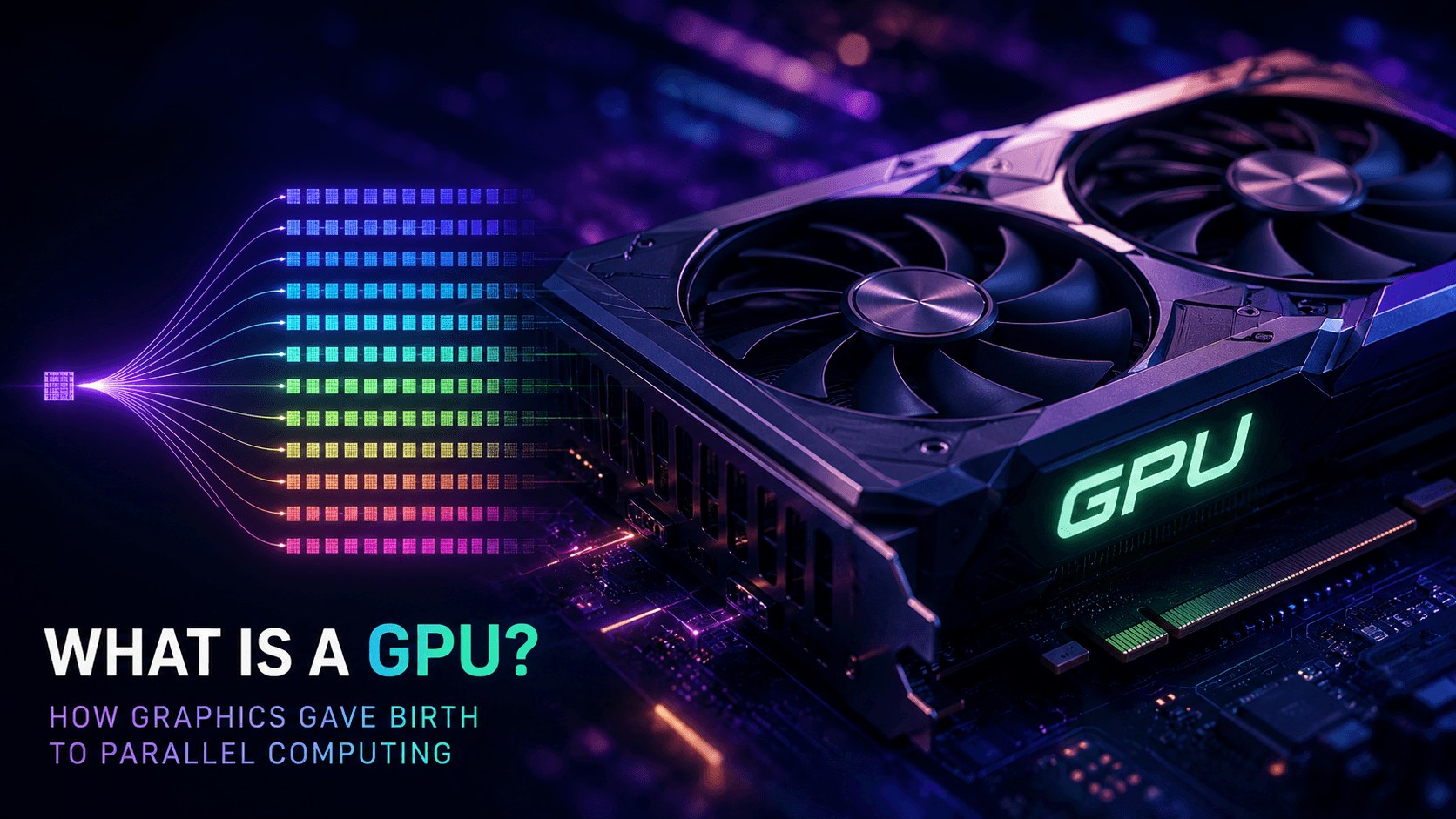
What Is a GPU? How Graphics Gave Birth to Parallel Computing
Imagine a computer in the 1990s trying to draw a 3D game.
The CPU had to calculate game logic, physics, sound, input, and thousands of tiny graphical operations needed to put every frame on the screen.
It could do the work.
But there was a problem.
Drawing graphics requires doing the same kind of calculation again and again, often millions of times.
CPUs were built to be excellent general-purpose thinkers.
Graphics needed something different.
It needed an army.
That army became the GPU.
CPU vs GPU: A Few Experts vs Thousands of Workers
A CPU, or Central Processing Unit, is designed to handle many different types of tasks.
It might:
- run your operating system
- execute application logic
- manage files
- process network traffic
- calculate business rules
- control other hardware
Modern CPUs usually contain a relatively small number of powerful cores.
Think of a CPU as a small team of highly skilled engineers.
Each engineer can solve complicated problems and quickly switch between different jobs.
A GPU works differently.
Instead of having only a few extremely powerful workers, it contains a huge number of smaller computational units designed to perform many similar operations at the same time.
Imagine needing to paint one million pixels.
A CPU might tell a few workers:
"Paint these pixels one after another."
A GPU says:
"Everyone take a pixel."
That difference is the heart of parallel computing.
Why Graphics Needed Parallel Processing
A screen is simply a grid of pixels.
A 1920×1080 display contains more than two million pixels.
At 60 frames per second, the computer may need to produce information for more than 120 million pixel positions every second.
And modern graphics are much more complicated than simply choosing a color.
For every object in a 3D scene, the computer may need to calculate:
- position
- perspective
- lighting
- shadows
- textures
- reflections
- transparency
- color
Many of these calculations are independent.
The color of one pixel can often be calculated without waiting for the neighboring pixel.
That made graphics the perfect parallel workload.
Instead of making one processor dramatically faster, engineers could create many smaller processing units and let them work simultaneously.
The GPU was born from that idea.
The Graphics Pipeline
Suppose you are playing a racing game.
Your computer doesn't store every frame as a completed picture.
Instead, it stores a mathematical description of the world.
There is a road.
A car.
Buildings.
Lights.
Trees.
The GPU must transform this 3D world into the 2D image appearing on your monitor.
The journey happens through something called the graphics pipeline.
First, the GPU processes the vertices that describe the shapes of objects.
A triangle might have three vertices.
A complex game character might contain thousands or millions.
The GPU transforms those vertices based on the camera's position.
Then the triangles are converted into screen regions through a process called rasterization.
Finally, programs called shaders calculate what individual pixels should look like.
A shader might ask:
How bright should this surface be?
What texture belongs here?
Is this point inside a shadow?
What color should this pixel become?
Thousands of these calculations can happen at once.
That is where the GPU becomes extraordinarily powerful.
One Instruction, Lots of Data
Much of GPU computing follows a simple idea:
Perform similar operations on lots of data simultaneously.
Suppose we have one million numbers and want to multiply every number by two.
A CPU could loop through them:
number 1 × 2
number 2 × 2
number 3 × 2
...
number 1,000,000 × 2
A GPU can divide those numbers among thousands of execution units.
Instead of one long queue, the workload becomes many small queues running together.
This concept is often associated with SIMD and closely related GPU execution models.
The important idea is simple:
Apply the same operation to many pieces of data at the same time.
Graphics happened to require exactly this kind of computation.
But programmers soon noticed something interesting.
Nothing said those numbers had to represent pixels.
The Moment GPUs Escaped Graphics
Researchers began asking:
What if we use the GPU for normal mathematics?
Instead of calculating the color of pixels, perhaps the GPU could calculate:
- scientific simulations
- financial models
- physics
- image processing
- cryptography
- molecular interactions
- machine learning
Early attempts were awkward.
Developers sometimes had to disguise mathematical problems as graphics workloads just to make GPUs process them.
Then GPU manufacturers began exposing more general programming interfaces.
NVIDIA introduced CUDA, while technologies such as OpenCL also allowed developers to write programs specifically for parallel processors.
The GPU had transformed.
It was no longer only a Graphics Processing Unit.
It had become a general-purpose parallel computing machine.
This became known as GPGPU:
General-Purpose computing on Graphics Processing Units.
Why AI Loves GPUs
Years later, another workload appeared that was almost perfectly matched to GPU architecture.
Artificial intelligence.
Modern neural networks perform enormous numbers of matrix and vector calculations.
Consider a simplified neural network operation:
output = weights × inputsNow imagine millions or billions of those operations.
They are highly parallel.
A CPU can certainly perform them.
But GPUs can divide many of those calculations across thousands of execution units.
Training that might take weeks on CPUs could sometimes be reduced dramatically using GPUs.
This helped fuel the modern deep-learning revolution.
GPUs became essential hardware for:
- large language models
- image generation
- speech recognition
- computer vision
- recommendation systems
- scientific AI
The same architecture originally designed to draw video-game triangles was now helping train machines to understand language.
Parallel Computing Is Not Always Faster
There is an important catch.
Not every problem can be parallelized.
Imagine a recipe:
- Boil water.
- Add pasta.
- Wait until cooked.
- Drain the pasta.
Step four cannot happen before step three.
Some workloads contain many dependencies like this.
They are sequential.
GPUs are strongest when thousands of tasks can run independently.
CPUs remain better for complex branching, operating-system work, general application logic, and workloads where one calculation depends heavily on the previous one.
This is why modern computers usually contain both.
The CPU acts like the coordinator.
The GPU acts like the massive workforce.
Thousands of Threads
GPU programs typically divide work into huge numbers of small execution units often called threads.
Suppose you are processing a photograph containing eight million pixels.
Instead of writing:
for every pixel:
    adjust brightness
a GPU program can conceptually launch millions of threads.
Each thread handles a tiny portion of the image.
One handles pixel 1.
Another handles pixel 2.
Another handles pixel 3.
And so on.
The GPU hardware schedules these threads across its available processing resources.
This is why GPUs can perform enormous amounts of work even though each individual execution unit may be simpler than a CPU core.
The power comes from numbers.
From Games to Supercomputers
The evolution is almost poetic.
We wanted better computer graphics.
Better graphics required processing many pixels simultaneously.
That required processors designed for massive parallelism.
Programmers realized that parallel processors could solve problems far beyond graphics.
Scientists began using them.
Engineers began using them.
Cryptocurrency miners used them.
AI researchers used them.
Eventually, entire supercomputers were built around GPU acceleration.
A technology created to make virtual worlds look more realistic became one of the foundations of modern scientific computing.
The Bigger Lesson
The GPU didn't replace the CPU.
It changed the way we think about computing.
For decades, faster computers often meant making individual processors execute instructions faster.
GPUs demonstrated another approach:
Instead of making one worker faster, add thousands of workers and divide the problem.
That idea now appears everywhere.
Modern computing increasingly combines specialized processors:
CPU for control.
GPU for massive parallelism.
NPU for AI workloads.
ASICs for specialized tasks.
And the GPU sits at the center of this transformation.
It started with a simple question:
"How can we draw millions of pixels quickly?"
The answer turned out to be much bigger than graphics.
Don't calculate everything one after another.
Calculate as much as possible at the same time.
That is the idea that carried the GPU from video games into supercomputers—and helped give birth to the modern era of parallel computing.