




From Dedicated Lines to Data Packets: How Modern Communication Really Works
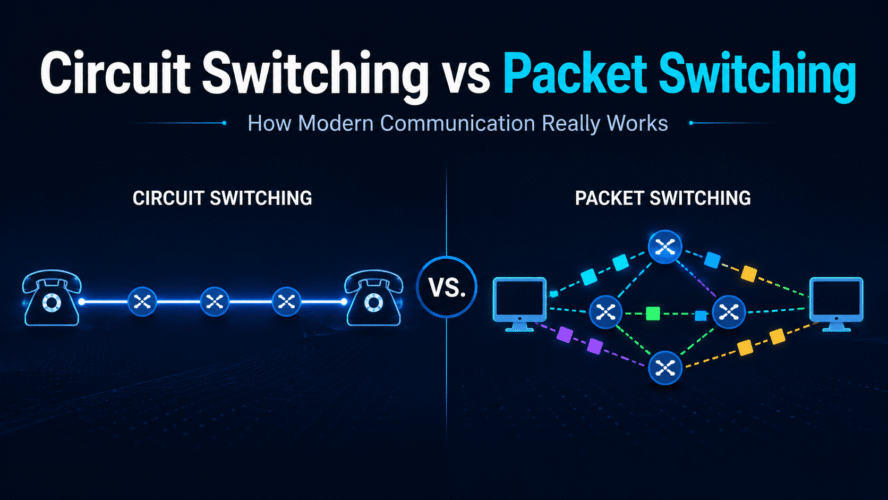
Circuit Switching vs Packet Switching
Imagine making a phone call in 1975.
You pick up the receiver, dial a number, and somewhere inside the telephone network a path is created between you and the person on the other end.
For the duration of that call, a dedicated communication route is reserved for you.
Now imagine sending a message over the internet today.
Your message is broken into small pieces, those pieces may travel through different paths across the network, and the destination puts them back together.
These are two very different ways of moving information:
Circuit Switchingand:
Packet SwitchingOne built the traditional telephone world.
The other became the foundation of the internet.
And modern communication infrastructure still carries ideas from both.
Start With a Simple Road Analogy
Imagine two cities.
You want to send traffic between them.
A circuit-switched network says:
Build a dedicated road for this one conversation and keep it reserved until the conversation ends.
A packet-switched network says:
Break the traffic into many vehicles and let each one use whatever road is available.
That difference sounds small.
It changes almost everything.
Circuit Switching: Reserve the Path First
Traditional telephone networks were built around circuit switching.
When you made a call:
Caller
   ↓
Telephone Exchange
   ↓
Intermediate Exchanges
   ↓
Receiver
the network established a dedicated path.
Conceptually:
You ======================= Other PersonThat path remained reserved until somebody hung up.
Even if both people were silent for ten seconds, the capacity was still allocated to the call.
The network had effectively promised:
This communication path belongs to you until the call ends.
Why Was That Useful?
Voice calls have one very important requirement:
ConsistencyHumans notice delays, interruptions, and uneven audio very quickly.
A dedicated circuit provides predictable resources.
Once the path is established:
Bandwidth reserved
Latency relatively predictable
Order preserved
That made circuit switching a natural fit for traditional telephone systems.
Think of It Like Booking a Private Train
Suppose you want to travel from Dhaka to Chattogram.
Circuit switching is like reserving an entire train just for yourself.
The train:
Waits for you
Travels your route
Cannot be used by anyone else
Very predictable.
Also wasteful if you are the only passenger.
That is roughly the problem with circuit switching.
The Silent Phone Call Problem
Imagine two people talking.
One says:
Hello.
Then both are silent for five seconds.
The circuit is still reserved.
No one else can use that capacity during the silence.
Multiply that by millions of telephone calls and you begin to see the problem.
Communication is often bursty.
Humans speak, pause, listen, think, then speak again.
Computers are even more bursty.
A web browser might send:
Requestthen receive data,
then remain idle.
Reserving an entire communication path would be inefficient.
Packet Switching Had a Different Idea
Instead of reserving a route, packet switching breaks information into smaller units called:
PacketsSuppose you send:
HELLOA simplified network might divide it into:
Packet 1: HE
Packet 2: LL
Packet 3: O
Each packet contains information needed to help deliver it.
Conceptually:
[Destination][Sequence][Data]The network forwards each packet independently.
The Packets Do Not Need Their Own Private Road
Imagine a network:
        Router B
       /        \
You --A          D-- Destination
       \        /
        Router C
Packet 1 might travel:
A → B → DPacket 2 might travel:
A → C → DPacket 3 could return to:
A → B → DThe receiving system puts the data back into the correct order.
The network does not need to dedicate one physical route to the conversation.
This Is Like the Postal System
Suppose you send a book as 20 numbered envelopes.
Each envelope says:
To:
Xeon Technology Limited

Part:
7 of 20
The postal system does not need to reserve one truck from your house to the destination.
Different envelopes can:
- travel on different trucks,
- pass through different sorting centers,
- arrive at slightly different times.
The receiver sorts them by number and reconstructs the book.
That is much closer to packet switching.
Why Packet Switching Was Revolutionary
The key advantage is:
Shared infrastructureInstead of:
Connection A gets this line
Connection B gets another line
Connection C gets another
packet switching allows:
Connection A
Connection B
Connection C
Connection D
        ↓
Share the same links
as long as capacity is available.
This is called statistical multiplexing.
In simple language:
Whoever has data right now gets to use the network.
That dramatically improves efficiency.
Imagine 100 Office Workers
Suppose an office has 100 computers.
Not all of them are downloading files at the same time.
One employee reads email.
Another is typing a document.
Another loads a web page.
Another joins a video call.
Traffic comes in bursts.
With packet switching, everyone can share one fast connection.
If one user is idle, others can use more bandwidth.
This sharing model is one of the reasons the internet could scale so enormously.
Circuit Switching Gives Predictability
Circuit switching's strength is certainty.
Once the circuit exists:
Capacity = reservedThat makes the network behavior easy to understand.
If you reserved 64 kbps for a voice channel, that capacity was yours.
Packet switching is less predictable.
Packets may encounter:
Congestion
Queueing
Different routes
Packet loss
So packet networks need protocols to handle those problems.
Packet Switching Can Get Congested
Imagine a highway that everyone shares.
Usually traffic moves perfectly.
Then rush hour arrives.
Suddenly:
Too many vehicles
      ↓
Queues
      ↓
Delays
Routers face the same issue.
If packets arrive faster than they can be forwarded, routers place them in queues.
If the queue fills up:
Packets may be droppedThat sounds terrible.
But higher-level protocols can often recover.
TCP Was Built to Deal With This Messy World
The internet does not assume every packet will arrive perfectly.
TCP can provide:
- sequencing,
- acknowledgements,
- retransmission,
- congestion control.
If packet number 57 disappears:
Receiver:
"I never got 57."
The sender can retransmit it.
So the network itself can remain relatively simple while endpoints handle reliability.
This was a powerful architectural decision.
UDP Takes a Different Approach
Not every application wants retransmission.
Imagine a live voice call.
A packet containing 20 milliseconds of audio is lost.
Would you rather:
Skip 20 msor wait half a second for the old packet to be retransmitted?
Usually, skip it.
That is why real-time systems often use UDP-based protocols.
For:
VoIP
WebRTC
Live video
Gaming
being late can be worse than being lost.
This Is Where the Two Worlds Meet Again
Traditional telephone systems used circuit switching because voice needed predictable delivery.
Modern voice services use packet-switched networks.
For example:
Voice
  ↓
RTP packets
  ↓
IP network
  ↓
Internet
So how do we make packet networks behave well enough for calls?
We add technologies such as:
QoS
Traffic prioritization
Jitter buffers
Congestion management
In other words, packet networks learned how to provide some circuit-like guarantees when necessary.
Old Telephone Network vs Modern VoIP
Traditional call:
Phone
  ↓
Dedicated circuit
  ↓
Telephone network
  ↓
Phone
Modern VoIP:
Phone
  ↓
Packets
  ↓
Shared IP network
  ↓
Packets
  ↓
Phone
The user still hears:
Hello?
But the infrastructure underneath is completely different.
Why the Internet Chose Packet Switching
The early designers of computer networks faced a different problem from telephone engineers.
Computers do not communicate like humans.
They send bursts.
For example:
Send request
Receive 2 MB
Idle
Send another request
Idle
A dedicated circuit would waste enormous amounts of bandwidth.
Packet switching lets thousands or millions of conversations share the same infrastructure efficiently.
That is exactly what the internet needed.
Resilience Was Another Major Advantage
Suppose this route fails:
A → B → C → DIn a circuit-switched network, an established circuit may fail and need to be rebuilt.
Packet networks can potentially route future packets through:
A → E → F → Dinstead.
Dynamic routing protocols allow networks to adapt to failures.
This flexibility helped make packet-switched networks extremely robust.
The Internet Is Really a Network of Shared Roads
When you open a website, your packets may cross:
Home router
ISP
Regional router
Internet exchange
Backbone provider
Data-center network
Server
The infrastructure is shared with enormous amounts of unrelated traffic.
Your packet could travel beside traffic from:
Netflix
Banking
Cloud backups
Gaming
Video calls
Email
The routers do not care about the human meaning.
They mostly care about:
Where does this packet need to go?Circuit Switching Is Not Dead
It would be wrong to say:
Circuit switching = old
Packet switching = new
Dedicated circuits still exist.
Businesses may buy:
Leased lines
Dedicated wavelengths
Private circuits
for predictable bandwidth.
Telecommunication networks also use reserved resources internally in various ways.
But most modern user data eventually travels through packet-based infrastructure.
MPLS Shows How the Ideas Can Blend
Enterprise networks have historically used technologies such as MPLS to create predictable paths through packet networks.
The network still carries packets.
But operators can engineer paths and service levels more deliberately.
Conceptually:
Packet switching
+
Traffic engineering
+
Service guarantees
This illustrates an important point:
Modern networks rarely follow one pure philosophy.
They combine ideas.
5G and Mobile Networks Are Packet-Based Too
Modern mobile networks increasingly treat communication as data.
Your:
Web browsing
Video
Messages
Voice
all ultimately move through packet-oriented infrastructure.
Even a normal mobile phone call can eventually become voice transported over IP-based systems.
Communication has steadily moved from:
Different networks for different servicestoward:
One packet network carrying everythingWhy This Changed the Economics of Communication
Think about the old world.
You had separate infrastructure for:
Telephone
Television
Computer data
Today the same IP network can carry:
Voice
Video
Web
Messaging
File transfer
Gaming
Streaming
That convergence dramatically simplified communication infrastructure.
Instead of building a new network for every service:
Build one powerful packet network.Then run applications on top.
That is essentially what happened.
Circuit Switching vs Packet Switching
| Area | Circuit Switching | Packet Switching |
|---|---|---|
| Path | Dedicated | Shared/dynamic |
| Resources | Reserved | Used as needed |
| Efficiency | Lower for bursty traffic | High |
| Delay | Predictable | Can vary |
| Packet loss | Not a packet concept in classic circuits | Possible |
| Setup | Circuit usually established first | Usually no dedicated path |
| Best historical use | Telephone calls | Computer networks |
| Failure handling | Circuit may need rebuilding | Packets can reroute |
| Scaling | Expensive | Extremely scalable |
| Modern internet | Limited role | Foundation |
A Simple Conversation Explains the Difference
Circuit switching says:
I need to talk to Chattogram. Reserve me a path.
The network replies:
Done. This route is yours until you finish.
Packet switching says:
I have some data for Chattogram.
The network replies:
Give me the packet. I'll forward it toward Chattogram.
Then another packet arrives.
And another.
No one owns the road.
Everyone shares it.
Which One Is Better?
Neither is universally better.
Circuit switching is excellent when you need:
Guaranteed dedicated resourcesPacket switching is excellent when you need:
Efficient sharing
Flexibility
Massive scale
The reason packet switching won the modern communication world is that most digital traffic is unpredictable and bursty.
Sharing resources makes far more economic sense.
Final Thoughts
The history of modern communication can be seen as a transition from:
Reserve the connectionto:
Send the informationTraditional telephone networks were designed around conversations.
Two people talked, so the network created a dedicated circuit between them.
The internet was designed around data.
Computers sent bursts of information, so the network divided that information into packets and allowed everyone to share the same infrastructure.
That simple change made it possible to build:
The web
Cloud computing
Streaming
VoIP
Online gaming
Video conferencing
Modern mobile networks
on top of a common global network.
Circuit switching taught us how to build reliable dedicated communication.
Packet switching taught us how to let billions of devices share the same infrastructure.
And the modern world works because networking engineers learned when to use ideas from both.
Every time you open a website, join a video call, send a message, or stream a movie, thousands of tiny packets race through shared networks around the world.
No private road is waiting for them.
They simply find their way.
And that is the quiet idea underneath almost all modern digital communication.