


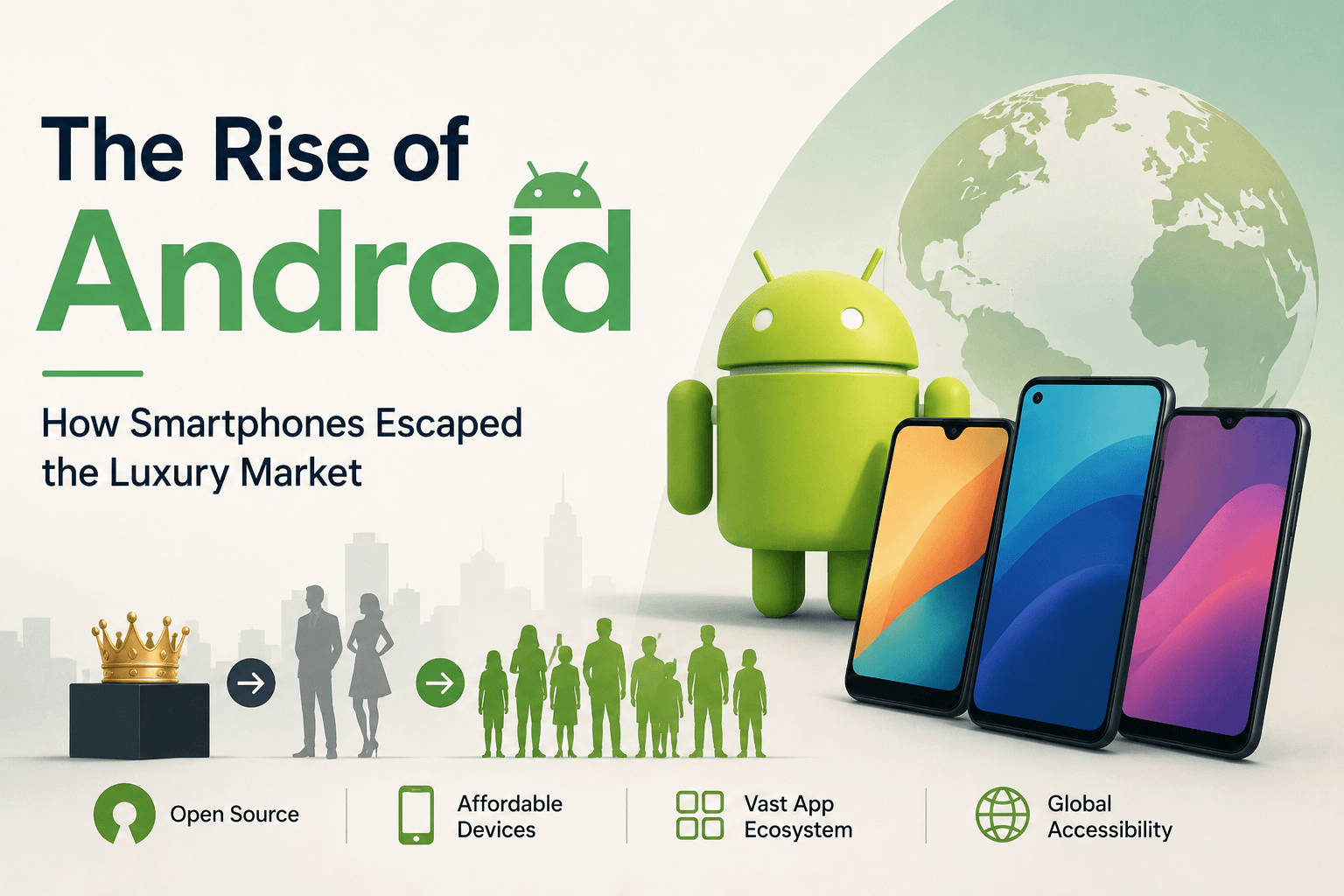
The Rise of Android: How Smartphones Escaped the Luxury Market
In 2007, Steve Jobs walked onto a stage and held up a device that looked almost impossible.
A phone with no physical keyboard.
A full web browser.
A large touchscreen.
Music.
Email.
Maps.
Photos.
And an interface that responded directly to your fingers.
The iPhone did not invent every ingredient of the smartphone.
Smartphones already existed.
BlackBerry had email.
Nokia had powerful mobile operating systems.
Palm had touch-based devices.
Windows Mobile had applications.
But Apple assembled those ideas into something ordinary people could immediately understand.
The modern smartphone had arrived.
There was only one problem.
For much of the world, it was expensive.
Very expensive.
A technology that seemed destined to reshape human communication initially looked like something that might remain concentrated among wealthy consumers and richer countries.
Then another operating system appeared.
It didn't belong to a phone manufacturer.
It didn't belong to a telecom operator.
And almost any hardware company could build a phone around it.
Its name was Android.
What followed became one of the most important technology battles of the 21st century.
Apple showed the world what the modern smartphone could be.
Android helped make sure billions of people could eventually own one.
Before Android, the Phone Industry Was a Kingdom of Walled Cities
Go back to the early 2000s.
The mobile phone world looked very different.
Nokia dominated huge parts of the market.
Motorola was enormous.
Samsung was growing.
Sony Ericsson had distinctive devices.
BlackBerry controlled the business world.
Microsoft pushed Windows Mobile.
Every company had its own strategy.
Every manufacturer wanted control.
And software was fragmented.
A developer building an application for one phone often couldn't easily bring it to another.
Screen sizes were different.
Processors were different.
Operating systems were different.
Distribution was difficult.
Telecom operators also had enormous influence.
In many countries, carriers controlled which phones were promoted, what software appeared on them, and sometimes even which features were enabled.
The phone was not yet a true general-purpose computing platform.
It was still mostly a product designed around calling.
Then the internet started swallowing everything.
Email.
Maps.
Search.
Music.
Video.
Shopping.
Social networks.
The next great computing platform was clearly going to fit inside a pocket.
Google understood the danger.
Google Had a Problem
Google's empire had been built on the web.
People opened browsers.
They searched.
Google showed them results and advertisements.
It was an extraordinarily successful business model.
But what if the future of computing moved from desktop browsers into mobile devices controlled by someone else?
Imagine a future where one company controlled the phone.
The operating system.
The browser.
The app store.
The default search engine.
The maps.
The payment system.
That company could decide which services users saw.
Google might become merely a guest inside someone else's platform.
That was a dangerous position.
So Google needed a mobile strategy.
And several years before the iPhone appeared, a small startup had been working on one.
A Small Company Called Android
Android Inc. was founded in 2003.
Among its founders was Andy Rubin, an engineer already deeply involved in mobile computing.
The company initially worked quietly.
Its direction changed over time, but the ambition became increasingly clear:
build a smarter operating system for mobile devices.
Google acquired Android in 2005.
At the time, the acquisition did not generate anything close to the attention that Google's later mobile dominance would suggest.
Android was still mostly invisible.
Inside Google, however, a team began developing an operating system that could become the foundation for a new generation of phones.
The early vision reportedly looked much more like the mobile devices of that era.
Physical keyboards.
Navigation buttons.
Small screens.
Then January 2007 happened.
Apple unveiled the iPhone.
And the mobile industry changed overnight.
The iPhone Changed the Question
The important thing about the iPhone was not simply that it had a touchscreen.
It changed what people expected a phone to be.
Instead of asking:
"How good is this phone?"
Consumers began asking:
"How close is this phone to a computer?"
The entire industry suddenly had a new reference point.
Large touchscreen.
Finger-driven interface.
Desktop-like web browsing.
Rich applications.
Beautiful animations.
Software became more important than buttons.
Google's Android team had to adapt.
And adapt quickly.
That moment is crucial to understanding Android.
Android did not rise because Google simply copied a successful phone.
It rose because the entire mobile industry suddenly realized that the old model was dying.
Manufacturers needed a modern answer to the iPhone.
Google was preparing one.
Android's Most Powerful Feature Wasn't a Feature
Apple's model was vertically integrated.
Apple designed the operating system.
Apple designed the phone.
Apple controlled the software distribution.
Apple controlled much of the user experience.
This produced something extremely valuable:
consistency.
Hardware and software could be designed together.
Performance could be carefully optimized.
The experience could be polished from top to bottom.
But there was another side to that model.
If you wanted an iPhone, there was only one company making it.
Apple.
Android took almost the opposite approach.
Google provided the operating system.
Manufacturers could build the hardware.
Samsung could make an Android phone.
HTC could make one.
Motorola could make one.
LG could make one.
Sony could make one.
Smaller manufacturers could make one.
Chinese companies could make one.
Eventually, almost anyone capable of building a smartphone could enter the market without first creating an entire mobile operating system.
This was Android's superpower.
Not widgets.
Not notifications.
Not customization.
Distribution.
The First Android Phone Wasn't Trying to Be an iPhone
In 2008, the first commercial Android phone appeared: the HTC Dream, sold in some markets as the T-Mobile G1.
It looked strange by today's standards.
It had a touchscreen.
But it also had a physical keyboard hidden beneath a sliding display.
There was a trackball.
The design felt like a bridge between two eras.
Part smartphone of the old world.
Part smartphone of the new one.
It was not as polished as the iPhone.
But it demonstrated something important.
There was now another path.
Manufacturers no longer had to choose between building their own complex operating system or licensing one of the older mobile platforms.
Android was becoming a viable alternative.
And Google had made a critical decision:
the core Android platform would be developed as open-source software through the Android Open Source Project.
For hardware companies, that changed the economics dramatically.
Suddenly, Everyone Could Build a Smartphone
Imagine you are a phone manufacturer in 2009.
You know smartphones are the future.
But developing a modern operating system is enormously expensive.
You need:
A kernel.
Networking.
Bluetooth.
Wi-Fi.
Graphics.
Touch input.
Memory management.
Application frameworks.
Security.
A browser.
Developer tools.
APIs.
An application ecosystem.
Years of engineering.
And even if you build all of that, why would developers create applications for your tiny platform?
Android offered another option.
Take an existing mobile operating system.
Adapt it to your hardware.
Build your own user interface on top if you want.
Install Google's popular services where licensing agreements permitted.
Join an ecosystem already attracting developers.
Suddenly the barrier to entering the smartphone industry collapsed.
That changed everything.
Samsung Saw the Opportunity
Few companies benefited from Android more dramatically than Samsung.
Samsung already knew how to manufacture electronics at enormous scale.
Displays.
Memory.
Processors.
Phones.
Televisions.
Components.
What it needed was a modern smartphone operating system capable of competing with Apple's iOS.
Android provided it.
The Galaxy line became one of the most important smartphone brands in history.
For years, Samsung and Apple became the two names most consumers associated with premium smartphones.
But Samsung could do something Apple would not.
It could use Android across a massive range of devices.
Large phones.
Small phones.
Flagships.
Mid-range phones.
Cheap phones.
Experimental phones.
Devices with styluses.
Foldable devices.
Android allowed the same broad ecosystem to stretch across almost every price category.
And Samsung was only one manufacturer.
Then China Entered the Game
The real transformation accelerated when Chinese manufacturers embraced Android.
Huawei.
Xiaomi.
Oppo.
Vivo.
OnePlus.
Honor.
Realme.
And many others.
Some became global brands.
Others focused heavily on regional markets.
Competition became brutal.
A feature that appeared in a $700 phone one year could appear in a $300 phone soon afterward.
Then perhaps in a $150 phone.
Better cameras.
Larger screens.
Faster processors.
More storage.
Fingerprint readers.
Fast charging.
High-refresh-rate displays.
Technology moved downward through price categories at astonishing speed.
Android had created a battlefield.
And consumers benefited from the competition.
The $100 Smartphone Changed More Lives Than the $1,000 Smartphone
Technology history tends to remember premium devices.
They photograph well.
They receive glamorous launches.
Journalists review them.
Enthusiasts debate benchmark scores.
But the most historically important smartphone may not be the most powerful one.
It may be the cheapest device that finally became good enough.
Consider someone buying their first smartphone in Bangladesh, India, Indonesia, Nigeria, Brazil, or another developing market.
They may not have owned a personal computer.
They may never have used broadband at home.
But suddenly, for a relatively affordable price, they could access:
Google Search.
YouTube.
Facebook.
WhatsApp.
Maps.
Email.
Online banking.
Video calls.
Government services.
Education.
Job listings.
E-commerce.
Translation.
News.
A camera.
A calculator.
A flashlight.
A GPS receiver.
A music player.
A document scanner.
All inside one device.
For millions of people, the smartphone was not a smaller version of their computer.
It was their first computer.
And overwhelmingly, many of those devices ran Android.
Android Changed What "Internet Access" Meant
There was once an assumption that people would join the internet through computers.
First a desktop.
Then perhaps a laptop.
Then mobile access later.
Much of the developing world skipped that sequence.
The smartphone became the primary gateway.
A farmer could check weather forecasts.
A small shop could accept digital payments.
A migrant worker could video call family.
A student could watch lectures.
A driver could navigate through an unfamiliar city.
A small business owner could advertise through social media.
None of these activities required owning an expensive computer.
That transformation cannot be credited to Android alone.
Mobile networks became cheaper and faster.
Semiconductor manufacturing improved.
Chinese manufacturing scaled dramatically.
Apps became more capable.
Cloud computing expanded.
But Android provided the common software platform connecting much of it together.
Apple Built a Cathedral
There is a useful way to understand the difference.
Apple built something like a cathedral.
Carefully designed.
Controlled.
Integrated.
Beautiful.
Every major architectural decision belonged to Apple.
Android became more like a city.
Messy.
Crowded.
Inconsistent.
Full of competing builders.
Sometimes chaotic.
But extraordinarily difficult to stop.
One company might produce a terrible Android phone.
Another could produce an excellent one.
One manufacturer might disappear.
Another could enter the market next year.
One device might cost more than an iPhone.
Another might cost a fraction of the price.
There was no single Android phone.
There was an entire ecosystem.
That difference allowed Android to reach places Apple's model could not reach as easily.
But Did Android Really "Save" Smartphones From Becoming Elite Technology?
That claim needs some nuance.
Apple was never necessarily trying to keep smartphones exclusively for wealthy people.
Its business model simply focused heavily on premium hardware, tight integration, and high margins.
And Apple did contribute enormously to making smartphones desirable and useful.
Without the iPhone, the mobile revolution may have developed very differently.
Android also did not make smartphones affordable by itself.
Hardware manufacturing, semiconductor scaling, global supply chains, telecom investment, and fierce competition all played major roles.
But Android changed something fundamental.
It prevented the modern smartphone operating system market from depending entirely on a single vertically integrated hardware company.
Manufacturers had an alternative.
And because many manufacturers competed using the same underlying platform, smartphone capabilities spread into lower price ranges much faster.
That competition mattered.
A lot.
The App Ecosystem Became the Real Battlefield
Hardware alone would not determine the winner.
Applications would.
A smartphone without apps is simply an expensive collection of sensors.
Developers needed customers.
Customers wanted apps.
This creates a powerful network effect.
More users attract more developers.
More developers create more applications.
More applications attract more users.
Apple had the App Store.
Android had what eventually became Google Play as its dominant global application marketplace on Google-certified devices.
Developers suddenly had access to enormous audiences.
Build an Android application and potentially reach users across hundreds of phone models and dozens of countries.
For businesses, this was transformative.
Banks built apps.
Retailers built apps.
Governments built apps.
Transportation companies built apps.
Schools built apps.
Startups built entire companies around apps.
A new software economy emerged.
Android Was Free—but Not Entirely Free
Android's openness is often simplified.
The Android Open Source Project provides an open-source base.
Manufacturers can build devices from it.
But the Android experience most people recognize also includes Google's proprietary services.
Google Play.
Google Maps integrations.
Google Play Services.
Push notifications and numerous APIs.
Access to those components comes with licensing and compatibility requirements.
This distinction matters.
Android is not simply:
"Google gives everything away."
It is better understood as a layered ecosystem.
An open-source operating system at the foundation.
Google services layered above it on many devices.
Manufacturer software layered above that.
Applications layered on top.
That structure helped Android spread while still allowing Google to maintain enormous influence over the ecosystem.
And That Influence Became Controversial
Success brought scrutiny.
If Android existed partly to prevent Google from becoming dependent on another company's mobile platform, eventually Google itself became enormously powerful in mobile computing.
Search.
Browser.
Maps.
Email.
App distribution.
Advertising.
Mobile services.
Regulators in multiple regions began examining Google's agreements with manufacturers and the way its services were bundled or promoted.
This is one of technology history's recurring patterns.
A platform begins by opening competition.
Then the platform itself becomes powerful enough to attract questions about competition.
Android broke one type of dependency.
Then created new ones.
Technology rarely gives us perfectly clean victories.
Fragmentation: The Price of Freedom
Apple had another advantage.
When Apple released an iOS update, it controlled both the operating system and the hardware.
Android updates were more complicated.
Google developed Android.
Chip manufacturers provided drivers.
Device manufacturers customized the software.
Telecom operators sometimes became involved.
The result could be slow updates and inconsistent support.
Some phones received updates quickly.
Others waited months.
Cheap phones were sometimes abandoned entirely.
Developers had to support enormous variation.
Different screen sizes.
Different performance levels.
Different Android versions.
Different manufacturer modifications.
Android's greatest strength—diversity—was also one of its greatest weaknesses.
The ecosystem gained scale by giving up some control.
The Android Phone Became Everything
Over time, Android expanded beyond the traditional smartphone.
Tablets.
Televisions.
Car infotainment systems.
Smartwatches.
Industrial devices.
Point-of-sale terminals.
Kiosks.
Barcode scanners.
Handheld warehouse computers.
Specialized enterprise hardware.
Entire product categories began using Android because manufacturers could build applications on top of a familiar platform.
The operating system that began as Google's answer to the mobile revolution became something much larger.
It became a general-purpose platform for connected devices.
Meanwhile, Apple Changed Too
Competition worked in both directions.
Android manufacturers pushed:
Larger screens.
OLED displays.
Fast charging.
Multiple cameras.
Wireless charging.
High-refresh-rate displays.
Foldable experiments.
Apple pushed:
Processor performance.
Long software support.
Privacy features.
Hardware integration.
Developer tooling.
Camera processing.
Ecosystem integration.
Neither ecosystem developed in isolation.
They watched each other.
Borrowed ideas.
Improved ideas.
Occasionally mocked ideas before adopting similar ones years later.
This competition accelerated smartphone development.
Consumers were not choosing between one future and no future.
They were choosing between competing visions of the future.
The Smartphone Eventually Stopped Feeling Magical
That may be Android's greatest success.
Think about the first time people saw multitouch zooming on an iPhone.
It looked like science fiction.
Today a child does it without thinking.
GPS navigation once required expensive dedicated equipment.
Now it exists inside budget phones.
Real-time video calling once belonged to futuristic movies.
Now relatives casually call each other across continents.
Instant translation.
Digital payments.
High-resolution photography.
Streaming video.
Voice recognition.
Artificial intelligence.
All slowly became ordinary.
Technology truly wins when people stop noticing how extraordinary it is.
The Phone in a Village Shop
Imagine a small shop somewhere far from Silicon Valley.
There is no dramatic product launch.
No glass Apple Store.
No technology journalist writing a review.
A shopkeeper holds an inexpensive Android phone.
A customer pays digitally.
A message arrives from a supplier.
The shopkeeper checks inventory through an app.
Takes a photo of a damaged shipment.
Sends it instantly.
Later that evening, the same device becomes a television for the family.
Then a classroom for a child.
Then a video phone connecting relatives living thousands of kilometers away.
The processor inside that phone may be slower than a flagship.
The camera may be worse.
The case may be plastic.
None of that changes what the device represents.
A supercomputer by historical standards has entered an ordinary person's pocket.
That is the revolution.
Android Didn't Defeat Apple
And perhaps this is the wrong way to tell the story.
Android did not destroy the iPhone.
The iPhone did not destroy Android.
Instead, the two systems settled into different roles.
Apple demonstrated the power of extreme vertical integration.
Android demonstrated the power of an ecosystem shared across manufacturers.
Apple captured enormous value from the premium market.
Android captured enormous global scale.
Both transformed computing.
But Android's particular historical importance lies in how widely that transformation spread.
The smartphone did not remain a luxury category.
It became infrastructure.
From Luxury Gadget to Human Utility
There are now people whose entire economic lives operate through a smartphone.
Their banking.
Their identity verification.
Their communication.
Their work.
Their entertainment.
Their education.
Their navigation.
Their access to government.
Their access to knowledge.
For them, a smartphone is no longer a gadget.
It is part of modern existence.
And that makes the story of Android bigger than the story of Google.
Bigger than Samsung.
Bigger than Apple.
It is a story about what happens when powerful computing stops belonging only to corporations, laboratories, offices, and wealthy consumers.
The computer escaped the desk.
Then it escaped the expensive premium market.
And eventually it reached almost everyone.
The Green Robot's Real Legacy
When Android first appeared, few people could have predicted how enormous it would become.
It looked like another mobile operating system entering an already crowded industry.
But Android carried a different economic idea.
Instead of saying:
Buy our phone to enter our software world.
It effectively told manufacturers:
Build your phone. We will provide the foundation.
That decision unleashed competition on a global scale.
Some devices were brilliant.
Some were terrible.
Some cost more than laptops.
Others became cheap enough for families buying their first internet-connected computer.
The ecosystem was imperfect.
Fragmented.
Commercially complicated.
Often dominated by powerful companies.
But it was open enough to create something enormously important:
choice at scale.
Apple helped define the modern smartphone.
Android helped mass-produce the idea.
And somewhere between the iPhone on a California stage and a $100 Android handset sold thousands of kilometers away, the smartphone stopped being a symbol of technological luxury.
It became something much more consequential.
A camera.
A map.
A bank.
A classroom.
A workplace.
A marketplace.
A library.
A television.
A communication network.
And for billions of people, their first real doorway into the digital world.
That may ultimately be Android's greatest achievement.
Not that it won the smartphone war.
But that it helped make the smartphone too widespread for any single company, market, or social class to own.