





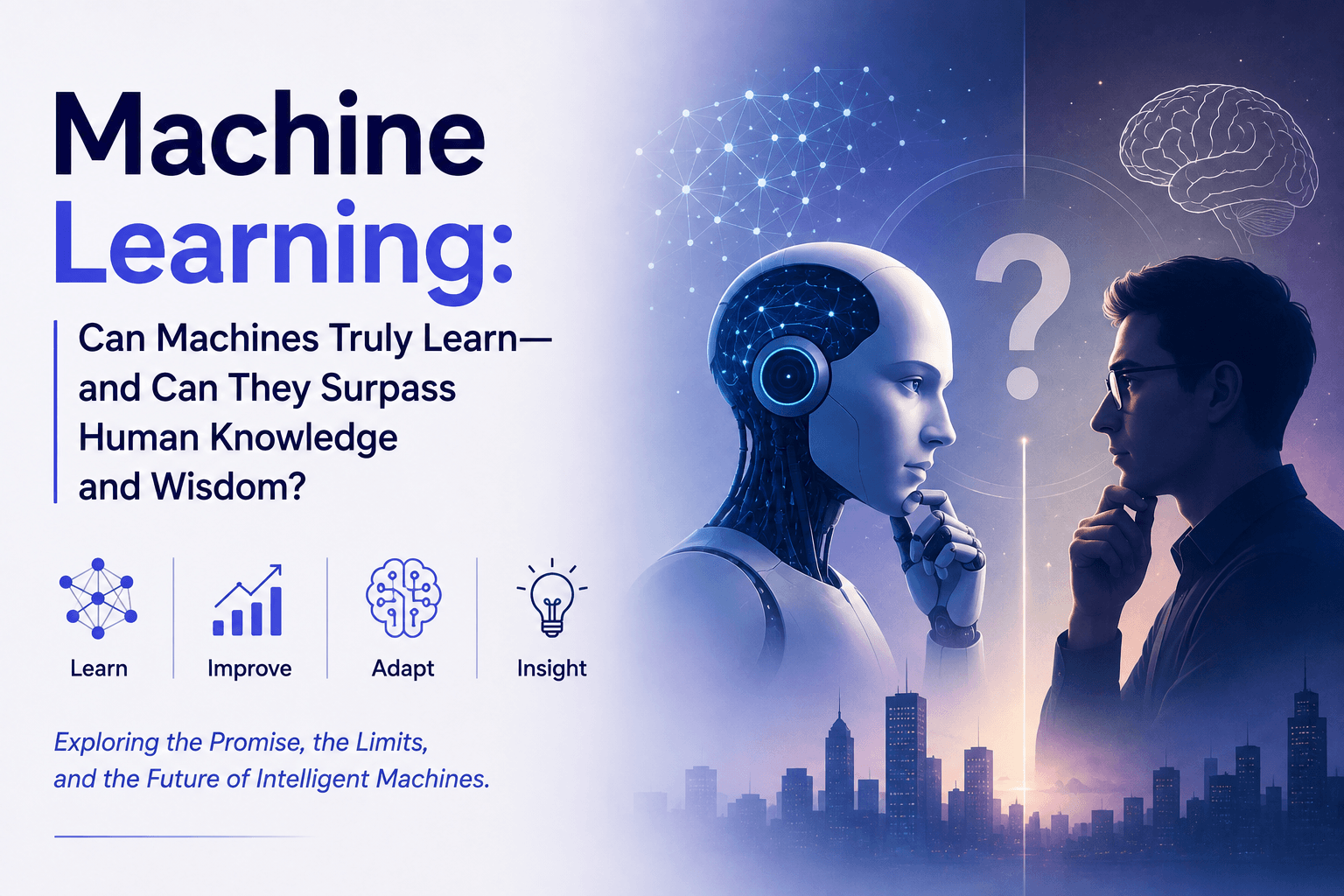
Machine Learning: Can Machines Truly Learn—and Can They Surpass Human Knowledge and Wisdom?
Imagine a child seeing a cat for the first time.
Someone points and says:
“That is a cat.”
The child looks carefully.
Four legs.
Fur.
Tail.
Pointed ears.
Later, the child sees another cat.
Different color.
Different size.
Different face.
Yet somehow, the child recognizes it.
Still a cat.
No one gave the child a mathematical formula for “cat.”
No one explained every possible breed, shape, or color.
The child learned from examples.
For most of computing history, machines could not do this very well.
Computers followed instructions.
Humans wrote the rules.
The machine executed them.
Then something changed.
Instead of telling computers exactly how to solve a problem, engineers began showing them examples and letting them discover patterns.
That idea became known as machine learning.
And it raised a much deeper question:
If a machine can learn from experience, how different is that from the way we learn?
And if machines continue improving, could they eventually know more than humanity itself?
The Old Computer Needed Rules
Suppose we want a computer to identify spam email.
The traditional programming approach might look like this:
IF email contains "YOU WON"
    mark as spam

IF sender is suspicious
    mark as spam

IF message contains too many links
    mark as spam
This works.
Until spammers change their language.
Then programmers need to write more rules.
And more.
And more.
The problem becomes obvious.
The world is too complicated to describe using endless IF statements.
What if instead we gave the computer millions of emails?
Some labeled:
Spam
Others labeled:
Not Spam
Then we ask the machine:
“Find the patterns yourself.”
Now we have machine learning.
Does the Machine Actually Learn?
This depends on what we mean by learn.
A machine-learning model does not usually sit down, think about yesterday, and suddenly understand life more deeply.
Instead, it adjusts mathematical parameters.
Imagine a huge network containing millions—or billions—of tiny adjustable knobs.
Initially, those knobs are mostly wrong.
We show the system an example.
It makes a prediction.
Suppose we show it a picture of a cat.
The model says:
“Dog: 78%.”
Wrong.
The training system measures how wrong the prediction was.
Then it slightly adjusts those internal knobs.
Another image arrives.
Another prediction.
Another correction.
This happens again.
And again.
And again.
Millions or billions of times.
Eventually, something remarkable happens.
The machine becomes good at recognizing cats.
Nobody explicitly programmed:
pointy ears + whiskers + tail = catThe model discovered useful statistical patterns by itself.
If learning means:
changing future behavior based on past experience
then yes.
Machines can learn.
But their learning is very different from ours.
A Child Learns Differently
Show a child three pictures of elephants.
The child may understand the concept.
A machine may need thousands.
Humans bring enormous amounts of prior knowledge into every new experience.
A child already understands:
- objects
- movement
- shape
- space
- cause and effect
- animals
- faces
- relationships
Human learning is connected to a lifetime of physical and social experience.
Machines often learn from data.
Humans learn from living.
That distinction matters.
A language model may read millions of pages describing fire.
But it has never felt heat.
It can describe heartbreak.
But it has never had its heart broken.
It can explain hunger.
But it has never missed a meal.
The machine can possess information without possessing the experience that gave those words meaning to humans.
Then Neural Networks Arrived
Machine learning existed for decades.
But one family of techniques became especially important:
artificial neural networks.
They were loosely inspired by biological neurons.
A neural network contains layers of mathematical units.
Data enters.
Each layer transforms it.
Patterns gradually become more abstract.
For an image-recognition system, early layers might detect:
edges
↓
shapes
↓
textures
↓
parts
↓
objects
Eventually:
pixels
↓
ears + eyes + fur
↓
CAT
As computers became faster and datasets became larger, neural networks became dramatically more powerful.
This led to deep learning.
And deep learning transformed:
- speech recognition
- translation
- computer vision
- recommendation systems
- robotics
- medical imaging
- autonomous vehicles
Then researchers applied similar ideas to language.
And another surprising transformation began.
Machines Begin Learning Language
Suppose you take an enormous collection of text.
Books.
Articles.
Documentation.
Conversations.
Code.
Web pages.
Then you train a neural network on a deceptively simple task:
Predict what comes next.
Consider:
The Earth revolves around the ___Probably:
SunBut language quickly becomes much more complicated.
To predict words accurately, the model benefits from learning patterns involving:
- grammar
- history
- programming
- science
- relationships
- reasoning
- culture
- style
Eventually, large language models became capable of writing essays, generating software, explaining mathematics, translating languages, and answering questions.
The machine had not been given millions of manually written rules.
It had learned statistical structure from enormous amounts of human-generated information.
And this is where the philosophical questions became impossible to ignore.
Does It Understand?
Suppose a machine answers:
“Water freezes at approximately 0°C under standard atmospheric pressure.”
Does it know that?
Or is it merely producing the sequence of words most likely to be correct?
This argument has no simple answer.
Humans also build knowledge through patterns.
We hear words repeatedly.
We associate them with experiences.
Our brains strengthen and weaken neural connections.
But humans have things current machines do not clearly possess:
a biological body,
continuous personal experience,
emotions,
survival instincts,
social relationships,
and perhaps consciousness.
A machine can explain fear without being afraid.
It can write a poem about death without knowing that it will die.
So there may be a difference between:
representing knowledge
and
experiencing understanding.
That difference becomes even more important when discussing wisdom.
Knowledge Is Not Wisdom
Imagine two people.
One has memorized every medical textbook ever written.
The other is an experienced doctor who has spent thirty years treating patients.
Who knows more?
The first person may possess more facts.
But the doctor may know something harder to describe.
When to wait.
When to worry.
How frightened patients behave.
When textbook probabilities don't quite fit reality.
How to communicate terrible news.
This is wisdom.
Knowledge asks:
“What is true?”
Intelligence asks:
“Can I solve this?”
Wisdom asks:
“What should I do?”
Those are not the same question.
A machine could theoretically contain every historical text humanity has produced and still face a difficult moral decision with no objectively correct answer.
Could Machines Surpass Human Knowledge?
In some ways, they already can.
No individual human can memorize the contents of millions of books.
No human can instantly search through enormous datasets.
Computers can perform calculations billions of times faster than we can.
Machines can already outperform humans in specialized domains.
Chess is an obvious example.
For centuries, chess was considered a demonstration of human intelligence.
Then computers surpassed even the best players.
The same happened with Go.
Machines can outperform humans at:
- certain pattern-recognition tasks
- large-scale optimization
- statistical analysis
- database retrieval
- many games
- high-speed calculation
But notice the phrase:
specialized domains.
A chess engine may destroy a grandmaster.
Ask it to cook dinner and it is useless.
Human intelligence is remarkably general.
We can learn mathematics in the morning, comfort a friend in the afternoon, repair something in the evening, and invent a joke at night.
Modern AI is becoming more general, but that flexibility remains one of humanity's remarkable strengths.
What Happens When Machines Know More Than Any One Person?
This may be the more interesting future.
Imagine an AI system with access to nearly everything humanity has published.
Medicine.
Engineering.
Law.
Physics.
History.
Agriculture.
Programming.
Biology.
Art.
No human could compete with that breadth of information.
A doctor knows medicine.
An engineer knows structures.
A physicist knows physics.
A historian knows history.
An AI system could potentially operate across all of them.
That doesn't automatically make it wiser.
But it could make it an extraordinary intellectual tool.
Instead of replacing human knowledge, it might become a new interface to humanity's collective knowledge.
Something like:
Human civilization
        ↓
Books + research + experience + data
        ↓
Machine learning
        ↓
Compressed model of patterns
        ↓
Instant access through conversation
That could transform education and research.
A student could have a tutor available every hour.
A scientist could explore ideas across disciplines.
A programmer could work with unfamiliar technologies.
Knowledge that once required years of searching might become accessible within seconds.
But Machines Learn Our Mistakes Too
There is another side to the story.
Machine-learning systems learn from data.
And human data contains human flaws.
Bias.
Misinformation.
Propaganda.
Bad science.
Historical prejudice.
Contradictions.
If millions of people repeatedly say something false, a machine can learn that pattern too.
Machine learning doesn't automatically discover truth.
It discovers patterns in its training information.
That means powerful AI systems require:
- careful data
- evaluation
- verification
- human oversight
- good scientific methods
A confident machine can still be wrong.
In fact, confidence may make errors more dangerous because people naturally trust systems that sound authoritative.
What About Creativity?
This question becomes even stranger.
If a machine writes a beautiful poem, who created it?
The machine?
The engineers?
The millions of human writers whose works influenced its training?
Perhaps creativity itself has always involved recombination.
Human musicians listen to other musicians.
Writers read other writers.
Artists absorb styles.
Then they combine influences with personal experience.
Machines also combine patterns.
But humans add something unique:
a life.
A poem written by someone mourning a parent carries the weight of that experience.
A machine may reproduce the structure of grief beautifully.
Whether that is the same thing as creativity remains an open philosophical question.
Can Machines Become Wiser Than Humans?
Here we reach the hardest question.
Imagine an AI that knows:
every philosophy book,
every major religious text,
every recorded war,
every economic collapse,
every psychological study,
every documented political mistake.
Would that make it wise?
Perhaps it could recognize patterns humans repeatedly fail to see.
It might say:
“Societies have tried this before. Here is what usually happens.”
That would be enormously valuable.
But wisdom also involves values.
Suppose there are two choices.
One creates more wealth.
The other produces greater equality.
Which is better?
Science cannot answer that alone.
The answer depends partly on what society values.
Machines can optimize goals.
Humans still have to decide which goals are worth pursuing.
And that may be one of the most important distinctions between intelligence and wisdom.
The Real Danger May Not Be Smarter Machines
People often imagine the future like this:
AI becomes smarter than humans
↓
AI takes control
But there is another possibility that deserves attention.
Humans may give machines too much authority before machines are truly wise.
An algorithm recommends what we watch.
Another decides which job applications get attention.
Another helps determine loans.
Another recommends medical decisions.
Another influences military systems.
The danger isn't necessarily that machines suddenly become evil.
Machines do not need hatred, greed, or ambition to cause harm.
A badly designed objective can be enough.
Tell an algorithm:
“Maximize engagement.”
And perhaps it learns that outrage keeps people watching.
It successfully accomplishes the goal.
The goal itself was incomplete.
This is why the future of AI isn't only about making machines smarter.
It is about making humans better at deciding what we ask machines to optimize.
Intelligence May Become Cheap
For thousands of years, intelligence was scarce.
If you wanted expert advice, you needed an expert.
If you wanted software, you needed a programmer.
If you wanted analysis, you needed analysts.
Machine learning may change that.
Some forms of intelligence could become abundant.
Imagine having thousands of artificial assistants capable of writing, researching, calculating, translating, designing, and analyzing simultaneously.
The economic consequences could be enormous.
We may eventually treat computational intelligence the way we treat electricity today:
something available almost everywhere.
And when intelligence becomes abundant, another resource may become more valuable.
Judgment.
The Machine and the Human
Perhaps the future isn't a competition where one side must win.
Human beings created calculators.
Calculators surpassed our arithmetic ability.
We didn't stop learning mathematics.
We built bridges, spacecraft, and global communication systems using them.
Computers surpassed our ability to store information.
We didn't stop thinking.
We created the internet.
AI may become another step.
Machines may eventually know more facts than any human who has ever lived.
They may discover scientific patterns beyond our ability to manually analyze.
They may design technologies no single person could have created alone.
But humans will still face the oldest questions:
What should we build?
Who should benefit?
What is fair?
What kind of society do we want?
What makes a life meaningful?
Those are not simply computational problems.
So, Can a Machine Truly Learn?
Yes—if learning means improving through experience and data.
Can it surpass human knowledge?
In many narrow areas, already yes.
Eventually, machines may possess access to far more information than any individual person could ever learn.
Can they surpass human intelligence?
Perhaps.
Can they surpass human wisdom?
That question is much harder.
Because intelligence is about finding answers.
Wisdom is about understanding which questions matter.
A machine may someday read every book humanity has written.
It may calculate faster than every mathematician.
It may remember more than every historian.
It may even discover things humans never could.
But knowledge alone doesn't tell you what is worth knowing.
And intelligence alone doesn't tell you what is worth doing.
The greatest question of the machine-learning age may therefore not be:
“Can machines become like humans?”
It may be:
“When machines become extraordinarily intelligent, will humans be wise enough to decide what to do with them?”