





Rise of the ARM Processor: How a Small Chip Conquered the Computing World
For decades, the story of computing seemed to belong to one family of processors.
Intel and AMD powered desktops, servers, and laptops. Their x86 architecture sat at the center of the PC revolution. If you owned a Windows computer, ran a business server, or built a gaming machine, chances were that an x86 processor was doing the work.
Meanwhile, another processor architecture was quietly growing somewhere else.
It wasn't trying to win the desktop war.
It was trying to use less power.
That architecture was ARM.
And that decision would eventually change the entire computing industry.
A Computer Company That Needed a Processor
The ARM story begins in Britain during the early 1980s.
A small company called Acorn Computers was building machines such as the BBC Micro. As Acorn planned its next generation of computers, its engineers needed a faster processor.
The available chips weren't quite what they wanted.
So instead of simply buying another processor, Acorn engineers decided to design one themselves.
Their idea was surprisingly simple: rather than making processors increasingly complicated, build a processor with a small and efficient instruction set.
This approach belonged to a philosophy known as:
RISC — Reduced Instruction Set Computer.
The first ARM processor appeared in the mid-1980s.
Originally, ARM meant Acorn RISC Machine.
The chip wasn't enormous or particularly complicated.
That was exactly the point.
Doing More With Less
Traditional processors such as x86 had grown around increasingly complex instructions.
ARM took a different path.
Imagine two workers.
One worker owns hundreds of specialized tools. Each tool can perform a complicated operation, but choosing and operating them requires more machinery.
The other worker owns fewer, simpler tools but uses them extremely quickly.
ARM followed the second philosophy.
Simpler instructions meant processor designs could require fewer transistors and consume less electricity.
At first, that didn't sound revolutionary.
Desktop computers were connected to wall sockets. Saving a few watts wasn't the industry's biggest concern.
Then computers started leaving the desk.
The Mobile Revolution
During the 1990s and early 2000s, mobile phones became increasingly powerful.
Suddenly, power efficiency mattered enormously.
A desktop processor could consume significant electricity because the wall supplied effectively unlimited energy.
A phone had a tiny battery.
Every calculation had a cost.
More processor activity meant more heat.
More heat meant more cooling problems.
And more electricity meant shorter battery life.
ARM processors were almost perfectly suited for this new world.
Companies including Nokia, Samsung, Qualcomm, and many semiconductor manufacturers began building ARM-based products.
But ARM's business model was unusual.
ARM generally didn't need to manufacture the processors itself.
Instead, it licensed processor architectures and designs to other companies.
Those companies could then build chips optimized for their own devices.
ARM wasn't trying to sell everyone the same processor.
It was providing the blueprint.
Then Came the Smartphone
When smartphones exploded in popularity, ARM was already waiting.
Inside smartphones, processors needed to handle increasingly demanding workloads:
- web browsing
- video
- photography
- GPS
- encryption
- gaming
- wireless communication
Yet they still needed to survive an entire day on a battery.
ARM's efficiency made it the natural foundation for smartphone processors.
Qualcomm's Snapdragon chips used ARM architecture.
Samsung's Exynos processors used ARM.
Apple's mobile processors used ARM.
Billions of phones eventually carried ARM technology.
Without most users realizing it, ARM had become one of the most widely deployed processor architectures in history.
But there was still one kingdom it hadn't conquered.
The personal computer.
Apple Changes the Conversation
For years, ARM processors were often viewed as excellent mobile chips but not serious replacements for high-performance desktop processors.
Then Apple challenged that assumption.
Apple had spent years designing ARM-based chips for the iPhone and iPad.
In 2020, it introduced the M1 processor and began moving Macs away from Intel processors to Apple-designed ARM-based silicon.
The result surprised much of the industry.
MacBooks using Apple Silicon delivered strong performance while consuming remarkably little power.
Fans didn't need to spin constantly.
Battery life improved dramatically.
And workloads once associated with power-hungry desktop processors were running efficiently on ARM-based laptops.
The argument changed almost overnight.
The question was no longer:
"Can ARM compete with desktop processors?"
It became:
"How far can ARM go?"
From Phones to Data Centers
The next battlefield was even bigger.
Servers.
Data centers contain thousands—or sometimes hundreds of thousands—of processors.
At that scale, electricity becomes one of the largest expenses.
Saving a few watts on one laptop is useful.
Saving several watts across hundreds of thousands of server cores can mean enormous reductions in electricity and cooling costs.
Cloud companies noticed.
Amazon Web Services developed its Graviton processors based on ARM architecture.
Other manufacturers began developing ARM server processors as well.
ARM was no longer simply powering smartphones.
It was running cloud applications, databases, containers, web services, and large-scale infrastructure.
The architecture that succeeded because batteries were small had discovered another advantage:
Data centers care about efficiency too.
Windows Joins the ARM Era
Windows on ARM existed for years, but adoption was relatively slow.
Compatibility was one of the biggest problems.
The Windows ecosystem had decades of software compiled primarily for x86 processors.
Changing processor architecture wasn't simply about changing hardware.
Applications, drivers, development tools, and operating systems also needed to adapt.
But the situation gradually improved.
Microsoft invested more heavily in Windows on ARM, developers began producing native ARM64 applications, and increasingly powerful ARM-based PC processors entered the market.
The dividing line between "mobile processors" and "computer processors" was disappearing.
ARM's Real Advantage
People sometimes describe ARM simply as being "more efficient than x86."
Reality is more complicated.
Modern processor performance depends on architecture, manufacturing process, cache design, memory systems, chip layout, workload, and many other factors.
ARM isn't magically efficient just because it is ARM.
But ARM helped create an ecosystem where companies could design highly customized processors around specific goals.
Apple can design processors specifically for Macs.
Amazon can design processors specifically for AWS servers.
Qualcomm can design processors specifically for laptops and smartphones.
Instead of asking:
"Which processor should we buy?"
Companies can increasingly ask:
"Which processor should we build?"
That is a major shift.
The Quiet Architecture That Became Everywhere
ARM never conquered computing through one dramatic battle.
It spread quietly.
First into embedded systems.
Then mobile phones.
Then smartphones.
Then tablets.
Then laptops.
Then cloud servers.
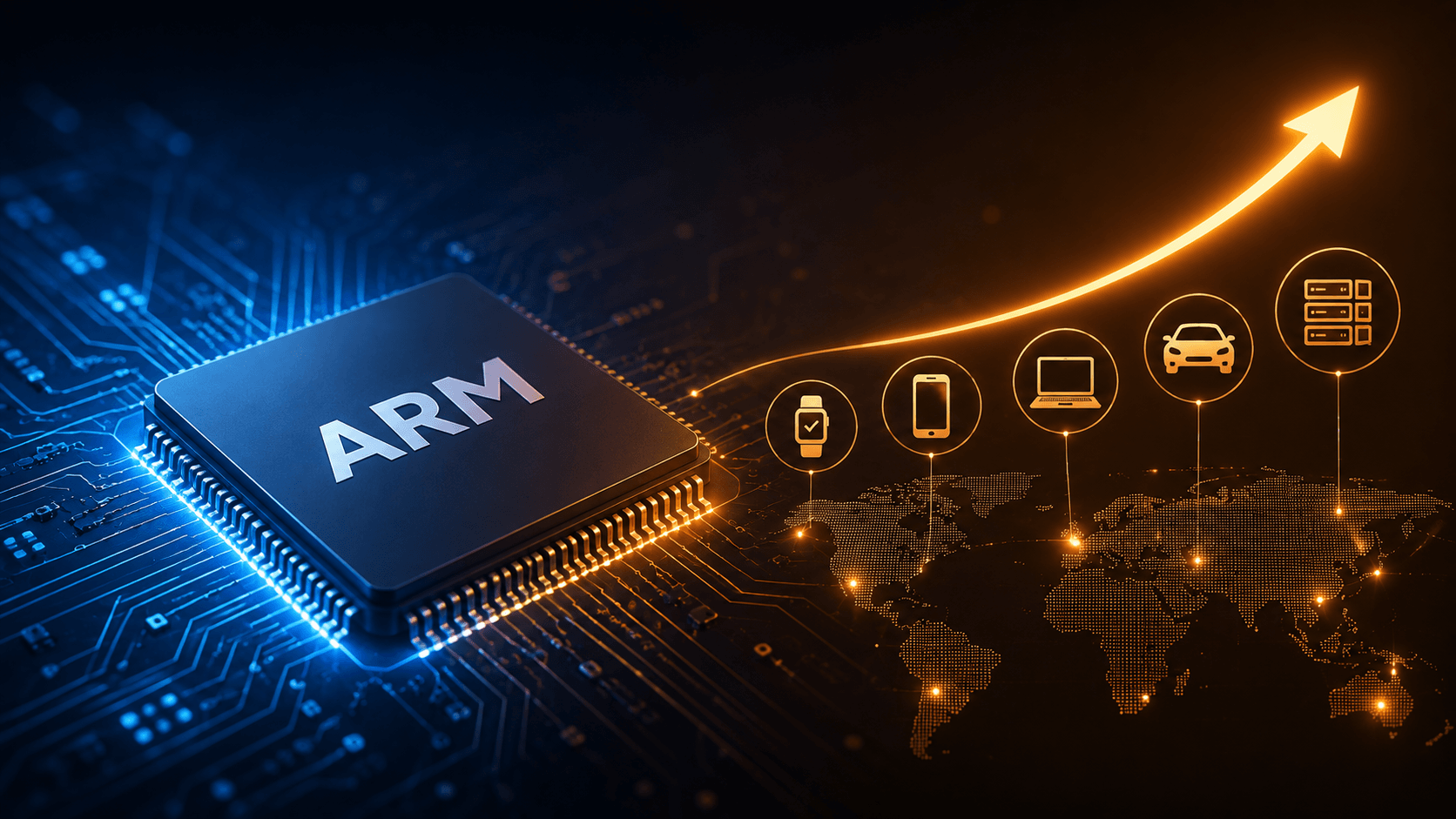
Today, ARM processors can be found inside routers, cars, televisions, Raspberry Pis, network devices, smart watches, industrial machines, phones, laptops, and data centers.
Ironically, ARM's greatest strength came from something that once looked like a limitation.
It was designed to be small.
Efficient.
Simple.
Computing eventually moved toward exactly those qualities.
The future probably won't belong entirely to ARM, x86, or any single architecture.
But the rise of ARM teaches an important lesson about technology:
The winner isn't always the system that starts out the most powerful.
Sometimes, it is the one designed around the constraint that eventually becomes the most important.
And for modern computing, that constraint is increasingly clear:
How much computing can we get from every watt of power?